Trajectory Releases a Concurrent Multi-LoRA Training Stack for Continual Learning, Reporting a 2.81× Experi…
What changed
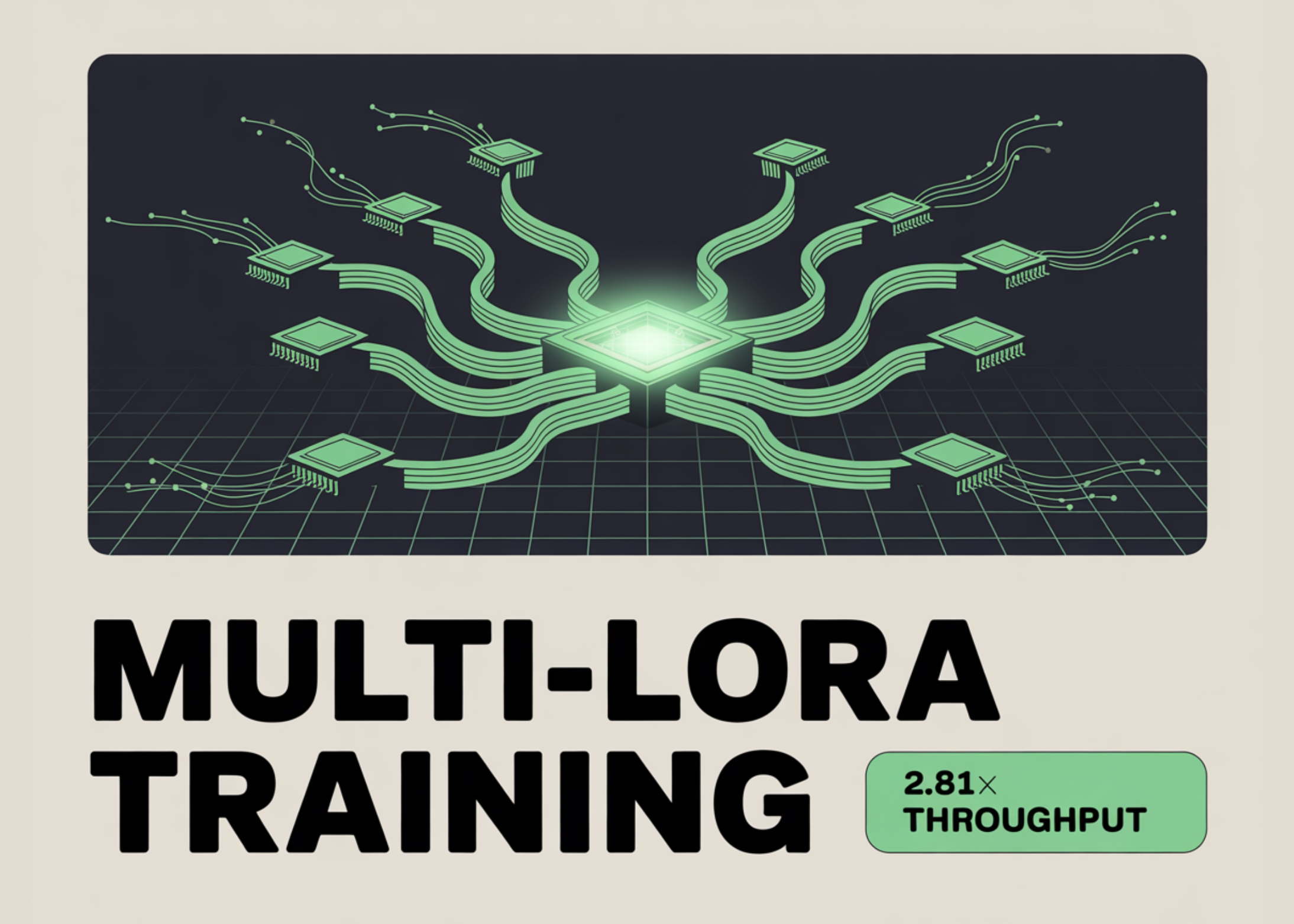
Trajectory, in collaboration with UC Berkeley Sky Lab and Anyscale, launched a concurrent multi-LoRA training stack for continual learning scenarios. This new system assigns each reinforcement learning experiment to its own Low-Rank Adaptation (LoRA) adapter running on a persistent, always-on compute engine. By managing multiple adapters simultaneously, it boosts training throughput by 2.81 times compared to a traditional single-tenant setup without sacrificing performance or reward quality.
Why builders should care
For teams running iterative RL experiments, this innovation directly addresses a common bottleneck: sequential training on limited resources. Mapping experiments to dedicated LoRA adapters enables parallel tuning of smaller, efficient model components rather than retraining or running isolated full-model workflows. This modular approach slashes wait times and operational overhead, making continual learning workflows faster and more cost-effective—especially for research groups or startups working on adaptive AI systems.
The practical takeaway
Operators can use Trajectory’s stack to increase experimental throughput on existing infrastructure with minimal hardware scaling. Keeping an engine “always-hot” for concurrent LoRA adapters avoids cold-start delays and enables rapid iteration across many RL tasks simultaneously. The performance gain of nearly threefold means faster model development cycles and more experiments per dollar spent on cloud or on-prem resources. Open sourcing the code in the NovaSky-AI/SkyRL repository means builders can integrate or customize the stack without waiting on proprietary solutions.
What to watch next
Look for adoption signals in academic labs and AI startups focusing on continual learning or reinforcement learning research. The ability to run multiple LoRA adapters concurrently could pressure cloud providers to optimize for adapter-based fine tuning. Also watch how this approach scales beyond LoRA to other parameter-efficient tuning methods or related multi-task training frameworks. Further improvements in scheduling, resource allocation, or adapter architecture could extend throughput gains and enable broader operational uses.
AI Quick Briefs Editorial Desk