NVIDIA Releases Alpamayo 2 Super: A 34B Open Vision-Language-Action Model for Robotaxis and Autonomous Driv…
What it does
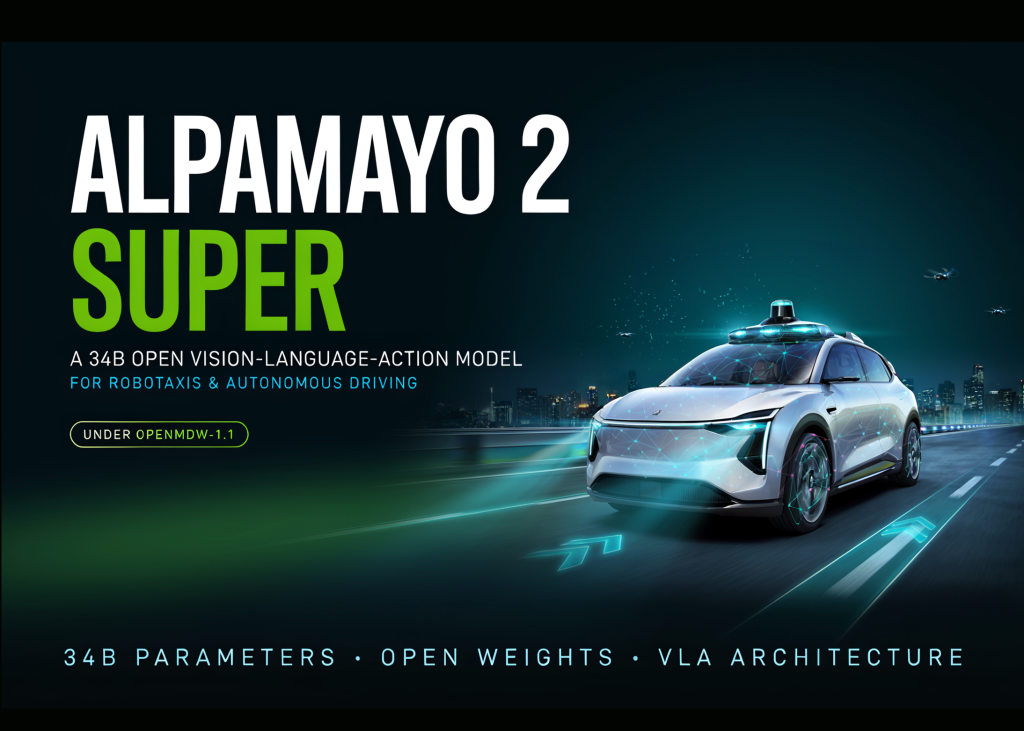
NVIDIA launched Alpamayo 2 Super, a large vision-language-action model with 34 billion parameters designed for autonomous driving tasks. It combines a 32 billion parameter reasoning backbone called Cosmos 3 Super with a 2.3 billion parameter diffusion action decoder. The model can handle driving-related vision and language inputs and outputs in a single pass, generating driving trajectories, chains of causation, meta-actions, auto-labels, and grounded visual question answering (VQA). Its language reasoning scored 79.2 on the LingoQA benchmark. Importantly, NVIDIA released this under OpenMDW-1.1, a permissive license allowing fine-tuning, derivatives, and commercial use.
Why it matters
Releasing a high-parameter vision-language-action model under an open commercial license changes the dynamics around autonomous vehicle AI development. It lowers the bar for startups and smaller players who want to build or customize multimodal driving intelligence without building models from scratch or negotiating restrictive licenses. The integrated outputs like chain-of-causation help machines explain their driving decisions, which can improve transparency and safety audits. OpenMDW-1.1 licensing signals an intent to accelerate open innovation in robotaxis and autonomous driving systems, potentially pressuring proprietary model makers.
Who it is for
This model targets autonomous vehicle developers, especially those focused on robotaxis and self-driving use cases requiring integrated vision and language capabilities. OEMs, Tier 1 suppliers, and autonomous fleet operators can fine-tune or build on Alpamayo 2 Super to improve perception, reasoning, and action planning. It is also useful for research teams working on explainability and grounded multimodal understanding in complex driving environments. The permissive licensing lowers barriers to commercial deployment, benefiting startups over large incumbents tied to closed AI stacks.
The catch
Despite the open licensing and high parameter count, Alpamayo 2 Super’s operational and compute costs remain a challenge. Running large models in real-time autonomous vehicles demands specialized hardware and efficient architecture tuning. Also, no information is provided on safety validation or regulatory acceptance, which remain key bottlenecks in real-world deployment. Operators should approach integration with caution until proven safe at scale.
What to watch next
Adoption and adaptation of Alpamayo 2 Super by autonomous driving companies and research groups will signal how quickly open vision-language-action models can disrupt proprietary AI stacks. Watch for benchmarks on safety, real-world driving performance, and model efficiency improvements. Regulatory responses to widely used open models in safety-critical domains could shift, pressing for clearer standards. NVIDIA’s further licensing moves and updates to OpenMDW-1.1 will also impact market openness and innovation pace.
AI Quick Briefs Editorial Desk