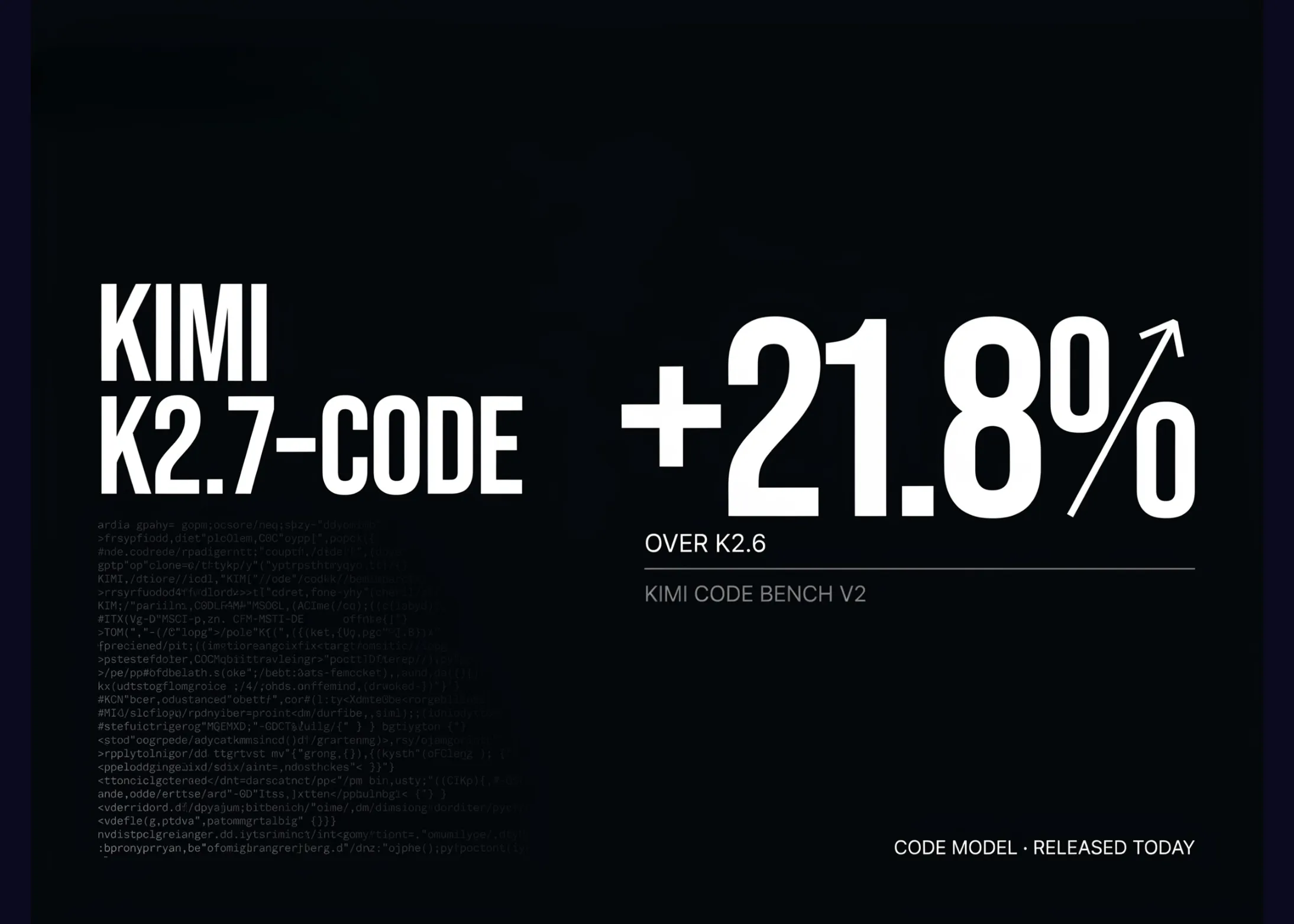
Moonshot AI Releases Kimi K2.7-Code: a Coding Model Reporting +21.8% on Kimi Code Bench v2 Over K2.6
What changed
Moonshot AI released Kimi K2.7-Code, an updated coding model that improves on its predecessor K2.6. The new model is open-sourced under a Modified MIT license, making it freely accessible to developers and companies that want to integrate or customize it. Kimi K2.7-Code offers a 256K context window, which expands the amount of code it can handle in a single pass. It also reduces reasoning-token usage by roughly 30 percent, which means it requires less computational power for complex problem-solving. On performance benchmarks, Moonshot AI reports a 21.8 percent gain on Kimi Code Bench v2 compared to K2.6, along with improvements across five additional coding benchmarks.
Why builders should care
This release pushes the efficiency and accuracy of coding-focused AI models forward while maintaining accessibility through permissive licensing. The larger context window helps in applications such as intelligent code completion, error detection, and automated refactoring on bigger codebases without hitting memory constraints quickly. Cutting reasoning-token usage by about 30 percent translates to faster responses and lower cloud costs, which are crucial for startups and teams deploying AI-assisted coding tools at scale. The improvements across multiple benchmarks indicate more reliable code generation and understanding, potentially reducing developer time spent on debugging and rewriting AI outputs.
The practical takeaway
Builders and product teams using AI for code should evaluate Kimi K2.7-Code for integration, especially if their current tools struggle with larger projects or high compute costs. The model’s open-source status accelerates experimentation and customized fine-tuning without vendor lock-in. Deployment via the Kimi API and Kimi Code means teams can start testing it in real-world workflows immediately. Lower token usage also helps make running the model on less powerful infrastructure more feasible, opening opportunities for edge or on-premises AI-assisted development.
What to watch next
It will be important to track real-world adoption of Kimi K2.7-Code, including how user feedback aligns with reported benchmark gains. Watch for new tools or IDE plugins leveraging this model to improve coding assistant quality. Also monitor how Moonshot AI competes or collaborates with other open-source and commercial coding models, as this segment tightens competition and pricing pressures. Finally, further efficiency gains or context window expansions could continue to shift what’s practical for AI-assisted software development at scale.
AI Quick Briefs Editorial Desk