A Coding Implementation on Spatial Graph Neural Networks for Urban Function Inference Using city2graph, OSM…
What changed
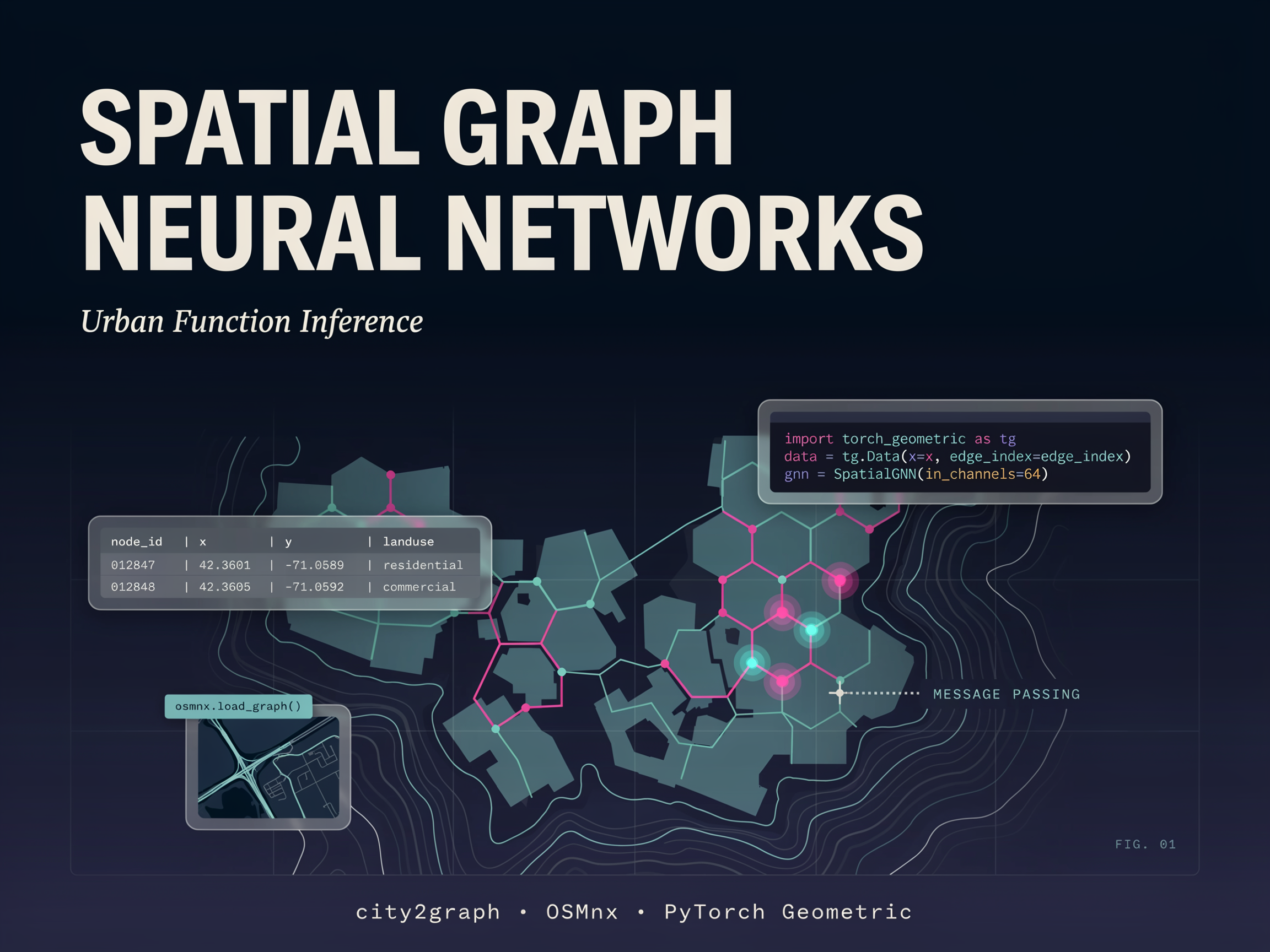
A new end-to-end pipeline demonstrates how to build spatial graph neural networks for urban function inference. Using city2graph, OpenStreetMap data, and PyTorch Geometric, the pipeline pulls urban points of interest (POI) and street networks. It then engineers spatial features and constructs multiple proximity graph types to represent the same urban environment. Both heterogeneous and homogeneous graphs are created, converted to a format suitable for PyTorch Geometric, and trained with a GraphSAGE model to predict POI categories from spatial relationships.
Why builders should care
This approach removes ambiguity around how to combine spatial urban data with graph neural networks for function classification. By automating data collection, feature engineering, and graph construction from open datasets, it cuts down time and manual error. PyTorch Geometric is an established graph learning framework, so integrating city2graph graphs directly into a model training workflow lowers the barrier to building graph-based urban analytics. It also clarifies how different graph representations can impact model performance on real-world urban inference tasks.
The practical takeaway
Operations or product teams working on urban analytics, smart city applications, or location-based services can now prototype spatial GNN solutions faster. This pipeline shows how to layer various spatial features and proximity graph types into graph machine learning models without bespoke coding at every step. The use of GraphSAGE means the method can scale to large urban graphs with inductive learning, improving the ability to reason about unseen city areas. This sets a practical baseline for improving or customizing spatial graph modeling in urban contexts.
What to watch next
It will be important to track how graph architectural choices influence predictive accuracy across different cities and POI types. Expanding beyond GraphSAGE models to other graph neural architectures may reveal performance or efficiency gains. Also, integrating more diverse urban data sources or temporal dynamics could extend functionality. Finally, watching adoption among urban planners, geospatial data scientists, and AI developers will show if this pipeline truly accelerates urban function inference workloads.
AI Quick Briefs Editorial Desk