How to Build a T4-Friendly Autonomous Data Science Agent with DeepAnalyze-8B, Sandboxed Code Execution, and…
What changed
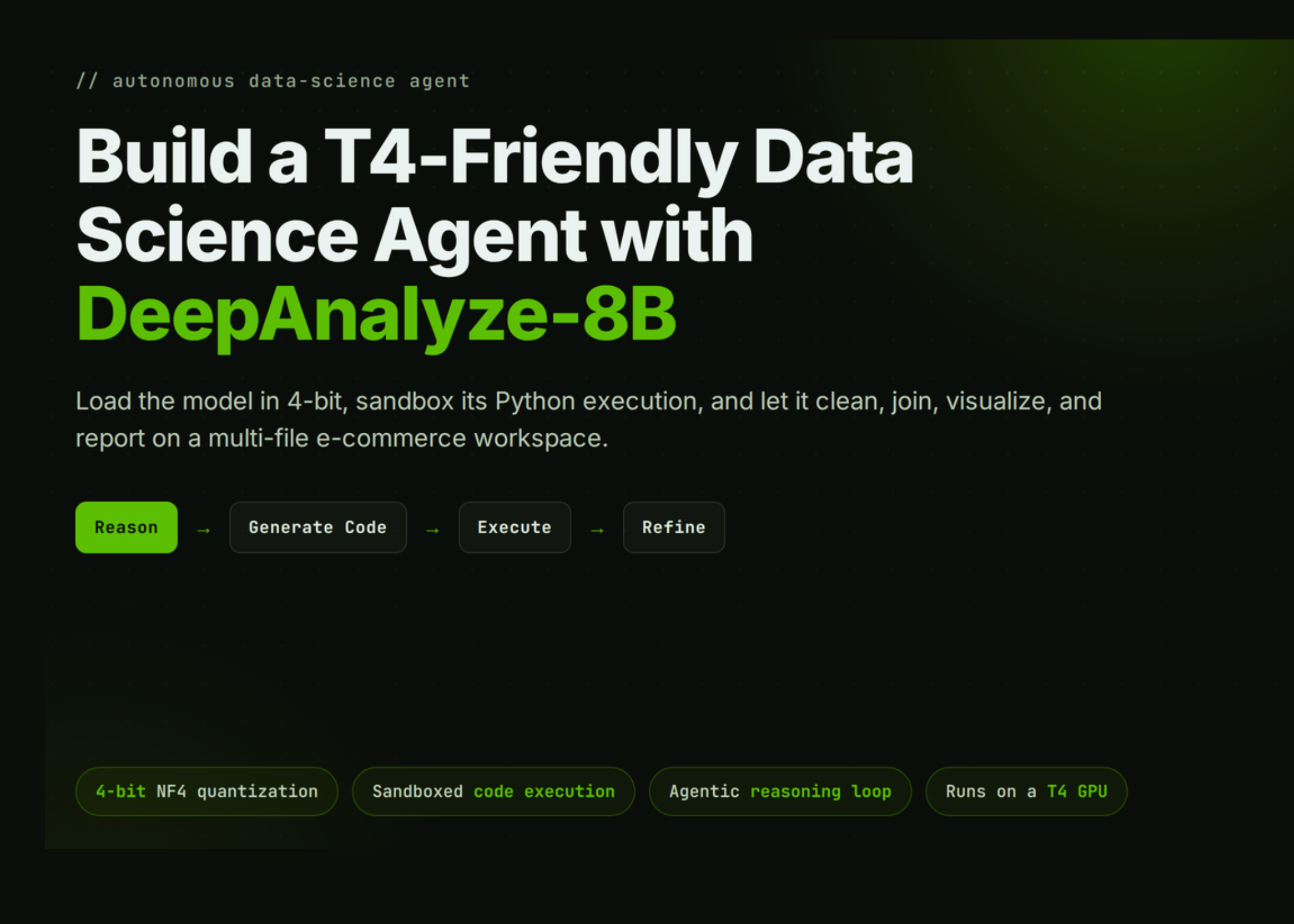
An autonomous data science agent was built around DeepAnalyze-8B to work within the constraints of NVIDIA T4 GPUs. This involved setting up a stable Colab environment, installing machine learning dependencies, and running the tokenizer and model in a memory-efficient 4-bit mode. The system integrates a sandboxed execution environment that lets the AI generate Python code, execute it safely, observe outcomes, and iterate in a continuous loop.
The agent was tested using a complex multi-file e-commerce dataset, where it autonomously performed data cleaning, merging, analysis, visualization, and summary tasks. This practical use case demonstrated how an agent can handle real-world data science workflows end to end without human intervention.
Why builders should care
Running large autonomous agents typically requires expensive GPUs or cloud setup, limiting access and experimentation. Adapting DeepAnalyze-8B for T4-level hardware lowers the barrier to entry for smaller teams and developers with budget or hardware limits. The 4-bit model loading approach preserves functionality while fitting within limited GPU memory.
Sandboxed code execution adds a crucial safety layer by isolating the AI’s generated Python code from the host environment. This reduces security risks when agents autonomously execute scripts generated on the fly. The combined system evidences a practical pattern for building fully self-sufficient data science assistants that can operate within cost-constrained environments.
The practical takeaway
For startups or data teams constrained by hardware budget but looking to automate data workflows, this approach offers a blueprint. It shows how to run a capable autonomous data science agent within hardware and security limits common on cloud platforms like Google Colab.
Operators gain the ability to hand an AI a messy, multi-file dataset and have it produce analytical insights without manual scripting. That shifts data science from manual analysis toward automated iterative workflows, speeding overall turnaround while keeping GPU costs manageable.
What to watch next
Watch for further refinements in memory-efficient LLM implementations that can push more powerful autonomous assistants onto modest hardware. Improvements in sandbox environments may also extend the range of safe autonomous operations beyond Python code.
Broader adoption will depend on generalizing this approach beyond e-commerce datasets to diverse real-world scenarios. Meanwhile, pay attention to how developers balance model performance, safety, and hardware cost when deploying autonomous agents for data science or related tasks.
AI Quick Briefs Editorial Desk