How to Build a Forecasting Pipeline with TimeCopilot Using Foundation Models and Automated Anomaly Detection
What changed
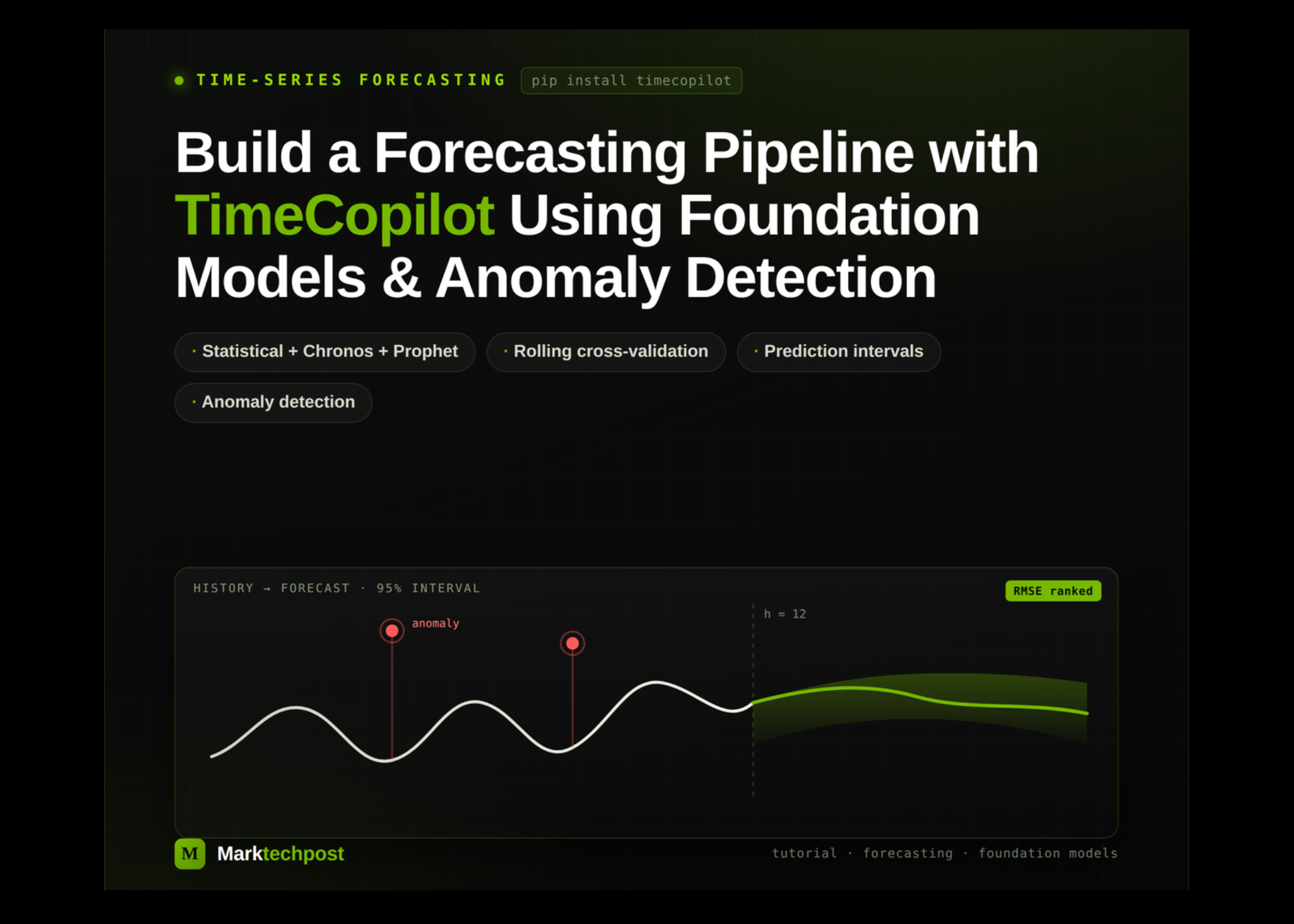
TimeCopilot introduced a complete forecasting pipeline that combines foundation models with automated anomaly detection. The workflow uses actual airline passenger data alongside a synthetic seasonal series where anomalies are deliberately inserted. Models tested include traditional statistical methods, foundation models leveraging large datasets, and optional GPU-accelerated algorithms. Evaluation happens through rolling cross-validation and multiple error metrics, offering a broad view of model performance. The system also produces probabilistic forecasts with prediction intervals, highlights future trends visually, and automatically flags unusual data points. An optional large language model (LLM) agent further assists by choosing a forecast model and explaining its predictions.
Why builders should care
Building reliable forecasting pipelines remains a challenge, especially when data series have irregularities or anomalies that degrade model accuracy. TimeCopilot’s approach integrates the latest foundation models without losing the rigor of standard statistical evaluations. The inclusion of automated anomaly detection reduces manual troubleshooting effort and enables more reliable predictions in operational settings. Having an LLM agent to select and rationalize model choices reduces the barrier for less-expert users and speeds up deployment. This workflow is especially relevant for sectors like travel or retail that need continuous, robust trend detection against noisy data.
The practical takeaway
Operators can use TimeCopilot to cut down time spent managing diverse forecasting models and cleaning messy time series. Forecasting accuracy improves by cross-validating multiple approaches side-by-side and by injecting anomaly detection early in the process. Prediction intervals give teams a realistic sense of forecast uncertainty, helping avoid overconfidence in planning decisions. The visualization of flagged anomalies and future trends supports quicker interpretation of forecasting results. The LLM agent’s automated model selection and explanation capabilities make forecasting workflows easier to scale and customize without deep data science expertise.
What to watch next
It will be important to see if TimeCopilot integrates with more data sources and how it manages scalability in real-world enterprise environments. The utility of the LLM agent in handling edge cases or rapidly changing patterns will also be a key factor in adoption. Tracking whether TimeCopilot’s approach lowers the total cost and time to deploy forecasting solutions across industries will show its commercial impact. Future advances could include more adaptive anomaly detection or fully automated end-to-end pipelines that adjust models in real time.
AI Quick Briefs Editorial Desk