NVIDIA AI Introduce SpatialClaw: A Training-Free Agent That Treats Code as the Action Interface for Spatial…
What it does
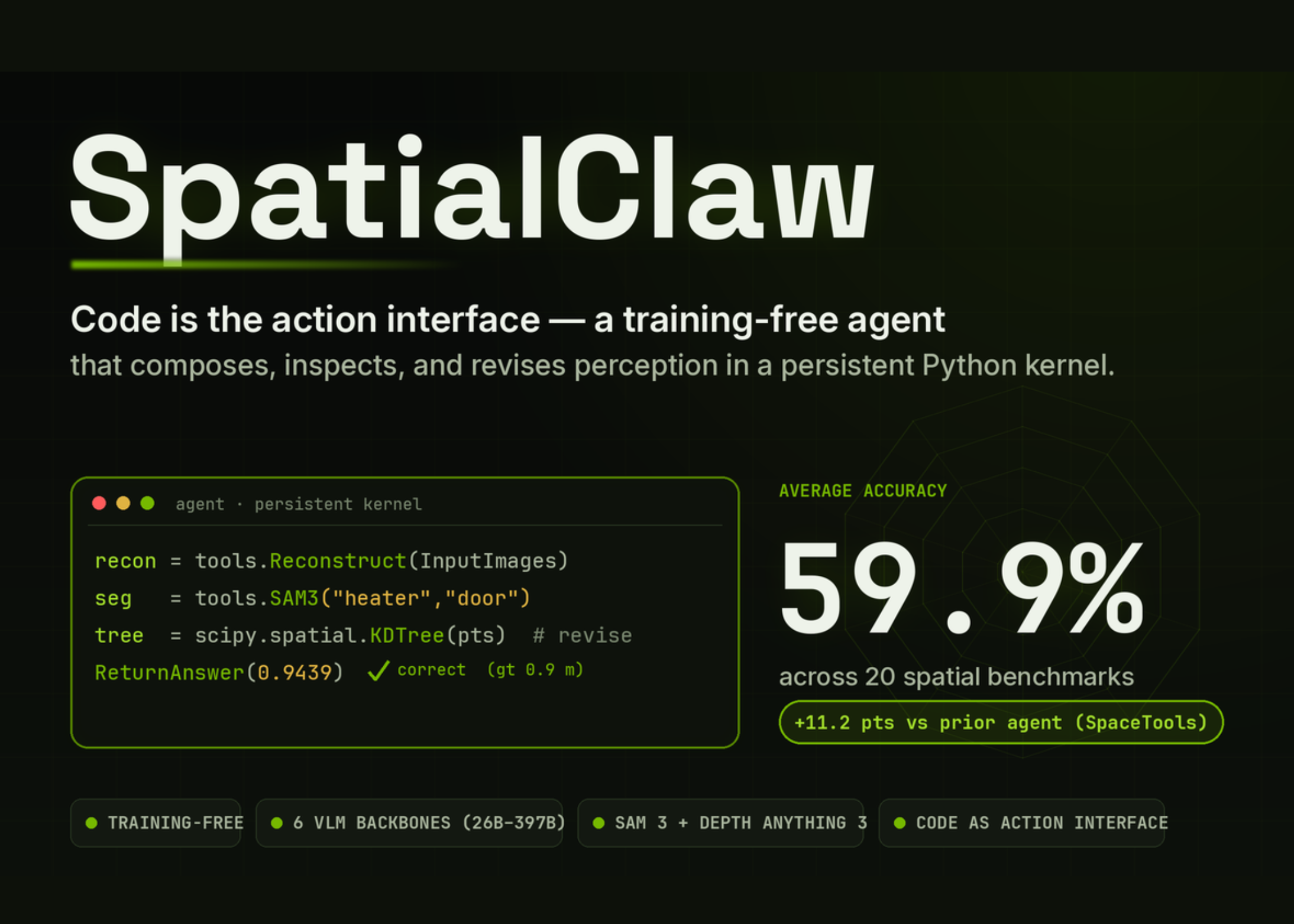
NVIDIA AI has introduced SpatialClaw, a new agent designed for 3D spatial reasoning that operates without training. SpatialClaw treats code as its action interface, writing Python scripts within a persistent kernel to compose perception tools that interpret and manipulate spatial data. This approach sets it apart from typical AI models that need extensive training on spatial tasks.
Why it matters
SpatialClaw’s ability to reason spatially by dynamically generating and executing code reduces the need for costly and time-consuming model training. By treating code itself as the interface for action, it provides a flexible platform for developing intelligent agents that solve complex spatial problems on the fly. This can accelerate workflows in robotics, autonomous systems, and any application requiring real-time 3D understanding without retraining models every time the task changes.
Who it is for
The technology primarily targets developers and researchers working with spatial reasoning challenges, especially those building AI agents for robotics and 3D environments. By simplifying the interaction with spatial data through code generation, SpatialClaw can help teams prototype and iterate faster, reducing reliance on large annotated datasets or custom-trained models.
The catch
While SpatialClaw offers a training-free approach, it depends heavily on the ability to generate effective Python code in context. This could introduce unpredictability in task performance depending on the complexity of the environment and the agent’s coding capabilities. It may also require operators to have some programming knowledge to fully leverage its code-based interaction model.
What to watch next
Keep an eye on how SpatialClaw integrates with existing robotics and AI frameworks, particularly whether it can scale to real-world spatial tasks without manual tuning. Its adoption will hinge on proving it can reliably replace or augment traditional training-heavy spatial AI models in production settings. Future updates might also extend its programming languages or interfaces beyond Python to broaden its usability.
AI Quick Briefs Editorial Desk