Building AI Agents? Here Are Some Anti-Patterns to Avoid.
What changed
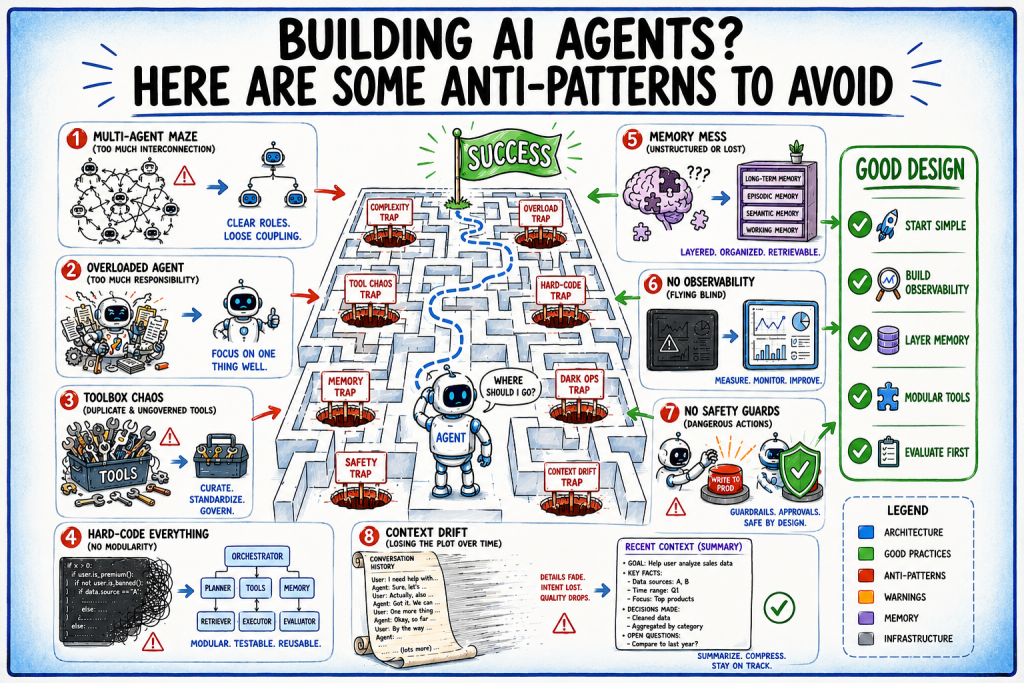
AI agent systems do not remain static after deployment. Instead, they change constantly in production environments. The article outlines common anti-patterns in building AI agents, warning that many systems fall into traps that degrade their effectiveness over time or create brittle workflows that resist adaptation.
These anti-patterns include overly rigid architectures that prevent gradual improvements, relying too much on single models without modularity, and ignoring the importance of ongoing monitoring and feedback loops. Systems that treat agent behavior as fixed tend to break or require costly manual intervention when facing new edge cases or shifting conditions.
Why builders should care
Developers and founders working on AI agents face pressure to deliver solutions that work reliably in unpredictable real-world scenarios. Ignoring these anti-patterns raises maintenance costs by forcing teams to rebuild or patch systems constantly. It also weakens trust in automation by causing erratic or nonsensical agent behavior over time.
By focusing on adaptive design principles—such as modularizing components, embracing continuous learning, and integrating telemetry for ongoing evaluation—builders can keep AI agents resilient and responsive. Avoiding these pitfalls cuts operational friction and accelerates deployment cycles, making AI agents more reliable business assets rather than liabilities.
The practical takeaway
Treat AI agents as fluid systems that must evolve post-launch. Build with modularity and layered models that can be swapped or retrained independently. Instrument your agent pipeline with monitoring tools that capture failures and drift early. Automate feedback loops that let the agent improve without extensive manual retraining.
This approach forces developers to rethink AI workflows away from “set and forget” toward “launch and iterate.” It shifts resources from firefighting to proactive optimization. For operators, it lowers the risk of costly downtime and makes AI agents better partners for long-term business goals.
What to watch next
Expect emerging tools and frameworks designed specifically to aid continuous deployment and maintenance of AI agents. Look for features that enable seamless modular updates and real-time performance monitoring. Investors might watch startups tackling agent durability and lifecycle management as a key competitive edge.
Build teams should track best practices evolving around composability and live feedback integration. Regulatory scrutiny could increase as AI agents in critical applications show instability due to these anti-patterns. Staying ahead of operational risks means embracing change as a feature, not a flaw, in AI agent design.
AI Quick Briefs Editorial Desk