Building a Semantic Search Engine and Open-Status Classifier over the ResearchMath-14k Dataset
What changed
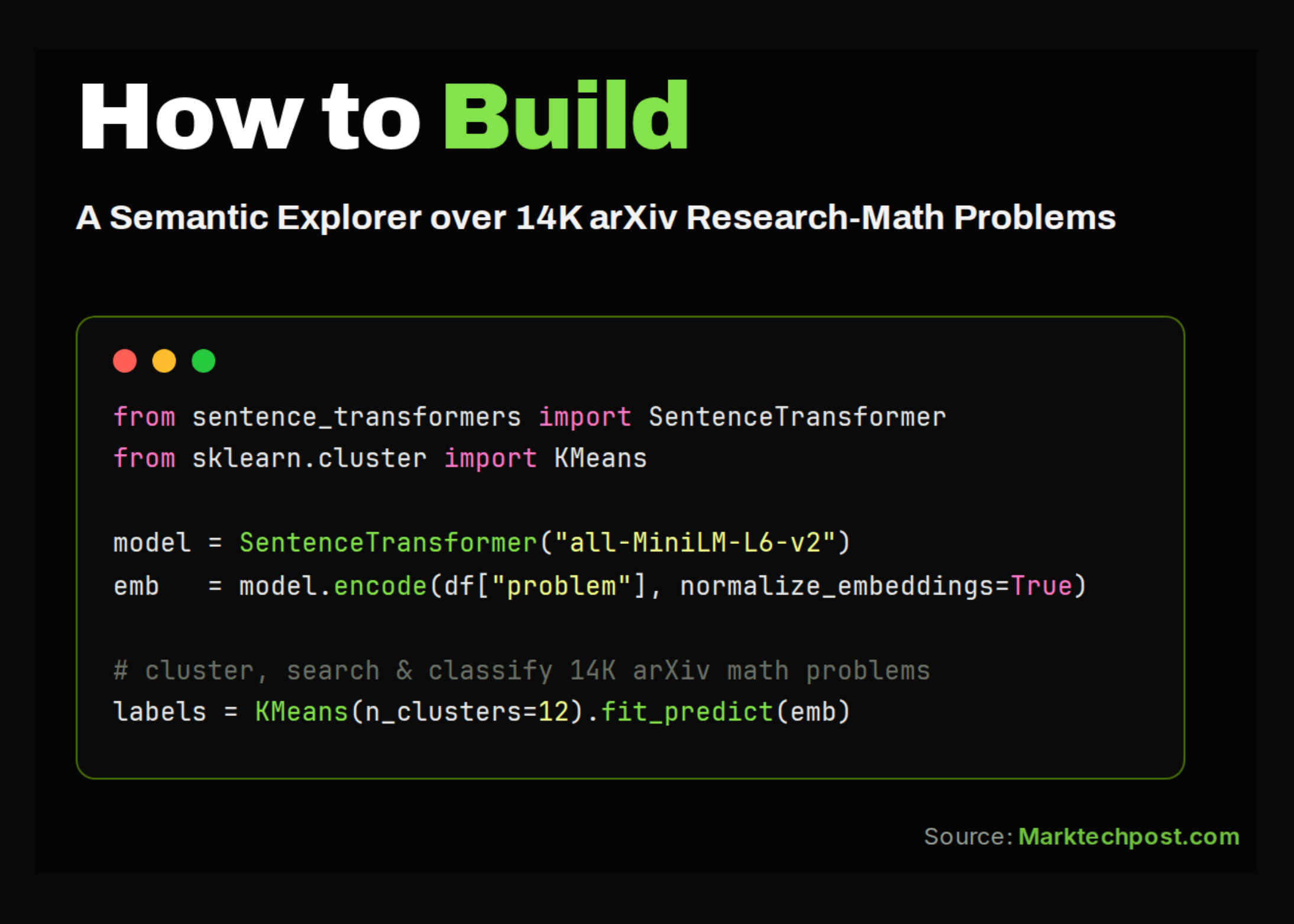
A full NLP pipeline for research-level math problems now shows how to build both a semantic search engine and a classifier to detect open problems using the ResearchMath-14k dataset. The approach extracts domain-specific keywords with TF-IDF, creates semantic sentence embeddings, reduces dimensionality with UMAP for visualization, clusters the questions using K-Means, then uses these elements to enable smart search and open-status prediction. It also identifies near-duplicate problems by similarity scoring.
Why builders should care
Math research data is notoriously dense and jargon-heavy, making generic NLP pipelines ineffective. This work proves field-tailored keyword extraction combined with embedding and clustering can distill a massive dataset into an organized, searchable space. Builders targeting academic or research data can leverage similar pipelines to accelerate knowledge discovery, reduce manual curation, and uncover latent problem patterns. Predicting the “open problem” status adds a useful layer for researchers deciding where to focus.
The practical takeaway
Operators building search tools or recommendation systems on specialized corpora benefit from the step-by-step method shown here. TF-IDF can highlight terms that matter to the discipline, embeddings create semantics-based access, and clustering organizes the landscape into manageable segments. Adding an open-status classifier can help surface unsolved issues or prioritize content based on novelty. This reduces noise and improves signal in research workflows where detail accuracy is critical.
What to watch next
Look for more pipelines that integrate traditional NLP techniques with domain-aware methods, especially on specialized datasets. Advances in embedding models suited for technical or scientific language will expand these capabilities. Also watch how semantic search and classification tools evolve to handle ambiguity and complexity in research texts beyond math, pressing academic search to become more contextual and actionable.
AI Quick Briefs Editorial Desk