Building a Scaffold-Split Random Forest QSAR Co-Scientist for EGFR Inhibitor Discovery Using ChEMBL, RDKit,…
What changed
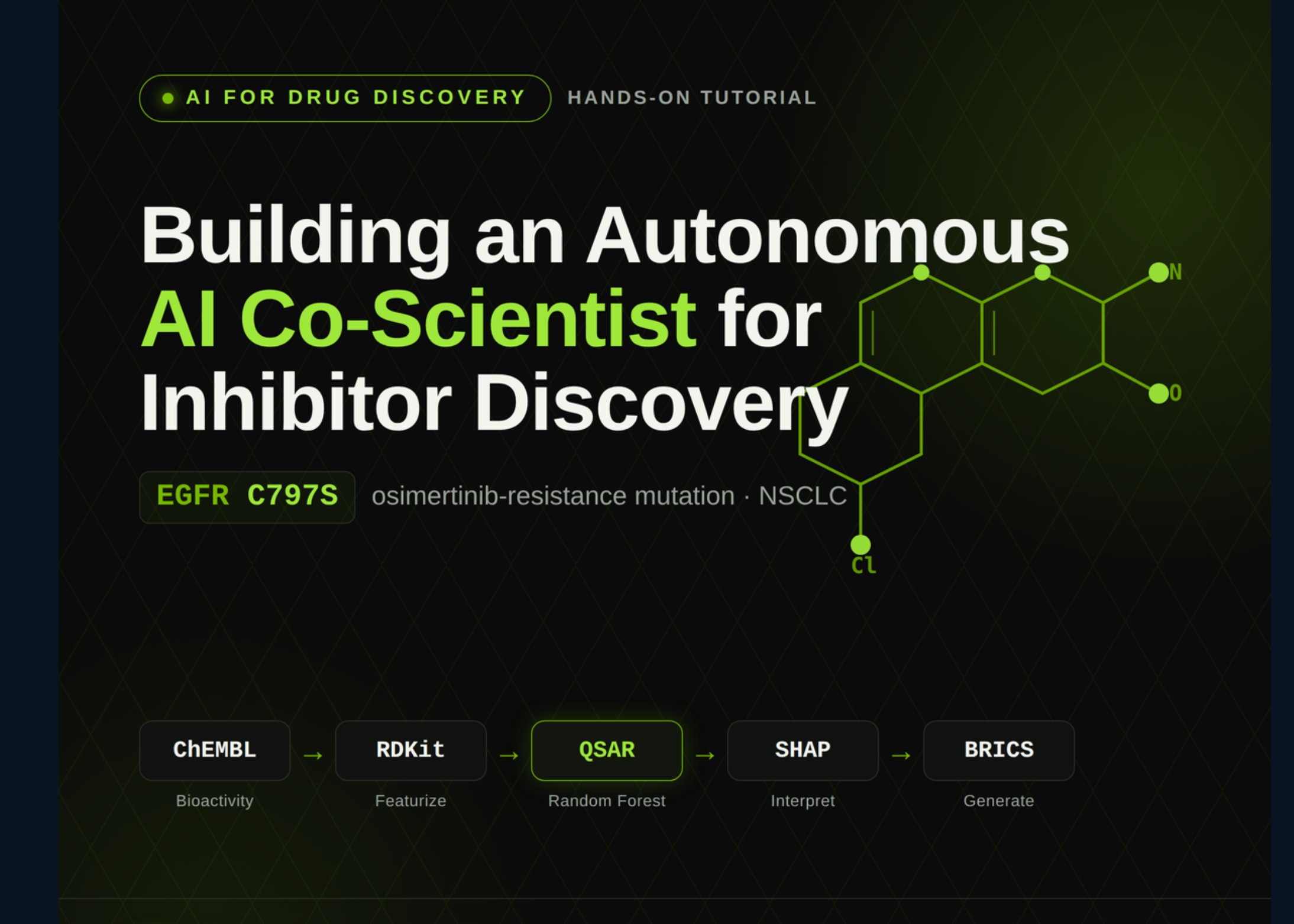
A new AI co-scientist was built to assist with discovering inhibitors targeting the EGFR C797S mutation, a variant relevant in drug resistance for cancer treatment. This system integrates data mining from ChEMBL and UniProt to identify and clean biologically relevant potency measurements, converting IC50 values into pIC50 for modeling. Molecular structures are standardized and featurized using RDKit’s Morgan fingerprints. Critically, the approach uses scaffold-based splitting for training a Random Forest QSAR model, which helps avoid data leakage from similar chemical scaffolds and ensures more realistic predictions on novel chemotypes. The model’s interpretability is enhanced through SHAP analysis to pinpoint which molecular features drive potency. Finally, fragment recombination via BRICS generates new candidate molecules ranked by predicted activity.
Why builders should care
This autonomous pipeline demonstrates how classic cheminformatics tools can be combined with explainable machine learning to build more reliable AI-driven drug discovery workflows. Scaffold splitting addresses a common blind spot where models overfit to scaffold-related chemical similarity rather than true activity patterns. The use of SHAP to interpret QSAR predictions adds transparency, helping researchers understand which substructures impact potency, which can accelerate hypothesis generation. Fragment-based generation via BRICS is a practical way to explore chemical space while maintaining drug-likeness. Builders designing AI for drug discovery can adopt this integrated approach to reduce false positives and improve candidate quality with limited manual intervention.
The practical takeaway
Operators looking to build or enhance AI models for small-molecule drug discovery will gain from adopting scaffold-split training to maintain prediction rigor, avoiding overly optimistic results common in random splits. Incorporating explainability through SHAP adds confidence in model-driven decisions by making potency drivers explicit. Fragment-based molecule design using BRICS complements the QSAR model to propose real, synthesizable candidates rather than arbitrary strings. The pipeline leverages open tools like RDKit and freely available bioactivity databases, allowing for cost-effective development. This approach raises the bar for automated inhibitor discovery workflows by combining data quality, model robustness, interpretability, and de novo design.
What to watch next
Watch for extensions of this workflow incorporating deep learning architectures or more advanced generative models to improve novel candidate diversity. Early adopters may integrate the scaffold-split interpretability approach to other protein targets to test generalizability. Attention will focus on how well candidates proposed by fragment recombination and QSAR ranking perform in experimental validations, which will determine the true operational impact. Also, observe if this pipeline concept gets integrated into commercial AI drug discovery platforms or open-source projects, influencing how computational chemistry teams structure their pipelines.
AI Quick Briefs Editorial Desk