Building a Context Pruning Pipeline for Long-Running Agents
What changed
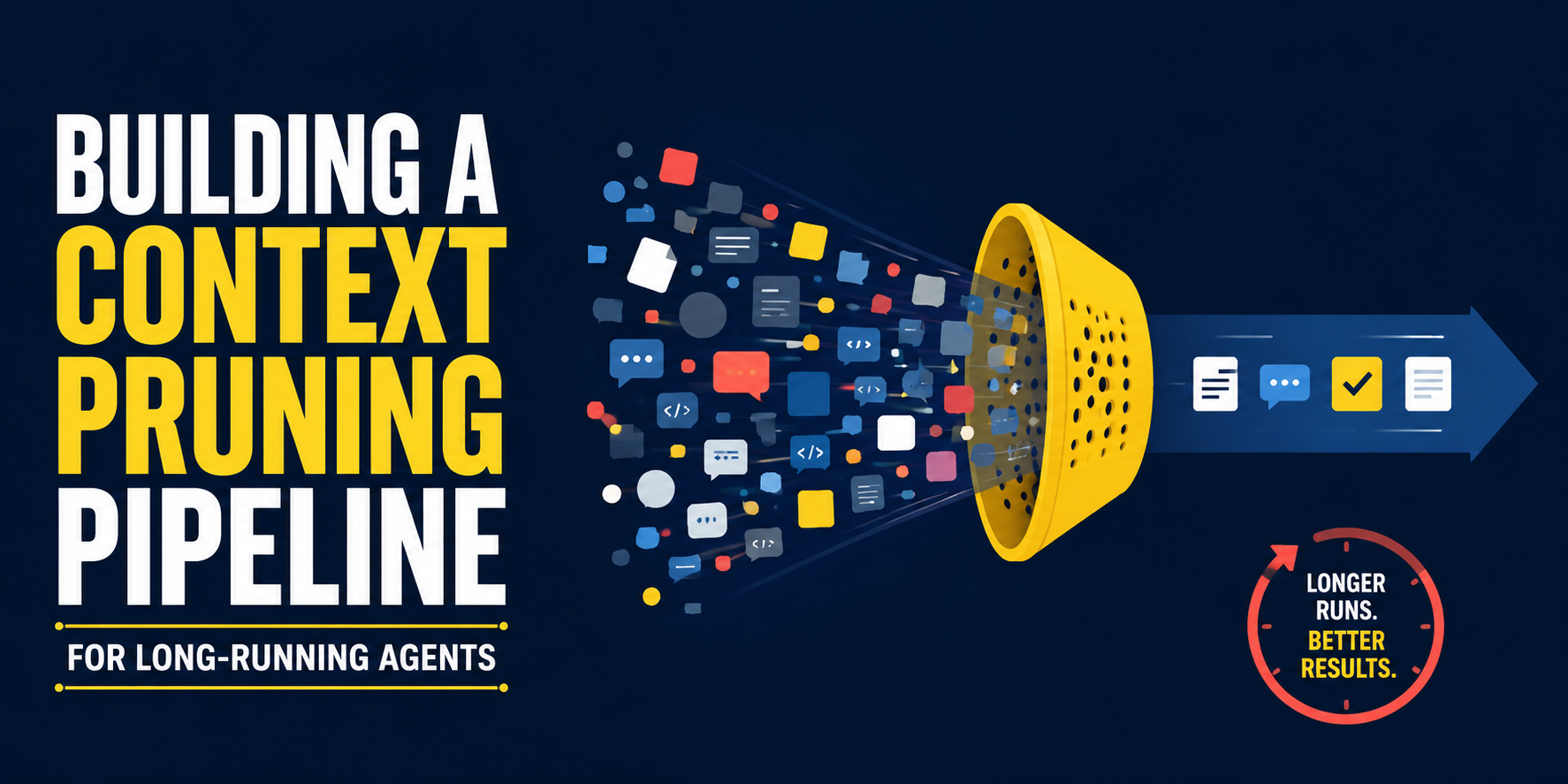
Long-running AI agents built on large language models face a tough challenge: their context windows fill up fast as they accumulate information over time. A new context pruning pipeline tackles this by selectively trimming memory and past interactions while keeping the agent’s performance intact. The pipeline uses strategies to decide what past data to keep and what to discard, balancing recency and importance without losing critical context for ongoing tasks.
Why builders should care
Without managing context effectively, continuous AI agents risk slowing down, hitting token limits, or producing degraded results. This pruning approach prevents runaway input size growth, which is a core bottleneck when running agents for extended periods. It also reduces API call costs and latency by limiting the amount of past information that gets processed on each step. For anyone designing autonomous or semi-autonomous LLM agents, such as chatbots, automation bots, or decision engines, implementing context pruning keeps workflows scalable and responsive.
The practical takeaway
Building an effective pruning pipeline means integrating heuristics or learned models that prioritize critical past data while dropping peripheral details. It may involve summarizing long conversations or removing redundant or obsolete information. The pipeline should be customizable to the agent’s domain and usage patterns to avoid losing valuable context. This work lowers operational overhead, keeps real-time interactions snappy, and maintains agent accuracy over time—helping projects push beyond short bursts of interaction to genuinely continuous AI agents.
What to watch next
The next step will be refining pruning methods with more intelligence, like context-aware embeddings or reinforcement learning to optimize what to keep. Expect advances in plugins and open-source tools that offer out-of-the-box context management for AI pipelines. As more teams deploy agents that operate nonstop in real environments, these pruning innovations will be crucial to avoid escalating compute loads and costs.
AI Quick Briefs Editorial Desk