Designing High-Performance GPU Kernels with TileLang: Tensor-Core GEMM, Fused Softmax, FlashAttention, and …
What changed
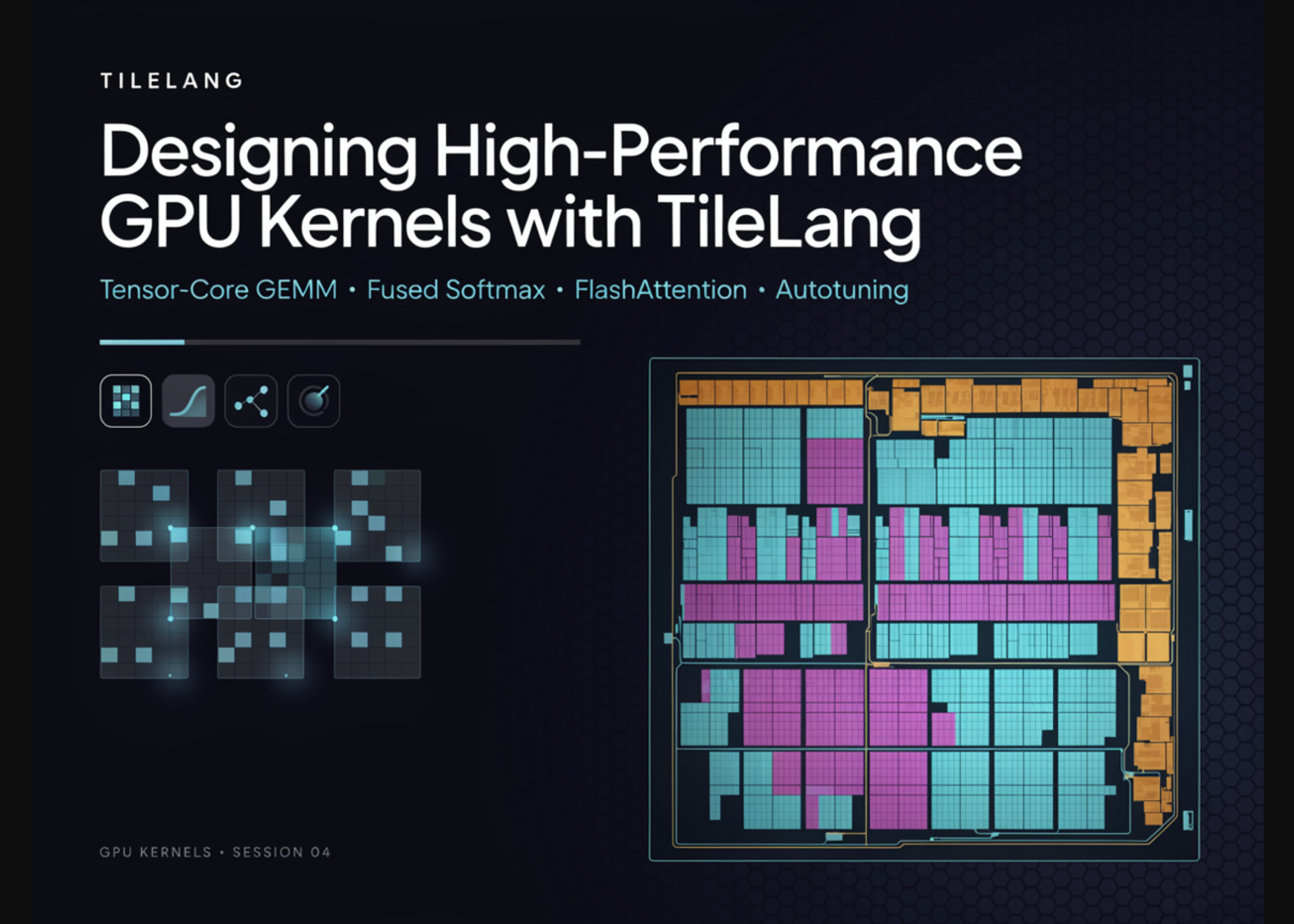
TileLang introduces a high-level Python domain-specific language designed to simplify creating high-performance GPU kernels. It handles complex workloads like tiled tensor-core GEMM, fused softmax, and FlashAttention without requiring engineers to manually map threads, manage memory layout, or write detailed CUDA instructions. Instead, the compiler automates these intricate steps, freeing developers to focus on algorithm design rather than low-level GPU programming details.
Why builders should care
Designing efficient GPU kernels is notoriously difficult. Developers often spend significant time optimizing thread synchronization, memory accesses, and instruction scheduling manually. TileLang lowers this barrier by abstracting these complexities without compromising performance. This reduces development time and technical risk while enabling easier experimentation with advanced operations like fused softmax—a critical kernel for transformers—and FlashAttention, known for its memory efficiency. Builders working on GPU-heavy ML workloads or custom accelerators gain a faster path to performance.
The practical takeaway
Using TileLang can speed up kernel development cycles and reduce costly engineering effort. Teams building ML frameworks, specialized inference engines, or custom GPU workflows can offload low-level optimization challenges to the TileLang compiler. This shifts resource allocation from debugging fine-grained CUDA details toward higher-level algorithmic tuning and iteration. The autotuning capabilities further optimize performance without deep manual intervention, potentially lowering time to production and improving hardware efficiency.
What to watch next
Check for TileLang’s integration in popular ML frameworks or GPU toolchains aimed at AI workloads. The ability to fuse operations and efficiently map to tensor cores points toward broader adoption in transformer model acceleration and large-scale inference. Also track enhancements in compiler autotuning features, which indicate how well TileLang adapts across GPU architectures and workload types. Practical benchmarks comparing TileLang-generated kernels versus hand-optimized CUDA remain a crucial metric for adoption decisions.
AI Quick Briefs Editorial Desk