Meet Open Dreamer: A JAX/Flax Reproduction of the Dreamer 4 World Model Pipeline, With the Full Training Re…
What changed
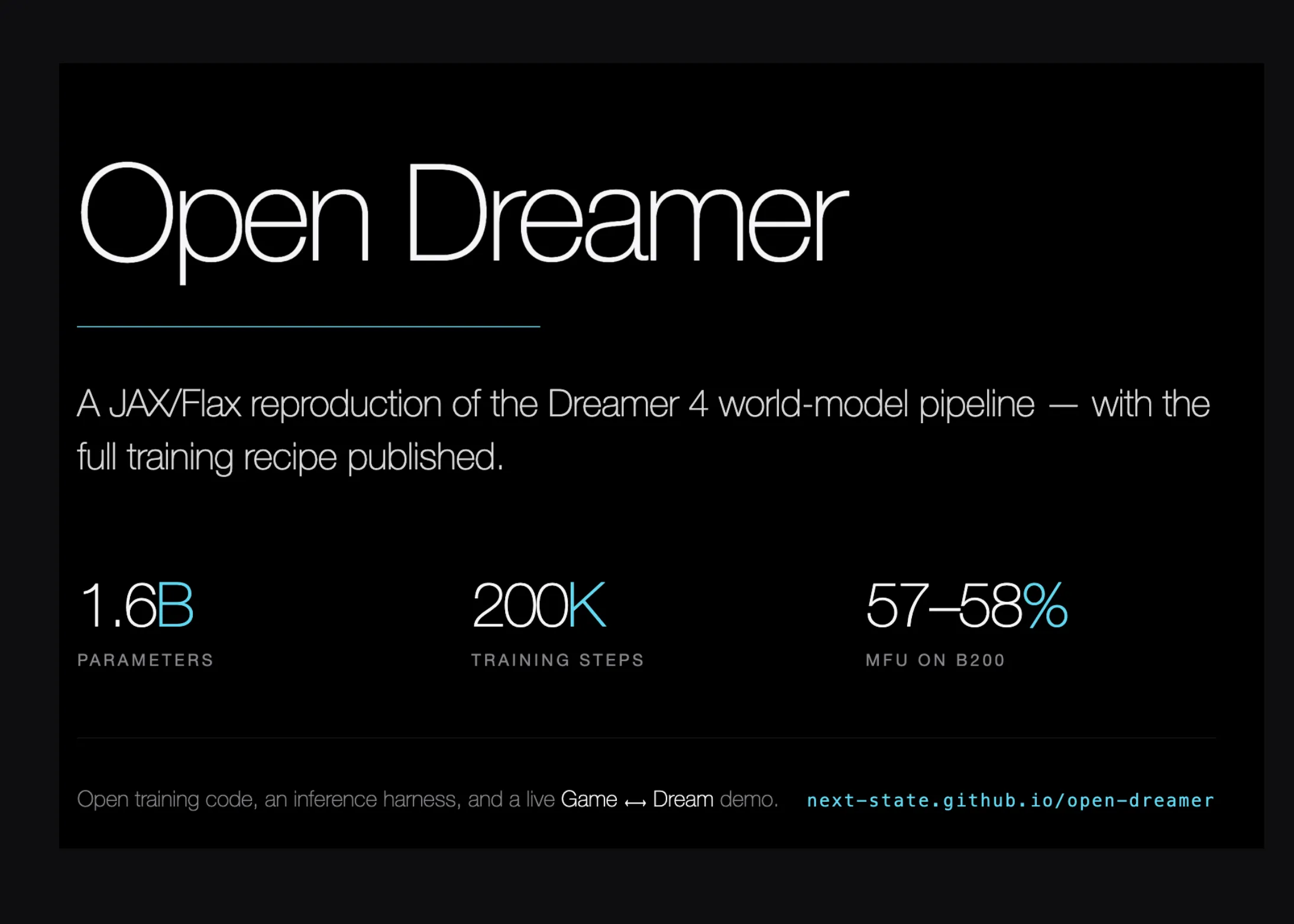
A research group named Reactor released Open Dreamer, an open-source reimplementation of the Dreamer 4 world model pipeline using JAX and Flax neural network libraries. The release includes two repositories: one contains a complete training pipeline with components like a causal video tokenizer, an action-conditioned latent dynamics model, rollout generation, and Frechet Video Distance scoring. The other repository holds a trained checkpoint along with visualization and evaluation tools. Crucially, the group published the full training recipe, offering a transparent look at how to rebuild Dreamer 4 from scratch.
Why builders should care
Dreamer 4’s world model pipeline was originally a closed or proprietary system, so having an open reproduction in JAX/Flax unlocks hands-on access to state-of-the-art world modeling for the research and development community. JAX’s efficiency with modern accelerators and functional programming style makes this a practical base for rapid experimentation and integration into other AI workflows. Builders, especially those working on reinforcement learning or model-based planning, get a tested toolkit to build on without starting blind. The complete training recipe demystifies the complex process, lowering the barrier to reproducing and extending Dreamer-style architectures.
The practical takeaway
Open Dreamer speeds up adoption of cutting-edge world models by providing not just code but also the full details needed for training, evaluation, and rollout generation right out of the box. Anyone developing AI agents that must learn to predict and plan in complex environments can now clone a production-level implementation. This transparency pressures proprietary solutions by making an advanced solution accessible without licensing fees or platform lock-in. Researchers can benchmark against a vetted baseline, investors can spot innovation rooted in reproducibility, and founders can explore commercial possibilities without lengthy R&D overhead.
What to watch next
Keep an eye on community contributions to the Open Dreamer repositories and early use cases that adapt the pipeline for new domains. Progress in scaling, efficiency optimizations, or combining Open Dreamer with other modalities could signal practical roadmaps forward. Also watch if and how proprietary players respond, whether by open-sourcing their own pipelines or tightening control on their models. The broader trend of releasing full training recipes may reshape expectations for transparency and reproducibility in AI model development.
AI Quick Briefs Editorial Desk