Training Gemma-3 for Structured Mathematical Reasoning with Tunix GRPO, LoRA Adapters, and GSM8K Rewards
What changed
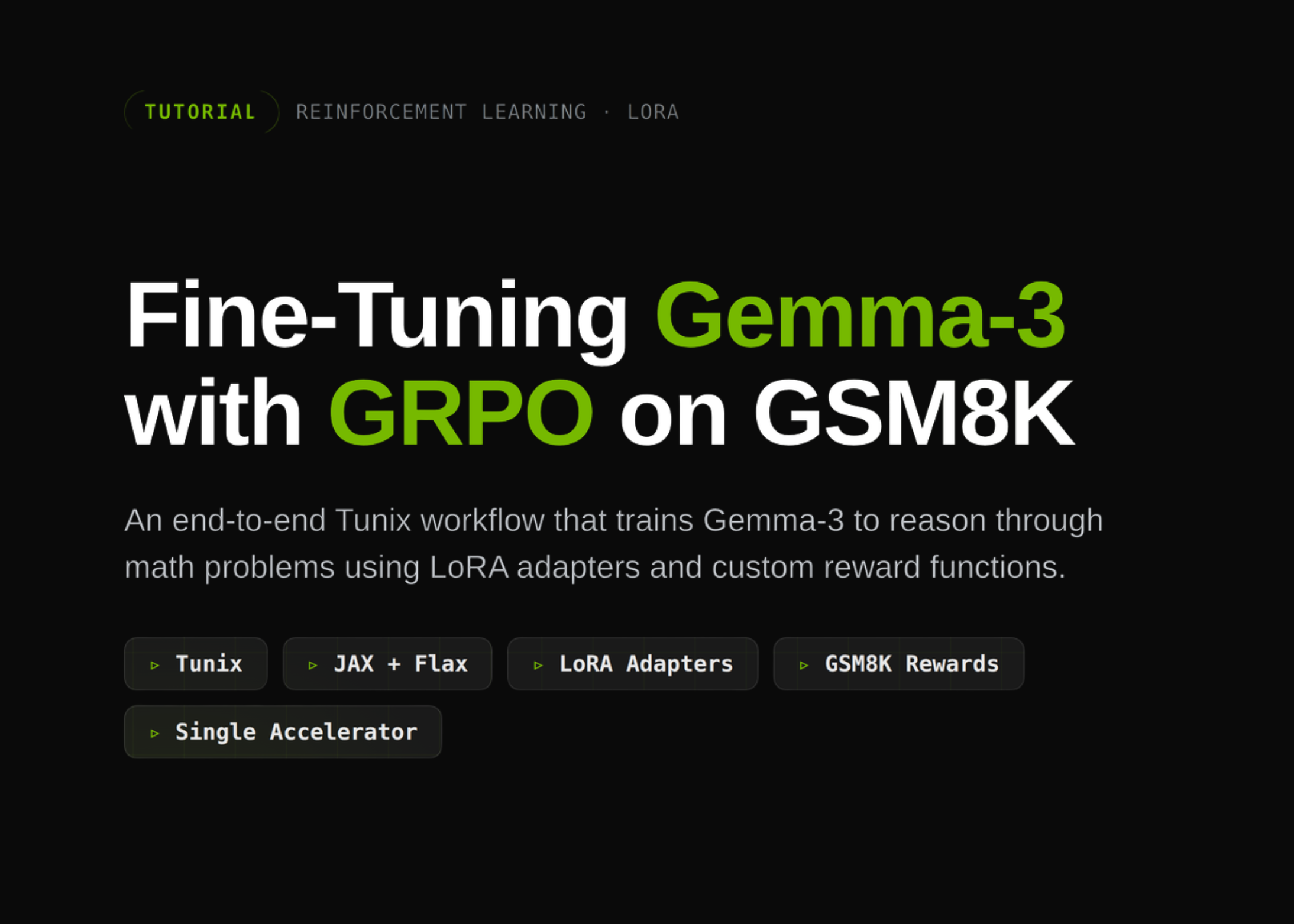
A full training workflow now exists for Gemma-3 to solve structured math problems using a combination of Tunix’s Group Reward Policy Optimization (GRPO), LoRA adapters, and specialized rewards from the GSM8K benchmark. The process starts with setting up the environment and authenticating via Hugging Face, then loading Gemma-3 and formatting training examples into a prompt structure that guides reasoning before giving answers.
The training incorporates reward functions that evaluate both adherence to a strict format and the numeric correctness of solutions. LoRA adapters attach during training to keep the fine-tuning process lightweight, avoiding the computational cost of retraining all model weights. The method benchmarks an initial baseline, then runs GRPO to iteratively improve the policy by sampling groups of reasoning steps and answers that maximize the defined rewards. There is also a step to export the merged model optionally.
Why builders should care
This approach delivers a practical path to teaching large language models rigorous step-by-step reasoning on math tasks with manageable compute overhead. By combining GRPO with LoRA adapters, it reduces the cost and complexity of training while targeting structured outputs rather than open-ended text, which commonly challenge standard supervised fine-tuning.
The dual reward signals push the model to not only produce correct answers but to maintain a strict reasoning format. That can be crucial for builders who want high confidence in model-generated workflows or explanations in math or logic-heavy domains. This workflow also shows how to connect Hugging Face tools and workflows for end-to-end reinforcement learning of policies, a template that can extend to other reasoning tasks.
The practical takeaway
Builders aiming to improve model reasoning on complex, logically structured tasks can adopt GRPO with LoRA adapters to make training practical and effective. The code walkthrough and reward setup provide a reusable guide for math reasoning improvement. Success here could translate into better toolkits for automation, tutoring, or any application that requires precise multi-step calculations and explanations from models.
Since the cost and technical demands stay relatively low via adapters and policy optimization, smaller teams may explore reinforcement learning techniques previously limited to larger AI labs.
What to watch next
Watch for how this approach adapts to other structured reasoning benchmarks beyond GSM8K and whether different reward schemes push accuracy even higher. See if the community develops more streamlined tools around Tunix’s GRPO and LoRA that make customized RL fine-tuning accessible.
It will also be important to track whether these methods improve model reliability during real user interactions and in safety-critical domains. How well the math reasoning trained via this method integrates into larger workflows or production systems remains a practical question for adopters.
AI Quick Briefs Editorial Desk