Meituan Releases LongCat-2.0: A 1.6T-Parameter Open MoE Model with Native 1M Context and LongCat Sparse Att…
What it does
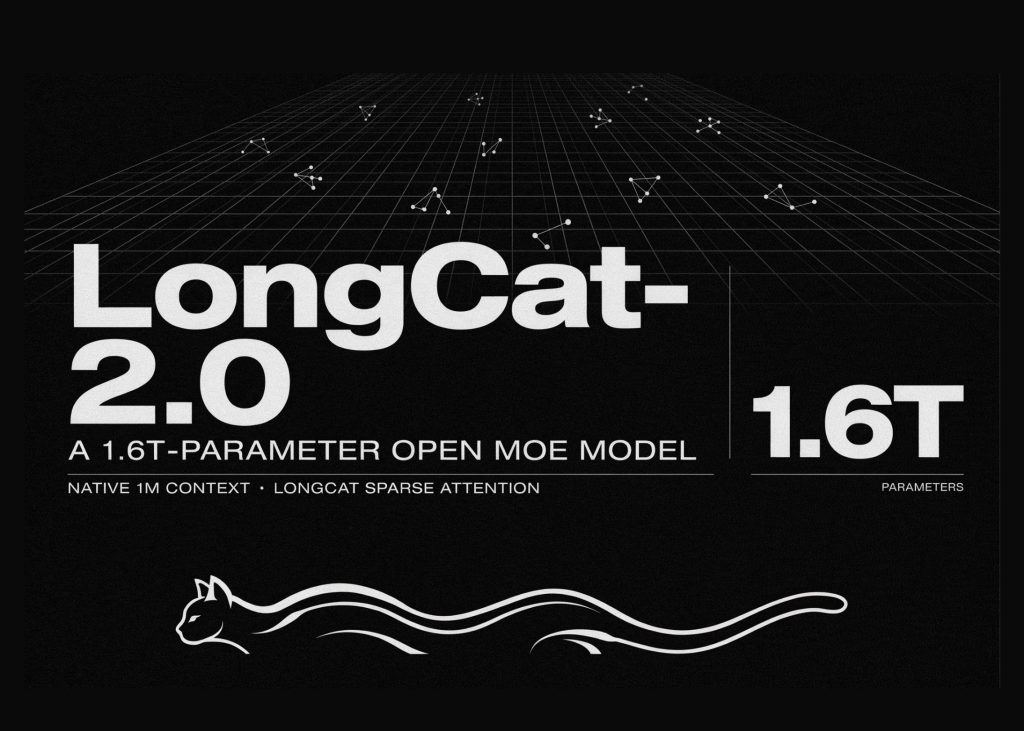
Meituan has launched LongCat-2.0, a massive 1.6 trillion-parameter Mixture-of-Experts (MoE) model. Unlike traditional dense models, LongCat-2.0 activates roughly 48 billion parameters per token, making it more compute-efficient during inference. It features a native 1-million-token context window enabled by LongCat Sparse Attention, designed to handle ultra-long sequences natively. The entire training and serving pipeline runs on China-made AI ASIC superpods, promising optimized performance with domestic hardware. Meituan also opened API access for developers to integrate this technology.
Why it matters
LongCat-2.0 pushes context length far beyond the million-token mark, a scale few models have tackled effectively. For operators and builders working on tasks requiring massive context—like analyzing extensive documents, logs, or multimedia streams—the ability to handle 1 million tokens natively means fewer workarounds such as chopping inputs into smaller chunks or stitching partial results. The use of sparse attention helps control compute costs which normally explode with context length, making it feasible to deploy long-context models in production.
This model also demonstrates significant progress in using MoE architectures at massive scale while filtering activation to a subset of experts. Activating 48 billion parameters per token suggests a sweet spot between capacity and efficiency, which could influence cost and performance tradeoffs for enterprises considering massive models in mission-critical applications.
Meituan’s choice to run everything on in-country AI ASIC superpods reinforces China’s drive for AI hardware sovereignty. This might affect international AI hardware and cloud vendors by raising the bar for localized integrated platforms with custom accelerators.
Who it is for
Developers and businesses with intensive long-range sequence demands stand to gain the most. Use cases in large-scale document analysis, legal tech, multi-hour audio/video transcription, and complex event monitoring could leverage LongCat-2.0’s huge context window to reduce fragmentation and loss of context. Cloud providers and AI infrastructure companies also need to note the model’s efficiency claims as it affects hardware utilization profiles and pricing models.
Investors and market watchers tracking Chinese AI scale efforts should see this as a significant bump in local AI capability, potentially shifting competitive dynamics in open MoE models.
The catch
Reported benchmarks and capabilities come from Meituan, with no independent third-party verification yet. Sparse attention and MoE models are complex and often struggle with stability, serving latency, and scaling outside labs. Real-world cost savings and latency improvements remain to be demonstrated under widely variable workloads.
The massive 1-million token context is impressive but calls for specialized tuning and possibly bespoke infrastructure. That raises integration costs and operational risks for businesses hoping to adopt the tech quickly.
Finally, API access will determine how widely and easily developers can try these features. Without open, well-documented APIs, adoption may be limited to larger players already embedded in Meituan’s ecosystem.
What to watch next
Look for independent benchmarks or real-world deployment stories confirming LongCat-2.0’s efficiency and context-length claims. Monitor how Meituan’s model compares in latency and cost to similarly sized models from global players.
Also watch how developers use the million-token context window in production workloads—whether it unlocks new applications or just adds complexity. Pay attention to Meituan’s API rollout and ecosystem-building efforts for signs of broader accessibility.
Hardware remains key. Follow domestic AI ASIC developments tied to LongCat and see if this fuels tighter tech cycles or competitive responses from established GPU cloud vendors.
AI Quick Briefs Editorial Desk


