Building a Stable Fable 5 Traces Workflow in Colab: Parsing Tool Calls, Auditing Data, and Training Baselines
What changed
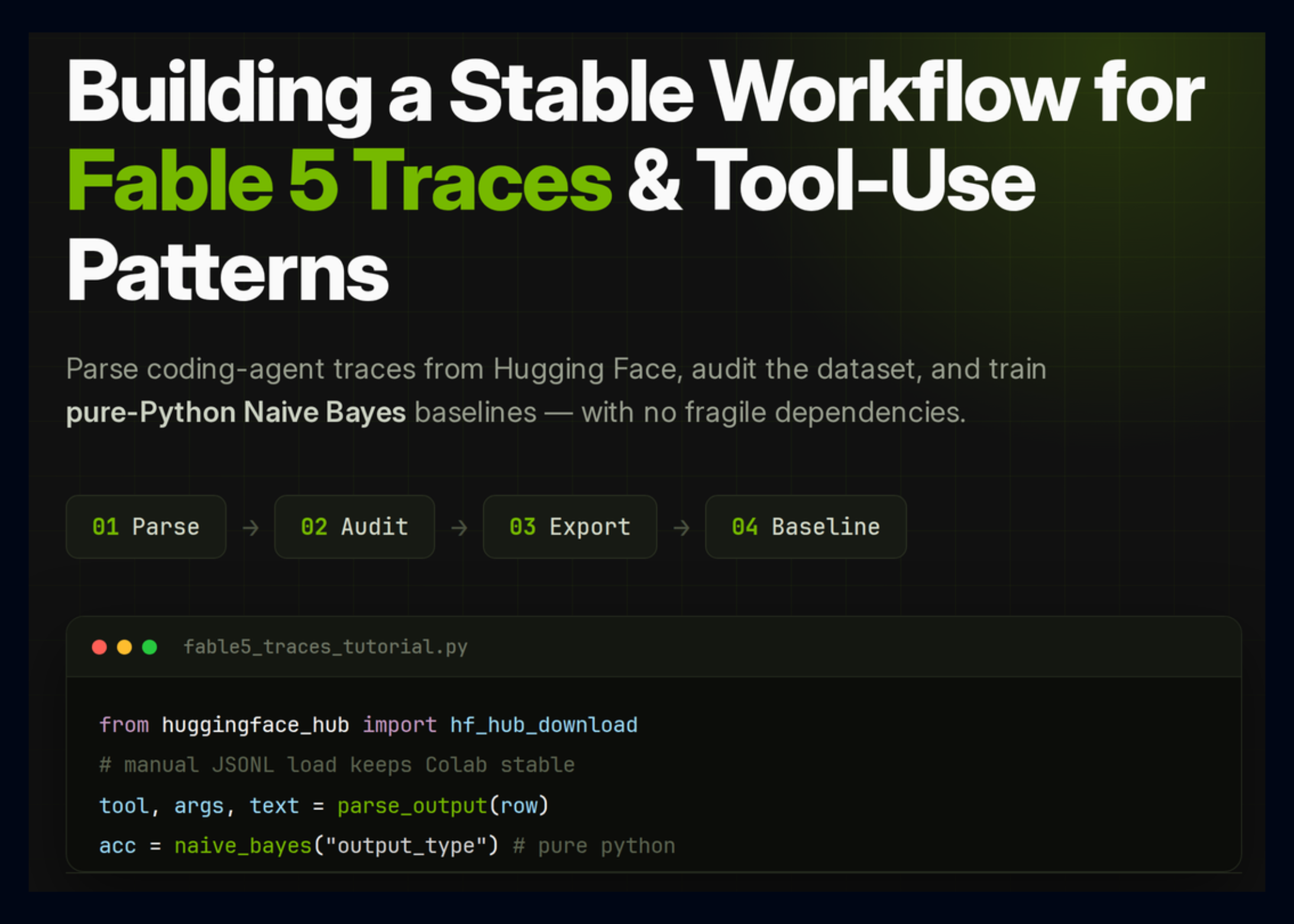
A stable workflow was built around the Fable 5 Traces dataset using Colab, avoiding fragile dependencies that often break in notebook environments. The process involved manually parsing the merged JSONL file instead of relying on brittle tools. The team inspected repository files to understand the data structure, normalized tool calls for consistency, audited overall dataset structure, redacted sensitive information, and visualized key data distributions. They also exported chat datasets without chain-of-thought prompts to ensure data safety. Finally, pure-Python Naive Bayes baselines were trained directly on the traces to establish benchmark models.
Why builders should care
The reliance on fragile dependencies or complex prebuilt loaders can quickly undermine productivity in Colab, which is a popular, accessible environment for developers. By manually parsing and auditing the dataset, the workflow makes the dataset more reliable and less prone to breaking. Normalizing tool calls and redacting secrets improves data quality and safety, which is critical when handling large datasets with potential hidden tokens. Training simple Naive Bayes baselines in pure Python offers a baseline for comparison without complex machine learning frameworks, making it easier for practitioners to iterate and build on the dataset.
The practical takeaway
Operators working with large trace or chat datasets should avoid overly complex pipeline dependencies that threaten stability in ephemeral environments like Colab. Manually parsing input files, auditing data integrity, and cleaning sensitive information upfront reduces unexpected errors and security risks. Establishing pure Python baselines allows faster prototyping and clearer understanding of the data’s predictive power. This approach saves time spent troubleshooting dependencies and debugging fragile imports or functions. It also establishes a transparent workflow for dataset inspectors, enhancing confidence in dataset quality and safety.
What to watch next
Look for further tool developments that simplify dataset parsing and auditing without adding new fragile layers. The Fable 5 Traces workflow could influence best practices on handling large JSONL datasets for AI training and evaluation. Watch for expansions of these simple baselines into more robust models or wider standardization around tool call normalization across datasets. Improvements to automate detection and redaction of secrets in public data sources would also be valuable for lowering operational risks when using real-world traces for AI model training.
AI Quick Briefs Editorial Desk