VibeThinker-3B: A 3B Dense Reasoning Model Built on Qwen2.5-Coder-3B With the Spectrum-to-Signal Post-Train…
What it does
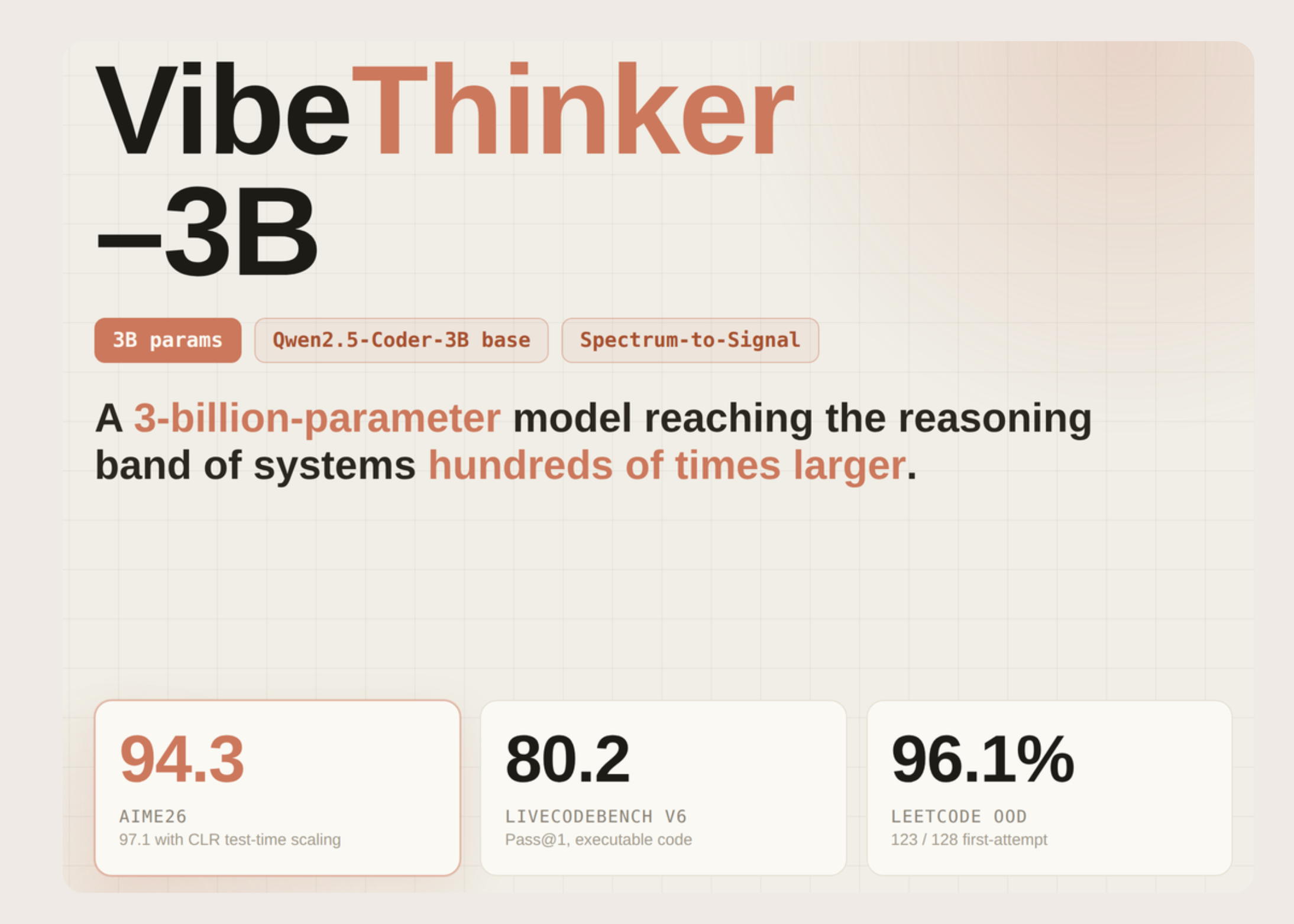
VibeThinker-3B is a 3 billion parameter dense reasoning model built directly on Qwen2.5-Coder-3B. It uses a Spectrum-to-Signal post-training pipeline to enhance its reasoning capabilities. Under an MIT license, this model matches or exceeds performance levels of peer models like DeepSeek V3.2 and Kimi K2.5 on verifiable public benchmarks. The approach focuses on refining model outputs by converting broad-spectrum data into clearer, signal-like forms that strengthen logical reasoning and task completion.
Why it matters
For AI builders and organizations needing strong reasoning without the cost or complexity of massive models, VibeThinker-3B offers a practical option. It lowers entry barriers by combining open licensing and efficient training methods while keeping competitive accuracy. This makes it easier to integrate costly reasoning functions into smaller deployments, edge devices, and cost-sensitive applications. Its competitive edge against similarly sized models means teams won’t have to sacrifice quality for size or license openness.
Who it is for
VibeThinker-3B targets developers, startups, and enterprises looking for a reliable, compact reasoning AI that can handle complex tasks in coding, analysis, and decision support. Since it is released under an MIT license, it also suits those aiming for customizable and extensible open-source AI solutions. Builders needing strong, dense reasoning at moderate scale will find this model a useful resource, especially for workflows constrained by compute or licensing costs.
The catch
This model’s efficacy depends on the Spectrum-to-Signal post-training, which may complicate adaptation for teams unfamiliar with this method. Adoption requires a solid understanding of dense model architectures and potentially non-trivial engineering effort to integrate the spectrum conversion pipeline effectively. Its focus on matching specific benchmarks means real-world performance might vary, especially in domains not covered by those measures.
What to watch next
Further benchmarking across diverse tasks will reveal if VibeThinker-3B can maintain its standing in broader operational settings. Also, watch for community uptake given its MIT license and potential forks or improvements. How the Spectrum-to-Signal post-training method evolves and whether it extends to larger or smaller parameter models will indicate if this technique becomes a new standard for dense reasoning AI.
AI Quick Briefs Editorial Desk