How to Build Memory-Efficient Transformers with xFormers Using Packed Sequences, GQA, ALiBi, SwiGLU, and Ca…
What changed
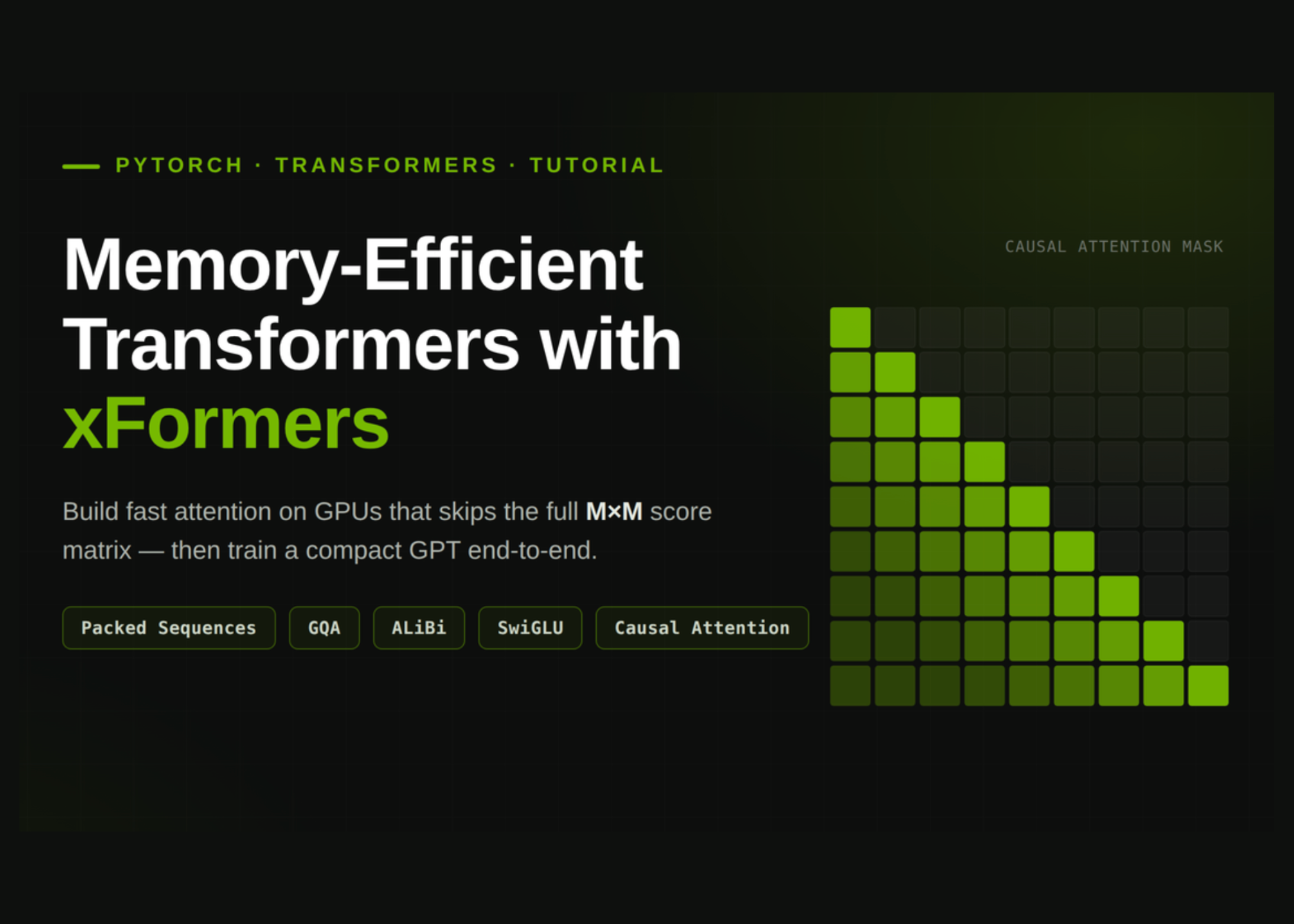
xFormers, a toolkit focused on delivering fast, memory-efficient Transformer models on GPUs, has demonstrated practical gains by integrating memory-saving techniques. The implementation verifies that optimized attention layers can perform comparably to standard ones but with notably lower memory use. Key features tested include causal masking for autoregressive models, packed variable-length sequences for efficient batching, grouped-query attention (GQA) to reduce compute overhead, and custom ALiBi positional biases to improve sequence length generalization. The toolkit also incorporates SwiGLU activation layers and automatic mixed-precision training to maximize speed and resource efficiency in GPT-style architectures.
Why builders should care
Transformers are at the heart of many AI applications but consume vast GPU memory, limiting batch sizes and sequence lengths. xFormers offers practical memory reduction techniques that ease these bottlenecks without sacrificing model fidelity. Efficient packing of variable-length sequences lets builders maximize GPU usage when working with diverse data. Causal masking support preserves compatibility for autoregressive tasks like language generation. GQA lowers query-key attention costs, freeing resources for deeper or wider models. Integrating ALiBi biases helps models handle longer sequences, addressing a common challenge. SwiGLU layers provide better performance per parameter, aligning with modern Transformer architectures.
The practical takeaway
Operators and developers running large-scale Transformer models can squeeze more throughput and longer context windows from existing GPU hardware with xFormers’ memory-efficient building blocks. This lowers costs by reducing peak memory demand and speeding training and inference. Experimenting with packed sequences and GQA lets teams customize trade-offs between speed, memory use, and model complexity. ALiBi support means models trained with xFormers can generalize to longer inputs without retraining from scratch. The combined use of these techniques in a trainable GPT model proves the approach is production-ready, not just experimental.
What to watch next
Watch for xFormers to influence broader Transformer tooling and libraries by setting a standard for memory-conscious design. As model sizes and context lengths continue to grow, adopting techniques demonstrated in xFormers may become essential. Builders will likely monitor further improvements in attention mechanisms, positional encoding strategies, and activation functions to push boundaries on GPUs without multiplying hardware costs. Integration with cloud AI platforms and training frameworks will signal xFormers’ move from a niche developer resource to a mainstream performance and cost lever.
AI Quick Briefs Editorial Desk