Meet Qwen-RobotSuite: Three Embodied AI Models for VLA Manipulation, Video World Modeling, and Navigation
What it does
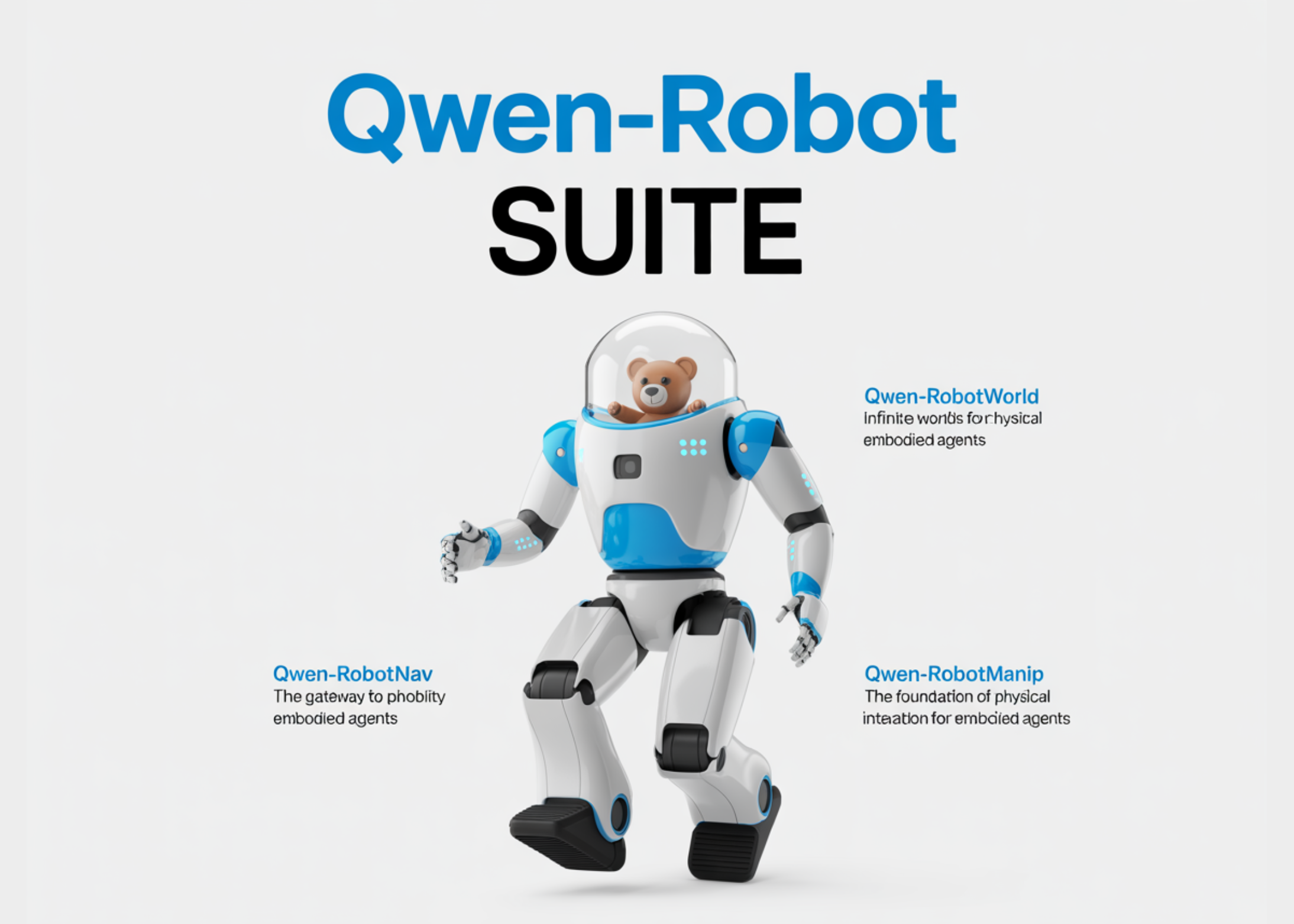
Qwen-RobotSuite delivers three new embodied AI models focused on real-world tasks involving vision, language, and action. RobotManip is a Vision-Language-Action (VLA) model built on Qwen3.5-4B optimized for precise manipulation tasks. RobotWorld uses a language-conditioned video model powered by a 60-layer Multi-Modal Dense Transformer (MMDiT) to understand and predict dynamic environments. RobotNav targets navigation challenges, scaling across three Qwen3-VL sizes—2B, 4B, and 8B parameters—to provide adaptable robotic movement and pathfinding capabilities. Each model integrates unique architectural features and extensive data pipelines to address specific embodied AI problems.
Why it matters
Qwen-RobotSuite moves beyond static image or text understanding by combining vision, language, and action in robotic contexts. For builders and operators, this translates into more capable AI systems that can grasp spoken or written commands, interpret complex visual surroundings, and execute physical tasks. This reduces the gap between language-grounded AI research and deployable robots, potentially cutting development time and improving task reliability. The modular approach allows choosing the right model size and architecture for distinct applications, from fine manipulation to environment modeling to navigation. It pressures existing embodied AI solutions by raising the expectations for multi-modal integration and scalability.
Who it is for
Developers building robots for manufacturing, logistics, or service roles will find these models useful for enhancing task-level autonomy with language interfaces. Research teams working on real-time environment understanding can leverage RobotWorld to better simulate and predict physical scenarios. Startups and integrators aiming to deploy practical robotics with natural language input benefit from RobotManip’s manipulation focus and RobotNav’s navigation options, especially where adapting to new tasks or environments is essential. The range of model sizes caters to various hardware constraints and performance goals.
The catch
Qwen-RobotSuite models are still research-grade, with complexity that may require significant computational resources to train and deploy effectively. The reliance on large parameter counts means hardware costs and response latency might limit real-time use cases in smaller or cost-sensitive setups. Integration into existing robotic systems may also demand non-trivial engineering effort for sensor alignment and task-specific tuning. While benchmark results show promise, real-world robustness and adaptability across diverse conditions remain unproven at scale.
What to watch next
Monitor how Qwen-RobotSuite’s components evolve toward lightweight versions or more accessible toolkits for integration. Watch for demonstration projects highlighting cross-domain success—such as combining manipulation, navigation, and environment modeling in a single robotic system. Stay alert for ecosystem support like APIs, data pipelines, or compatibility improvements that ease adoption. Competitors’ responses focusing on multi-modal robotic AI at similar or smaller scales will reveal whether Qwen-RobotSuite pushes embodied AI standards or simply adds noise. Practical deployment stories will clarify the real operator gains from these new models.
AI Quick Briefs Editorial Desk