Why Do LLMs Corrupt Your Documents When You Delegate?
Quick take
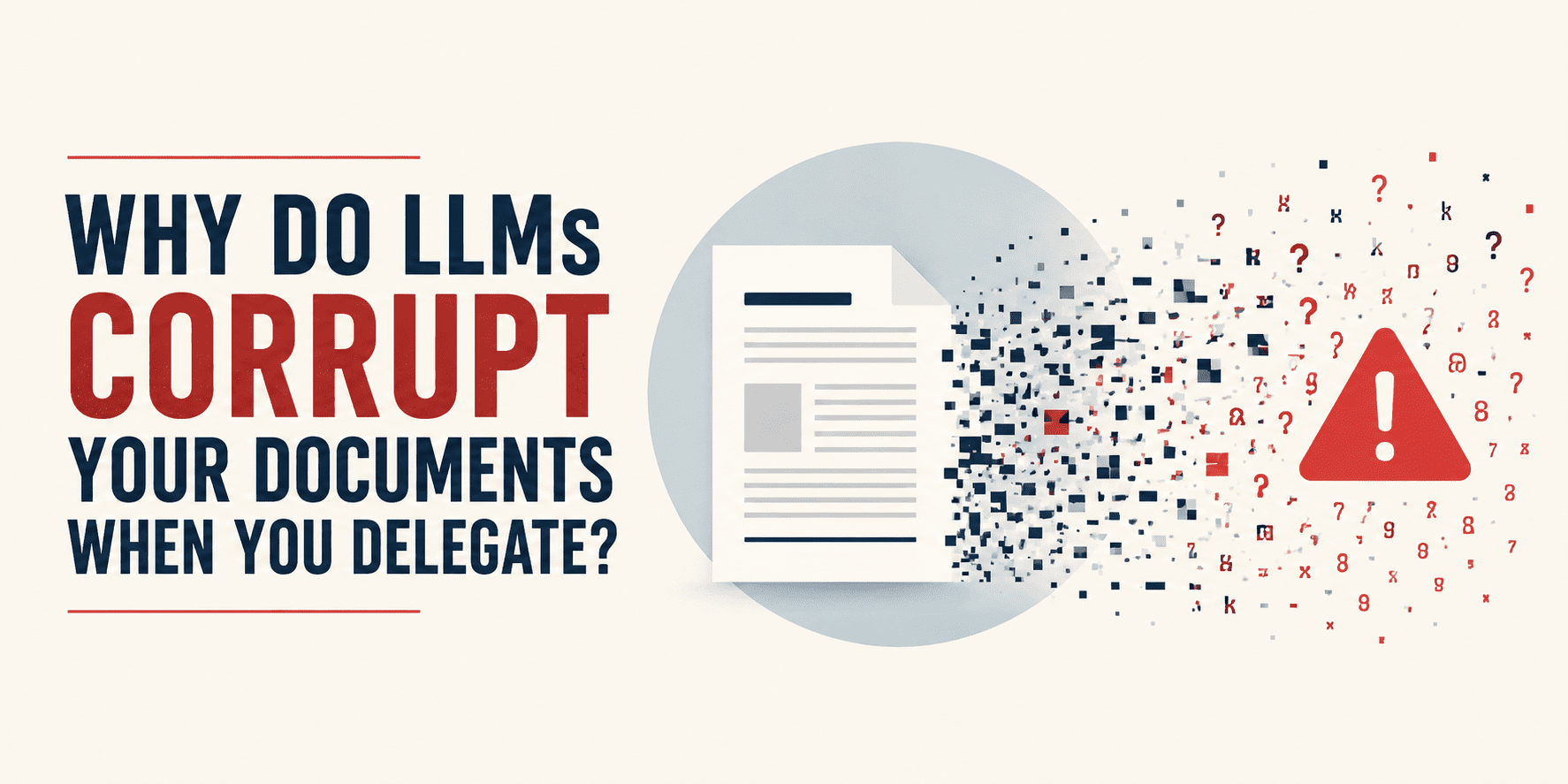
Large language models (LLMs) often introduce unseen errors when tasked with complex document editing. This structural content decay happens because LLMs are natural language generators, not document-aware editors. They can break formatting, shuffle or omit content, and lose context as they rewrite sections, especially on longer or multi-layered documents.
Why it matters
Relying blindly on LLMs to edit or rewrite complex documents risks corrupting the intended logical and visual structure. This raises operational friction for anyone needing clean, professional, consistent documents—marketers, legal teams, technical writers, and knowledge managers. It forces human reviewers to spend hours correcting LLM changes, which slows workflows and inflates labor costs. It can also lower trust in automation when documents contain unexplained errors or misalignments.
The problem deepens with more complex delegated tasks. LLMs struggle to preserve nested hierarchies and specific formatting because they generate text token by token without an internal model of document architecture. They also face a trade-off between creativity and fidelity, frequently prioritizing rephrasing or simplification over structural precision. Operators need to adjust expectations or supplement LLM pipelines with deterministic post-processing or validation tools.
This underlines a key challenge: using LLMs as collaborative editors demands added controls and domain expertise to maintain document integrity. Blind delegation without checkpoints weakens quality and reliability, nudging operators toward hybrid human-AI workflows that separate creative regeneration from exacting structural edits.
AI Quick Briefs Editorial Desk