ClawHub Security Signals: A Coding Guide to End-to-End Security Signal Analysis and Verdict Classification …
What changed
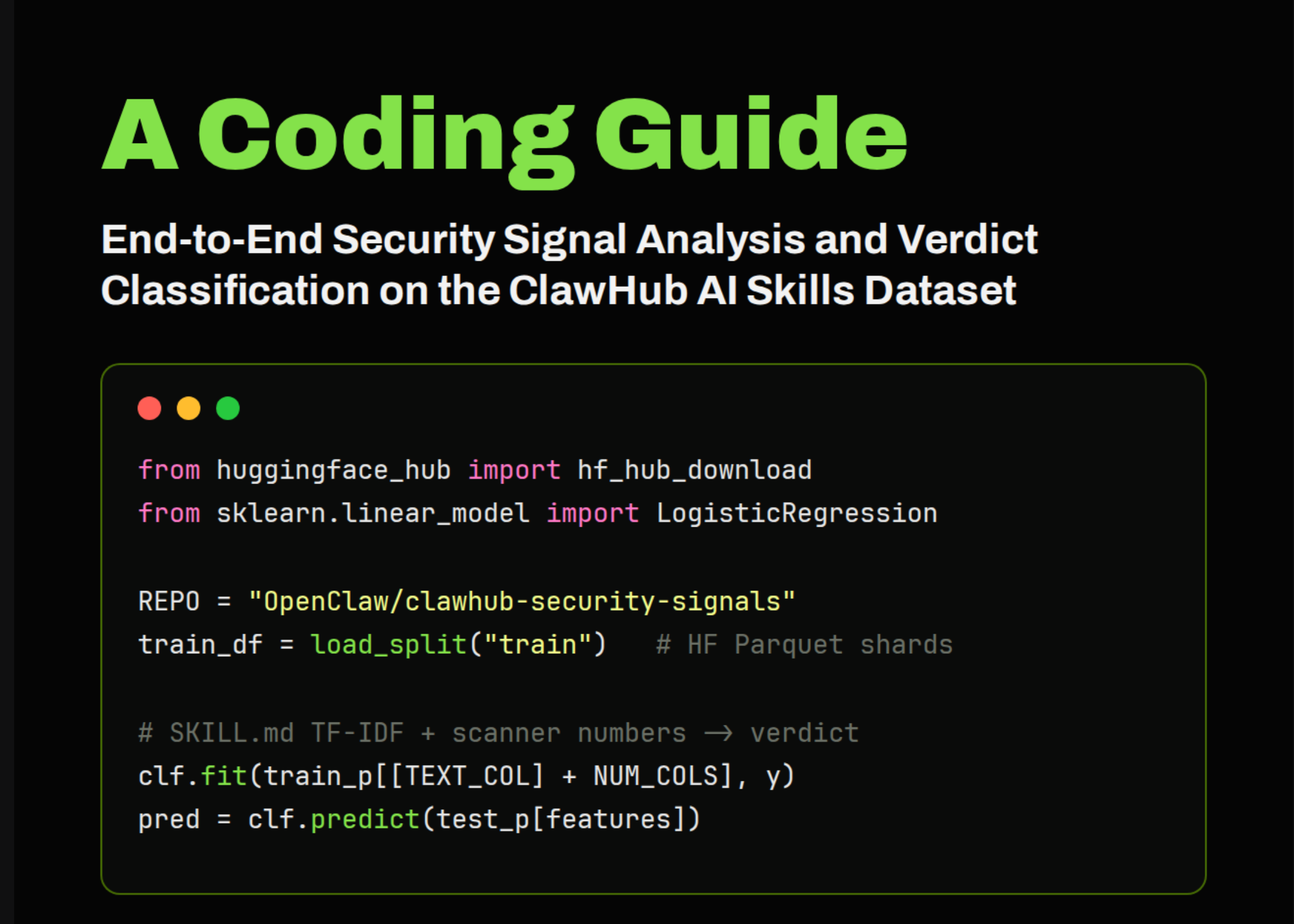
ClawHub introduced a coding workflow to analyze security signals on an AI skills dataset. This involved loading structured data from Hugging Face, inspecting verdicts and severity labels from multiple security scanners, and quantifying their agreement using Jaccard and Cohen’s kappa metrics. The study then combined static signals and textual data from SKILL.md files to train a logistic regression model aimed at predicting ClawScan verdicts. This end-to-end approach unites diverse signal sources with machine learning to better classify AI skill security risks.
Why builders should care
This work exposes how different scanners overlap and clash when evaluating AI skill sets for security threats. Static analysis, VirusTotal results, and SkillSpector outputs often disagree, highlighting the difficulty of consistent threat detection in AI components. By combining textual content from skill definitions with scanner verdicts, this approach improves classification accuracy, suggesting hybrid methods can reduce false positives and false negatives. Builders working on AI marketplaces, skill repositories, or security tooling can leverage these insights to prioritize signals and enhance detection pipelines.
The practical takeaway
Implementing multi-signal fusion with logistic regression offers a concrete path to improve AI skill security classification. Instead of relying on single-source scanner verdicts, combining severity labels and skill metadata strengthens predictability. Operators running AI skill stores or automated security reviews can adopt this method to tighten protections without manual overhead. Tracking scanner disagreements using quantitative metrics also aids ongoing signal quality assessment, helping tune detection for evolving AI artifacts.
What to watch next
Look for future work expanding beyond logistic regression into more sophisticated models that integrate textual skill descriptions and security outputs. Also watch for tools packaging these analyses into automated scanners or dashboards tailored for AI skill marketplaces. Improvements in scanner consensus measurement and verdict explainability will be key as AI component ecosystems grow and new threat vectors emerge. Finally, observe how these methods influence vendor trust and marketplace policies around security labeling and AI skill certification.
AI Quick Briefs Editorial Desk