Meet Harness-1: A 20B Retrieval Subagent Trained With Reinforcement Learning Inside a Stateful Search Harne…
What changed
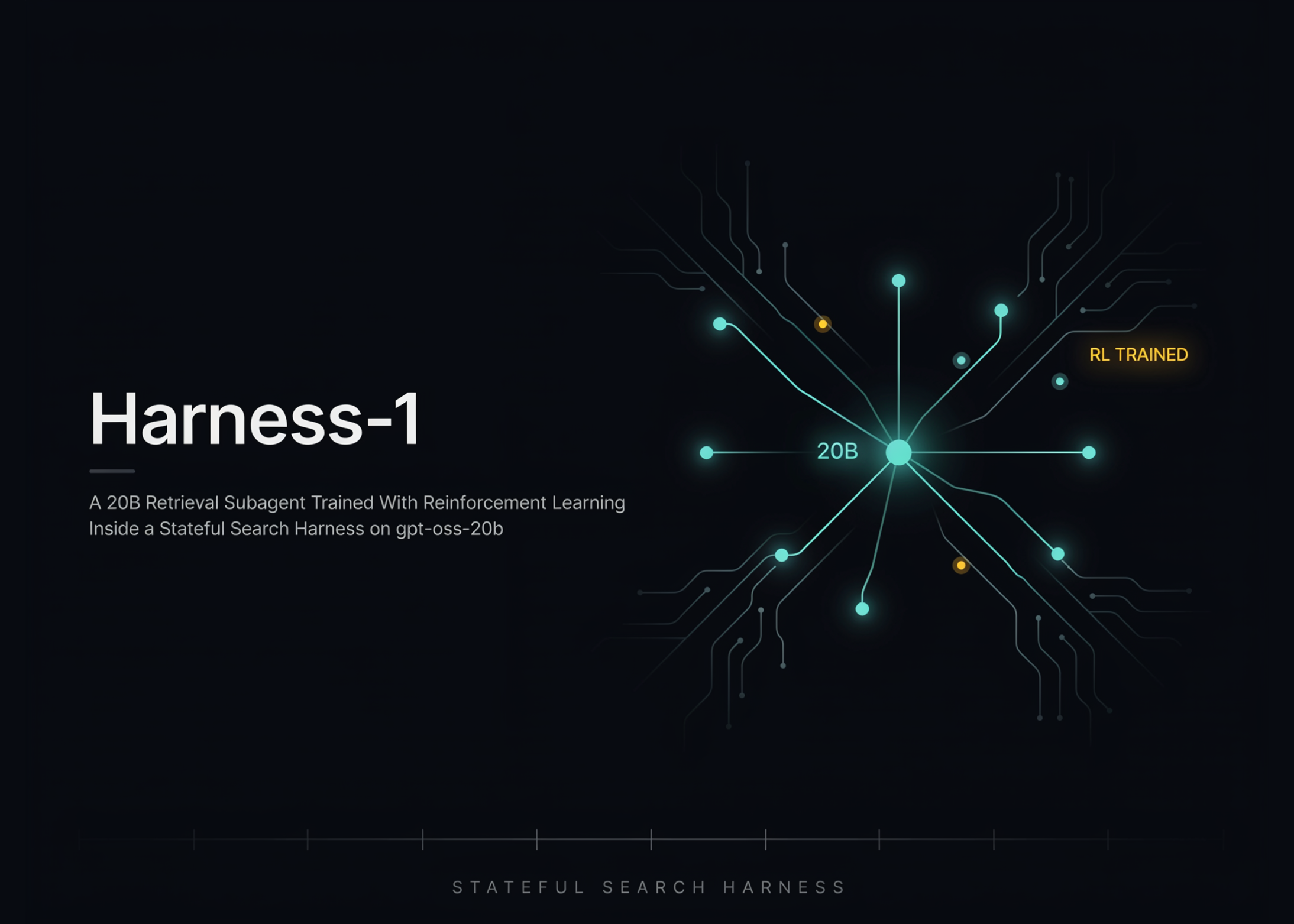
UIUC and Chroma released Harness-1, a 20 billion-parameter retrieval subagent trained with reinforcement learning inside a stateful search harness. The harness manages detailed bookkeeping like maintaining candidate pools, tagging important curated content, tracking evidence graphs, and recording verification steps. Its policy controls what to search, curate, verify, and when to halt the process. This setup pushes the retrieval subagent’s average curated recall to 0.730 across eight benchmarks, outperforming the next-best open agent by 11.4 points and trailing only Opus-4.6.
Why builders should care
Harness-1 offers a practical architecture that separates policy from state management, allowing more precise control over the search and curation workflow. For developers building retrieval-augmented systems, this means a new design pattern that improves accuracy while maintaining transparency on how information is verified and selected. The public release of both weights and harness code lowers the barrier to experimentation with stateful search systems that can learn to optimize retrieval policies over time.
The practical takeaway
Operators building knowledge-intensive applications will appreciate how Harness-1’s system codifies crucial operational tasks into a stateful module rather than relying on opaque, stateless querying. This approach can tighten information accuracy and reduce noise in retrieved outputs—key for customer-facing search, research assistants, or compliance tools requiring traceability. Harness-1 sets a new open baseline for reinforced retrieval agents, enabling more reliable evidence gathering in complex workflows.
What to watch next
Tracking the adoption of Harness-1’s open harness framework is essential since it may inspire competitors and startups to design retrieval agents with built-in state management and verification loops. Watch for integrations with other open language models and the development of richer curation strategies that further boost recall or precision. Also, see if this approach redefines benchmarks or becomes a building block for more general-purpose retrieval-augmented generation systems.
AI Quick Briefs Editorial Desk