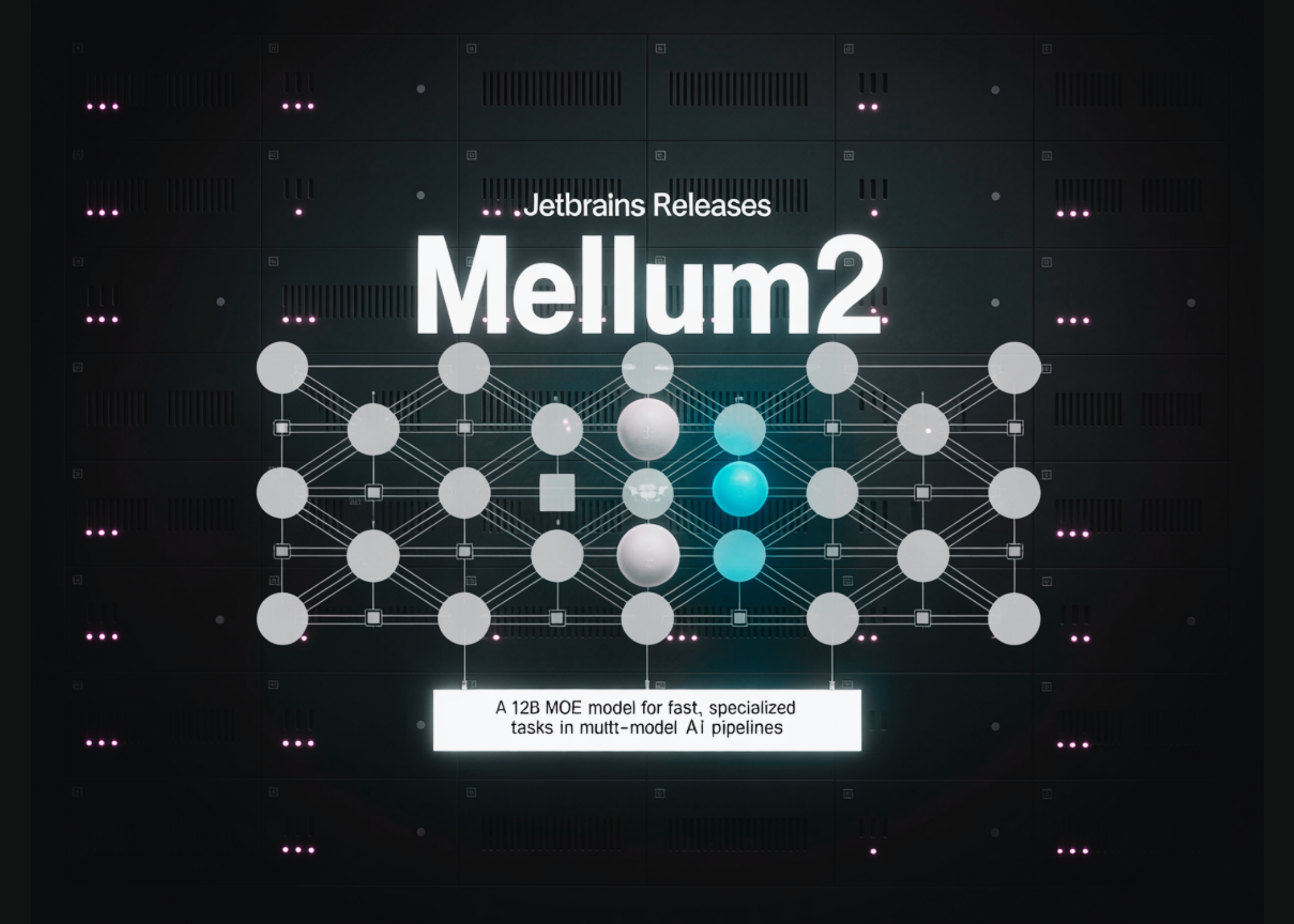
JetBrains Releases Mellum2: A 12B MoE Model for Fast, Specialized Tasks in Multi-Model AI Pipelines
What changed
JetBrains has released Mellum2, a 12 billion parameter mixture-of-experts (MoE) model, under the Apache 2.0 license. This model was trained on a massive dataset of 10.6 trillion tokens, positioning it as a powerful tool for AI workflows that require specialized and efficient task handling. Mellum2 is designed to be integrated within multi-model AI pipelines, enabling faster execution for specific tasks by activating only relevant expert sub-networks instead of a full dense model.
Why builders should care
Mellum2’s MoE architecture lets developers run large-scale models with a fraction of the computational cost typical of dense models with similar total parameters. This translates into faster inference and lower resource consumption for targeted tasks without sacrificing performance. Builders creating AI workflows can use Mellum2 to improve throughput and cost-efficiency, especially in setups where multiple specialized models collaborate. The Apache 2.0 license also allows commercial and open-source projects to adopt and modify the model freely, encouraging experimentation and integration.
The practical takeaway
Mellum2 offers a practical balance between model size and operational efficiency. By using a modular approach to enable only relevant experts, it can accelerate AI workloads that benefit from task specialization. For teams managing multi-model pipelines or constrained infrastructure, Mellum2 could reduce latency and cloud costs while maintaining high performance. Its training on 10.6 trillion tokens suggests broad language understanding, but the MoE design means it can ramp up expertise in narrow domains faster than monolithic models.
What to watch next
Monitor Mellum2’s adoption in open-source AI frameworks and how it performs in real-world benchmark tests against dense parametric models of similar size. Look for case studies on cost savings and latency improvements in multi-model pipelines. The impact of licensing under Apache 2.0 could prompt more contributors to build derivatives or enhance the model’s capabilities. Finally, watch how the MoE approach competes with other efficiency techniques gaining traction in the AI space.
AI Quick Briefs Editorial Desk