Prompt Engineering vs Loop Engineering vs Graph Engineering: What Changes at Each Layer
Quick take
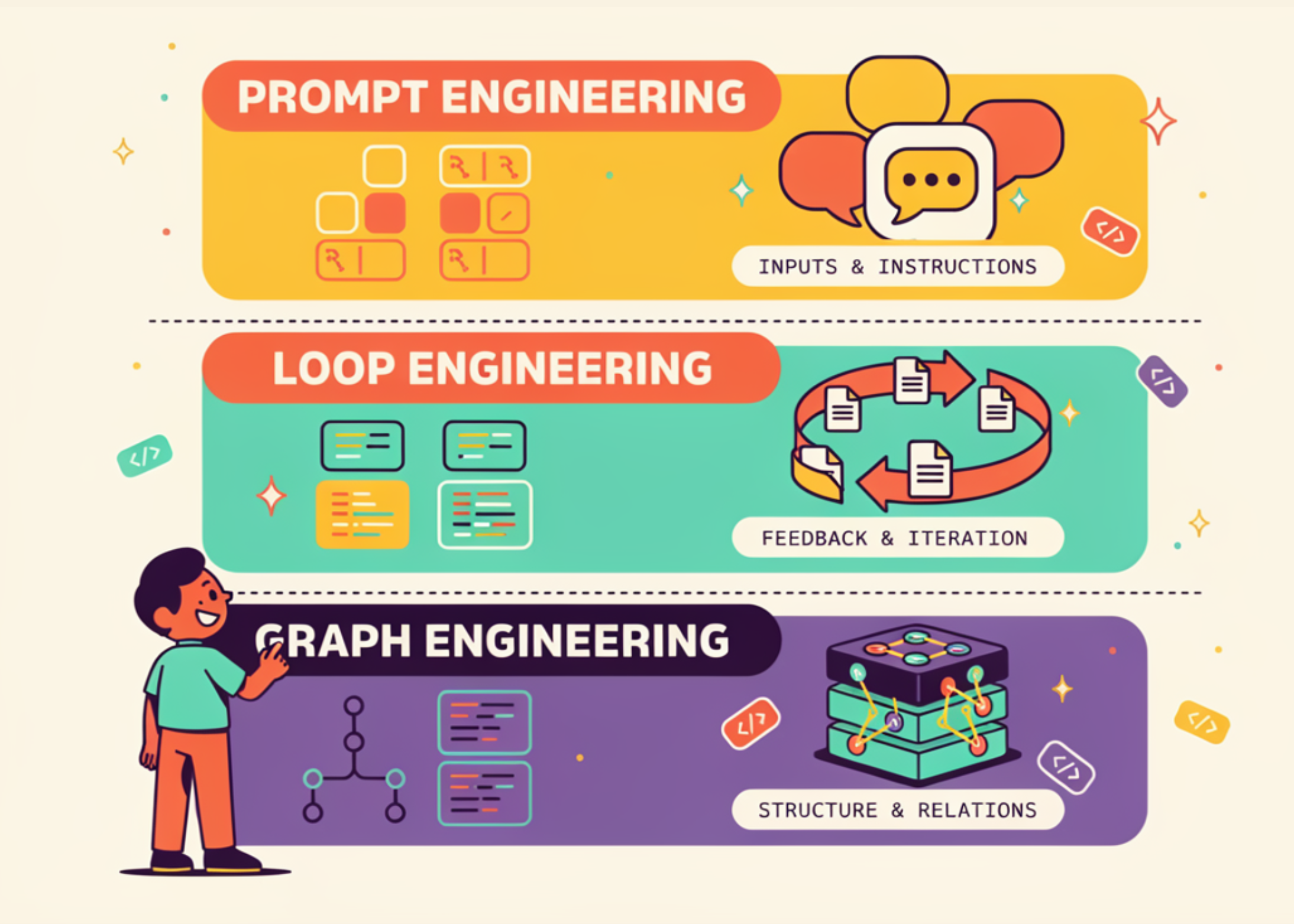
Prompt engineering, loop engineering, and graph engineering are three distinct terms that now overlap in AI job descriptions. Prompt engineering is the oldest and most established method, focusing on crafting inputs that guide AI models to produce desired outputs. Loop engineering, emerging in late 2025 and dominating discussions through mid-2026, introduces active feedback cycles where AI outputs are refined continuously by feeding information back into the model. Graph engineering surfaced about six weeks after loop engineering and builds on representing data and AI processes as interconnected nodes, allowing for more complex reasoning or workflows.
These terms often get mixed up but represent different layers of AI interaction. Prompt engineering works at the input level, shaping how a single AI call behaves. Loop engineering adds a layer of iteration, managing multiple steps of refinement or complex workflows through repeated interaction. Graph engineering structures AI operations as relational data flows, enabling more sophisticated orchestration and bridging AI with knowledge systems or automation pipelines.
Why it matters
Understanding these distinctions clarifies what companies aim to hire for and what skills builders need. Prompt engineering still matters for frontline AI interaction design, influencing quality and creativity of outputs. Loop engineering changes how AI is integrated into workflows by automating iterative improvements, making AI outputs more reliable and adaptable. Graph engineering raises the bar, especially for complex AI systems requiring relationships between data points and multi-step decision logic.
For operators and founders, mixing these terms risks mismatched expectations. Hiring for prompt engineering will get a different focus than seeking loop or graph engineering skills. Mislabeling may lead to gaps in product development or wasted effort chasing the wrong tool or process layer. Investors and operators should note that AI is moving beyond single prompt design to more complex lifecycle and relational engineering, which affects deployment timelines and talent sourcing.
The practical takeaway
Prompt engineering remains essential for direct AI interaction and input crafting. Loop engineering makes AI workflows repeatable and self-improving. Graph engineering supports building AI systems able to navigate networks of data and steps at scale. Those building AI products should map their needs to these layers clearly: use prompt engineering for tuning single prompts, loop engineering when outputs require iteration or feedback, and graph engineering when handling structured, multi-node logic.
Getting this layering right will save time on tooling choices, reduce hiring headaches, and improve AI system robustness. It also signals an evolution in AI work that operators must track to avoid falling behind the sophistication curve in building AI-powered products or services.
What to watch next
Watch how job descriptions refine these terms to better separate responsibilities. Expect developer tooling to adapt with specialized support for loop and graph engineering, beyond classic prompt tuning tools. The growing adoption of graph-based AI platforms could accelerate workflows involving data connectivity and autonomous decision-making. Keep an eye on emerging training programs that specialize in loop and graph engineering processes, as they will address current talent gaps.
How rapidly organizations shift from pure prompt tactics to loop and graph engineering techniques will pressure recruitment, project scoping, and budget allocation in AI initiatives.
AI Quick Briefs Editorial Desk