Top 7 Coding Models You Can Run Locally in 2026
Quick take
Seven coding models stand out for running locally on GPUs in 2026, targeting developers who want private, fast, and versatile AI assistance. These models support private code generation, rapid inference using GGUF format, and workflows integrating agents for automation. Several also handle multimodal inputs, mixing code with images or text, expanding their utility beyond pure coding tasks.
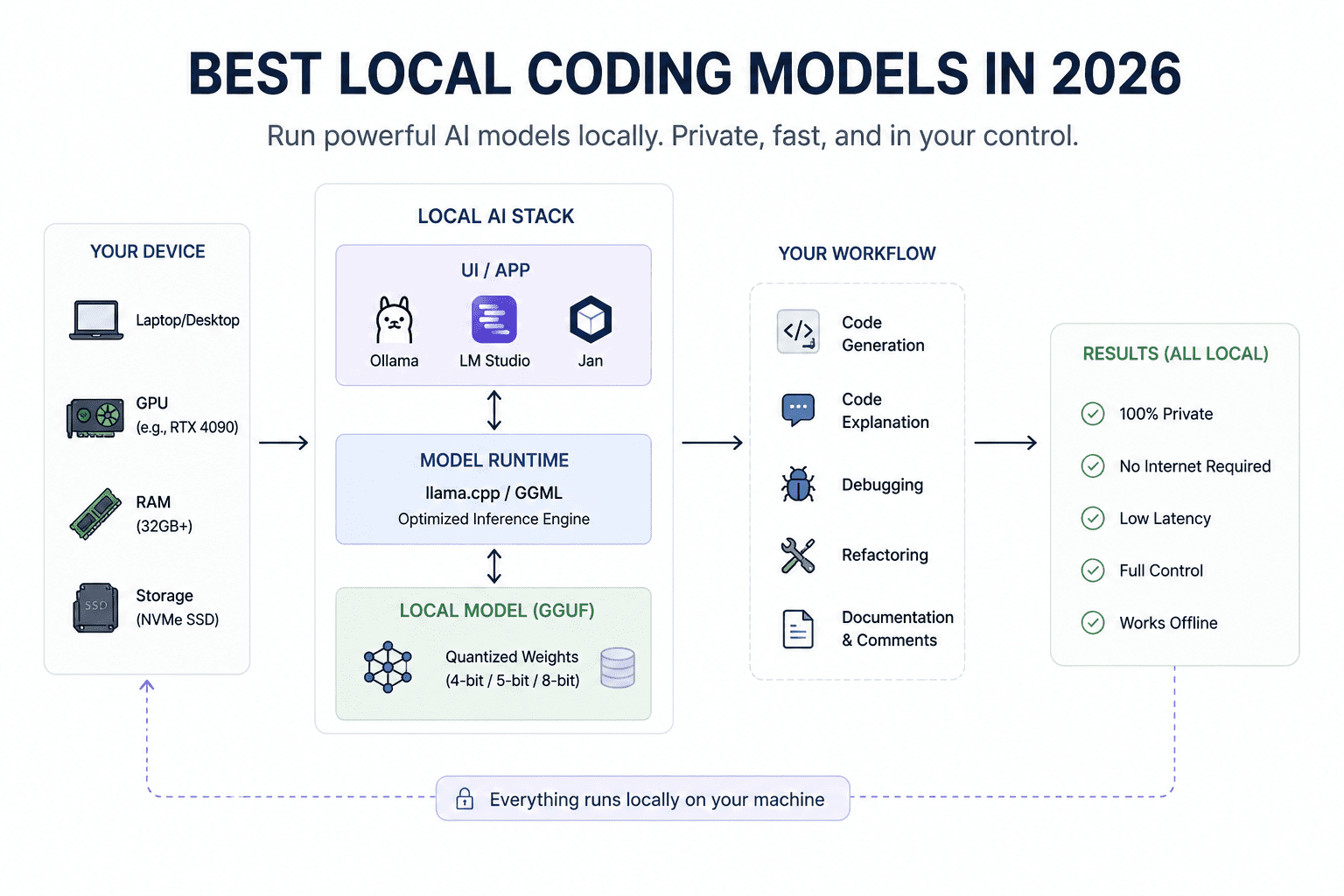
Local execution pushes back against reliance on cloud APIs that raise costs, slow iteration, or expose sensitive code. Running models locally via efficient formats like GGUF reduces latency and gives operators full control over data privacy and resource allocation. This shift strengthens developer autonomy and lowers operating expenses for teams building AI-powered developer tools or internal automation.
Most models in the list balance power with feasibility to run on a single GPU, not requiring sprawling cloud infrastructure. This includes open-source and community-backed options, which open doors to experimentation without vendor lock-in. Architectures supporting agentic workflows also speed task automation by combining multiple AI steps seamlessly, cutting overhead for developers who chain code generation, validation, testing, and deployment.
These coding models elevate practical AI adoption by aligning with the needs of builders who treat AI as a local resource. They signal that faster and more private AI coding assistance will likely become standard on developer workstations without depending on expensive or slow cloud calls. For businesses, this means tighter integration of AI with software pipelines at lower cost and higher reliability.
Why it matters
Local AI coding models change incentives around how developers build and deploy helpers. They reduce dependence on third-party APIs that are costly and introduce delays or privacy risks. Operators running AI on their own GPUs retain full control over sensitive intellectual property and data pipelines. This control tightens security while eliminating unpredictable variables like cloud outages or price hikes.
Faster local inference makes AI tools more responsive for real-time coding tasks, boosting developer productivity. Agentic workflows mean less manual coordination across multiple AI steps, automating complex software-building tasks end-to-end. Multimodal capabilities widen use cases, enabling AI to work with code alongside diagrams, screenshots, or documentation. That expands the scope of automation and support beyond text or pure code generation.
For businesses, the rise of locally runnable, open, fast coding models shifts the economics of AI integration. It lowers ongoing cloud costs and legal risks tied to sending code or data offsite. This raises the value of in-house AI operations teams and tools tailored specifically for sensitive or proprietary projects. At the same time, investing in hardware capable of supporting these models becomes a strategic decision for companies prioritizing AI-assisted development.