Retrieval vs. Memory in Agentic AI Systems
Quick take
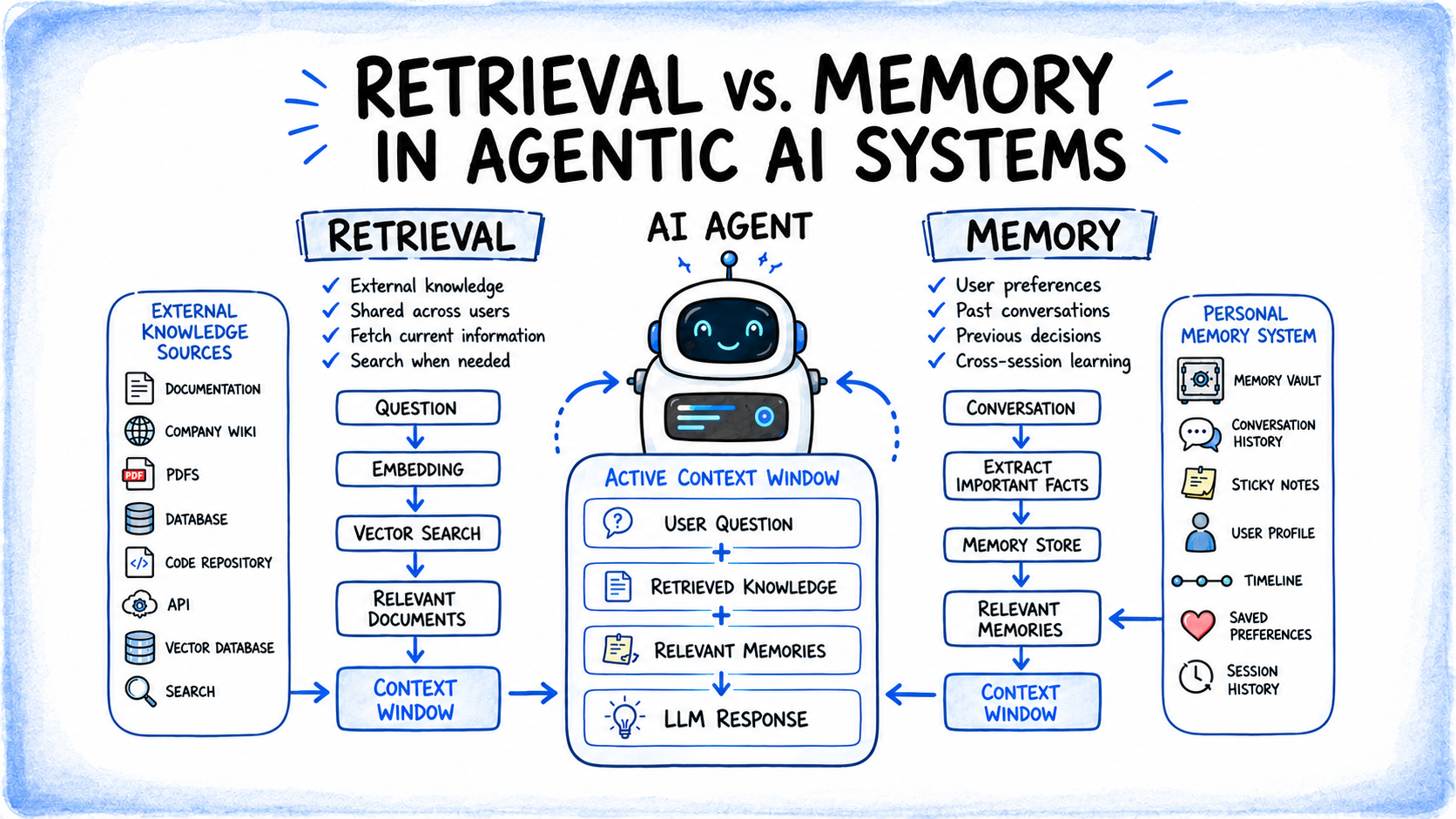
Retrieval and memory are two distinct but critical mechanisms in agentic AI systems, and understanding the difference can shape how these systems perform in real-world tasks. Retrieval means pulling relevant information from an external source such as databases or document stores in real time. Memory, by contrast, involves the AI holding and recalling facts or experiences internally over time to guide its behavior. Both play unique roles in decision-making and sustaining context.
Retrieval adapts the AI’s outputs dynamically by connecting it to updated or domain-specific knowledge outside its base model. Memory builds continuity and efficiency by letting the system remember what it has learned or encountered during previous interactions. Neither alone is sufficient for complex tasks, because retrieval without memory forgets past context, and memory without retrieval can become stale or narrow.
Why it matters
Operators and builders should note how retrieval and memory affect the responsiveness and relevance of agentic AI workflows. Retrieval boosts flexibility and precision by tapping external data, often necessary for current facts, legal regulations, or user-specific info. Memory supports consistency and personalization, making the agent more autonomous and context-aware across multiple steps or sessions.
Ignoring either leads to degraded performance and increased error rates. Relying only on memory makes the system less adaptable to new data or changing conditions. Depending solely on retrieval risks repetitive interactions and poor long-term planning when the agent lacks internal continuity. Balancing and integrating both enables smarter, faster, and more reliable AI agents capable of handling more complex business processes or user needs.
The practical takeaway
Start by clearly defining which information your AI must access externally versus what it should remember internally. Implement retrieval tools linked to up-to-date data sources to keep answers current and precise. Meanwhile, design memory architectures that capture relevant context and learning during interactions to reduce redundant queries and maintain coherence.
Test and tune both systems together since they interact: a well-structured memory can reduce unnecessary retrieval calls, lowering latency and costs. Effective retrieval enhances memory by feeding it fresh inputs to store. Consider hybrid designs that update memory with retrieved insights, creating an evolving knowledge base inside the agent.
The combination sharpens agent autonomy, improves user experience, and optimizes resource use across applications from customer support to process automation.
What to watch next
Focus on emerging frameworks and toolkits that explicitly support integrating retrieval with memory for agentic AI. See how industry leaders prioritize hybrid architectures in commercial agents and large-scale workflows. Watch for advances in memory management techniques that dynamically learn from retrieval results without bloating system complexity or response time.
Interest will grow in how this balance affects cost structures, especially in cloud-based AI services where retrieval calls can be expensive. Keep an eye on vendors offering turnkey solutions blending both capabilities, including options for fine-tuning memory to business rules and retrieval to specialized datasets.
Sharper distinctions and integrations between retrieval and memory will put pressure on AI providers to offer clearer configuration controls and performance benchmarks so users can optimize agents for their specific operational needs.
AI Quick Briefs Editorial Desk