RAG-Anything Tutorial: Build a Multimodal Retrieval Pipeline for Text, Tables, Equations, and Images in Colab
What changed
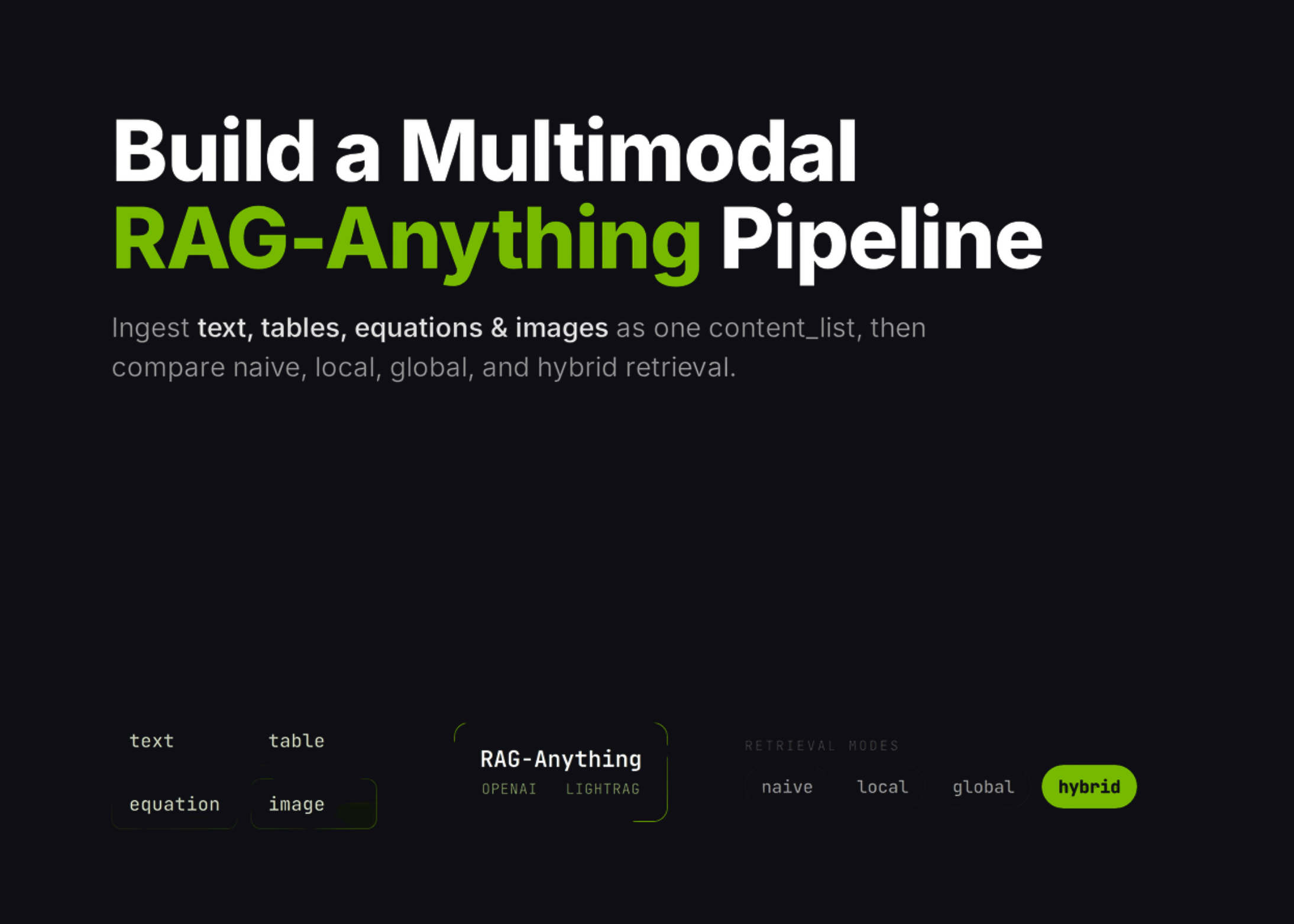
RAG-Anything delivers a new workflow for building multimodal retrieval pipelines. The tutorial demonstrates how to handle different content types in a single system—text, tables, equations, and images—within a single Colab environment. Users prepare their environment by entering an OpenAI API key at runtime, then generate synthetic reports that include charts and PDFs. These files convert into a format that RAG-Anything can directly index for retrieval. This hands-on approach then integrates OpenAI’s chat, vision, and embedding models to test multiple retrieval modes: naive, local, global, and hybrid.
Why builders should care
Most retrieval systems specialize in single data types or require complex custom engineering to combine modalities. RAG-Anything’s approach lowers that barrier by providing a ready pipeline specifically designed to handle file types ranging from raw text to complex visuals and math expressions. Builders get a practical example of how to unify diverse data sources with minimal setup and no separate pre-processing steps beyond the tutorial’s pipeline. This expands the range of real-world use cases for retrieval-augmented generation (RAG) technology, especially for teams managing reports or documents rich in varied data formats.
The practical takeaway
Operators building knowledge retrieval systems can leverage RAG-Anything to accelerate prototyping and reduce custom coding. The system’s integration with OpenAI API calls for chat, vision, and embeddings shows how off-the-shelf foundation models can serve complex multimodal scenarios without building separate models or training new embeddings per data type. Testing across multiple retrieval modes gives builders insight on when to rely on local vs global or combined retrieval to optimize results. This practical workflow lets teams experiment live and build retrieval pipelines that can handle the mixed content realities of business reporting, research data, or educational materials.
What to watch next
Pay attention to how other toolkits evolve to simplify multimodal retrieval and whether RAG-Anything’s direct content_list format becomes a standard for multi-file indexing. OpenAI’s continued improvements in vision and text embedding models will further lower the cost and complexity of combining modalities. Builders should also monitor how retrieval modes mature, especially hybrid approaches that mix local detail with global context. Practical pipelines like RAG-Anything set a baseline for integrating future models that blend video, audio, and other emerging data types into retrieval workflows.
AI Quick Briefs Editorial Desk