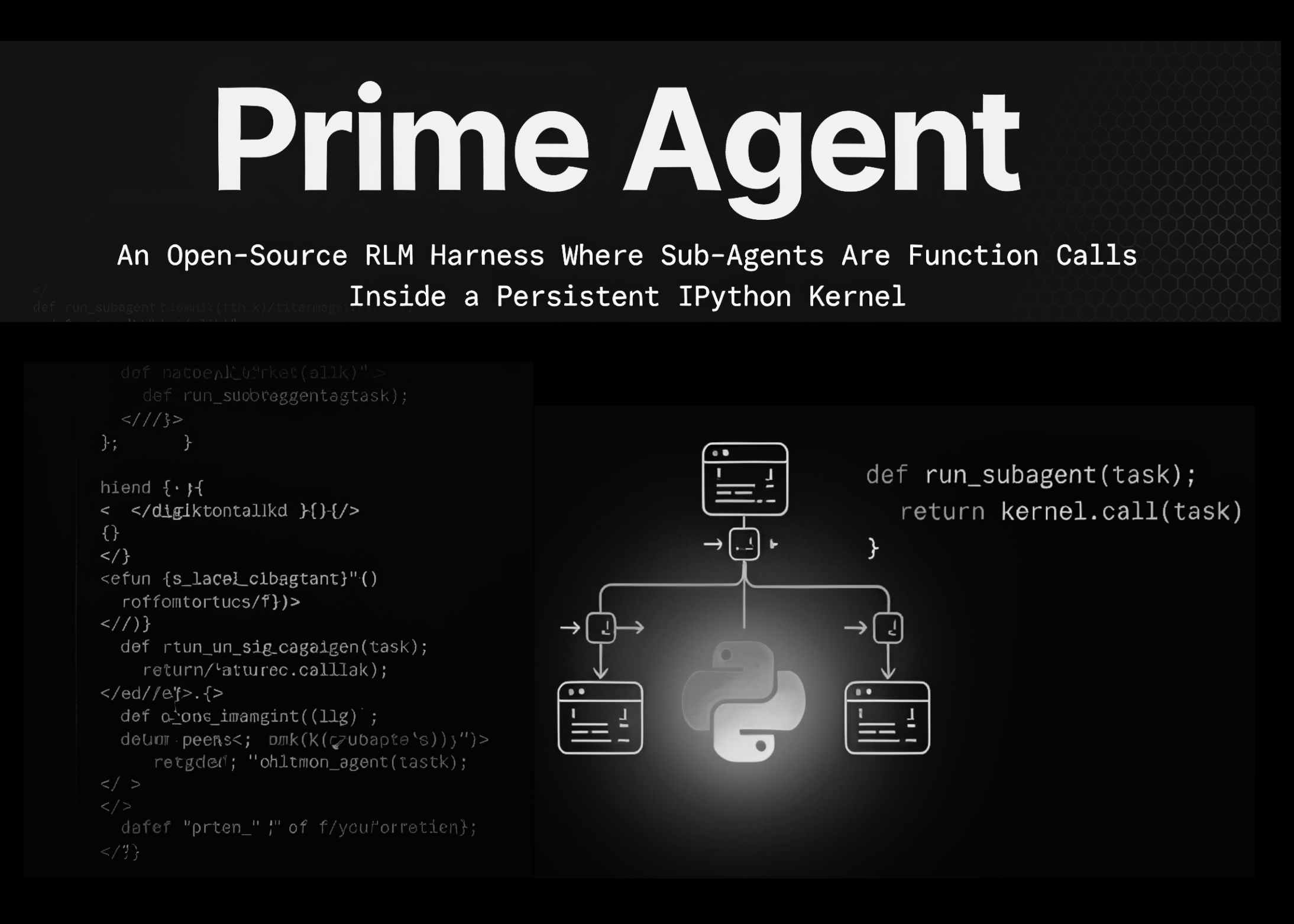
Prime Intellect Releases Prime Agent: An Open-Source RLM Harness Where Sub-Agents Are Function Calls Inside…
What changed
Prime Intellect has open-sourced Prime Agent, a Recursive Language Model (RLM) based harness for coding and research. It turns calls to sub-agents into function calls within a persistent IPython kernel. This lets the agent operate by invoking modular functions that live in the same runtime, enabling seamless state and memory management across calls. Additionally, the drone-like Continual Harness allows Prime Agent to self-edit its own prompts, skills, memory, and sub-agent definitions dynamically while running.
Why builders should care
Prime Agent breaks from typical black-box AI calls by exposing sub-agents as functions inside an IPython environment, making it easier to inspect, extend, and debug agent behavior. The ability to modify prompt engineering and skills mid-run removes the bottleneck of fixed prompt templates, creating a programmable, adaptive research agent. This flexibility could speed experimentation for developers and researchers who want iterative control over language model workflows without restarting the whole pipeline.
The practical takeaway
If precision, modularity, and adaptability matter in your AI tooling, Prime Agent offers an open, reusable framework to build on. It provides a persistent, integrated workspace better suited for complex, multi-step agent workflows than repeated stateless API calls. The reported benchmark—95.5% on ARC-AGI-3, just above expert human level—signals that this approach yields practical performance gain rather than theoretical novelty. Builders working on agent architectures and research automation stand to gain a robust baseline for experimentation and scaling.
What to watch next
Watch how the open-source community adopts Prime Agent in research and production. Whether developers integrate it into existing pipelines or extend its recursive function model to other LLMs or tasks will reveal its long-term utility. Performance comparisons against competing modular agent frameworks could pressure the market toward more transparent, introspective AI tooling. Updates to the Continual Harness’s self-editing capabilities will also be worth tracking for incremental workflow breakthroughs.
AI Quick Briefs Editorial Desk