OpenAI Releases GPT-5.6 (Sol, Terra, Luna): A Three-Tier Model Family With Programmatic Tool Calling in the…
What changed
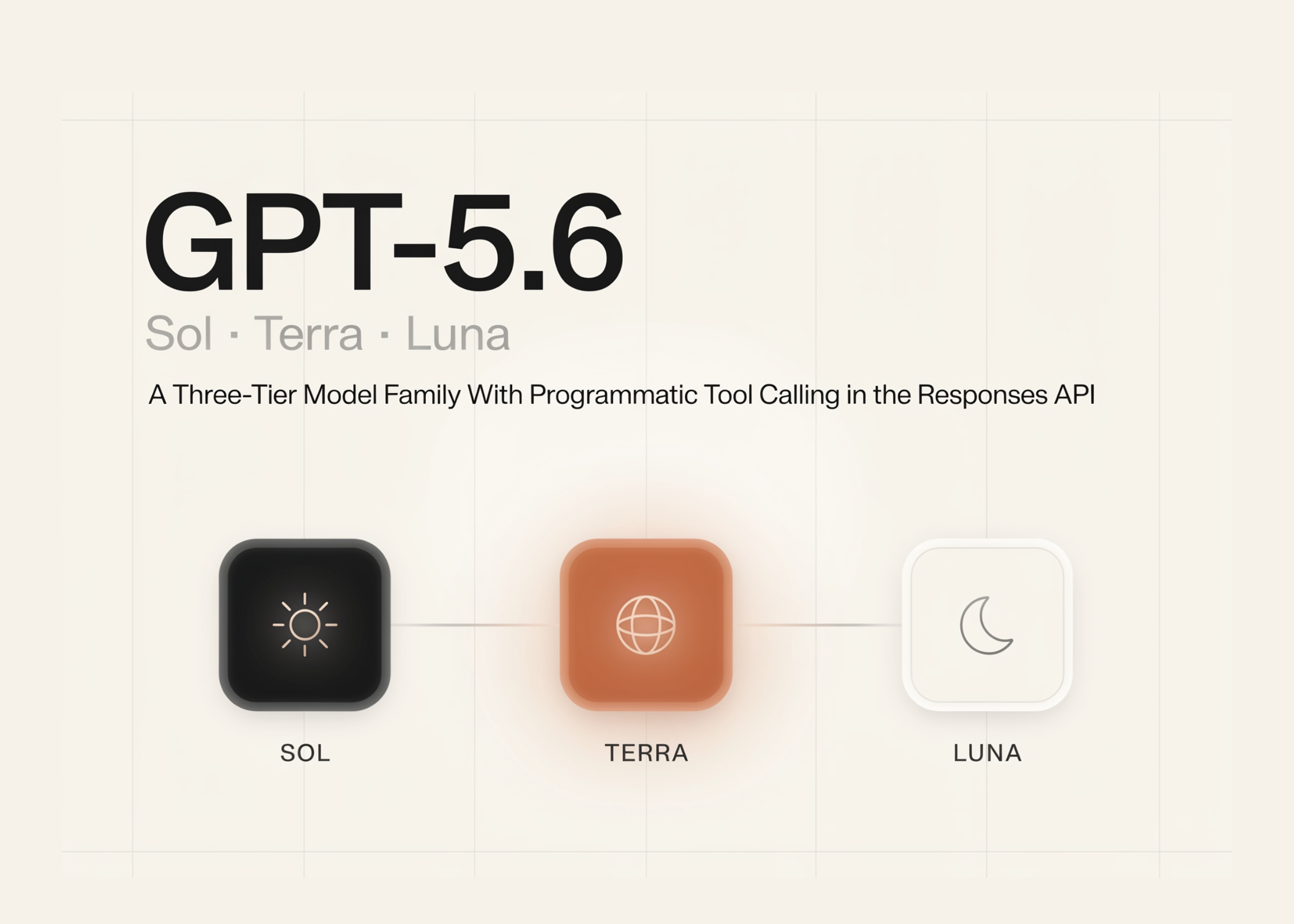
OpenAI launched GPT-5.6 as a three-tier model family called Sol, Terra, and Luna, available since July 9, 2026. Instead of offering one version, OpenAI now provides options at different price points and performance levels. Sol is the top tier at $5 per 1 million tokens for prompt input and $30 for output. Terra sits in the middle at $2.50 and $15, while Luna is the most affordable at $1 and $6.
The most practical update is Programmatic Tool Calling integrated into the Responses API. This feature runs model-generated JavaScript inside a secure V8 runtime environment. It allows GPT-5.6 to actively manage and orchestrate external tools and data sources dynamically as part of its answers, rather than just suggesting actions or APIs.
Performance-wise, Sol sets a new bar on OpenAI’s internal Artificial Analysis Coding Agent Index, scoring an 80. That places it ahead of Claude Fable 5 by 2.8 points. On the OSWorld 2.0 benchmark, Sol reached 62.6 percent accuracy while using 85 percent fewer tokens than past models, which indicates much more efficient and precise generation.
Why builders should care
Segmented pricing gives developers straightforward choices to balance cost and capability. Builders on tight budgets or smaller projects can opt for Luna’s lower price with reasonable performance, while power users can pay more for Sol’s improved accuracy and efficiency.
Programmatic Tool Calling shifts the interaction model for AI-driven workflows. Instead of manually coding middleware or app logic around language understanding, GPT-5.6 can generate and execute JavaScript on the fly inside a secure, isolated environment. This can drastically reduce development overhead for orchestrating complex tools or APIs and improve automation reliability.
The efficiency gains in token usage mean faster, cheaper operations, particularly for real-time or large-scale deployments. Using fewer tokens reduces latency and cost, which directly impacts AI service margins and product pricing.
The practical takeaway
The three-tier model lineup lets teams scale AI usage according to their budgets and accuracy needs without overpaying. The Programmatic Tool Calling feature can compress developer cycles by embedding execution control directly within the model’s responses. This reduces the friction of gluing AI models with external services and scripts.
For operators, efficient token consumption means more queries or interactions per dollar, improving ROI on AI-driven tools. Competitive benchmark results signal that GPT-5.6 with Sol is pushing top-tier performance but with better resource use than before.
Overall, GPT-5.6’s architecture encourages modular AI deployment: choose a model tier that fits your use case and potentially embed code execution as part of your AI workflow, streamlining automation and integration tasks.
What to watch next
Monitor how quickly developers adopt Programmatic Tool Calling for real-world integrations, especially for complex tooling or API orchestration. This feature could reduce dependency on external orchestration platforms if it proves robust and secure in production.
Keep an eye on pricing strategies from OpenAI and competitors as tiered models pressure providers to offer flexible, cost-effective AI options. Watch whether lower tiers like Luna attract startups and small businesses or remain limited by capability.
Lastly, benchmark comparisons to other LLMs such as Claude Fable 5 or Opus 4.8 will show if OpenAI maintains its lead in accuracy and efficiency or if rivals close the gap with new model improvements or cost structures.
AI Quick Briefs Editorial Desk


