Ollama vs. LM Studio vs. llama.cpp: Which Local AI Runtime Should You Use in 2026?
What changed
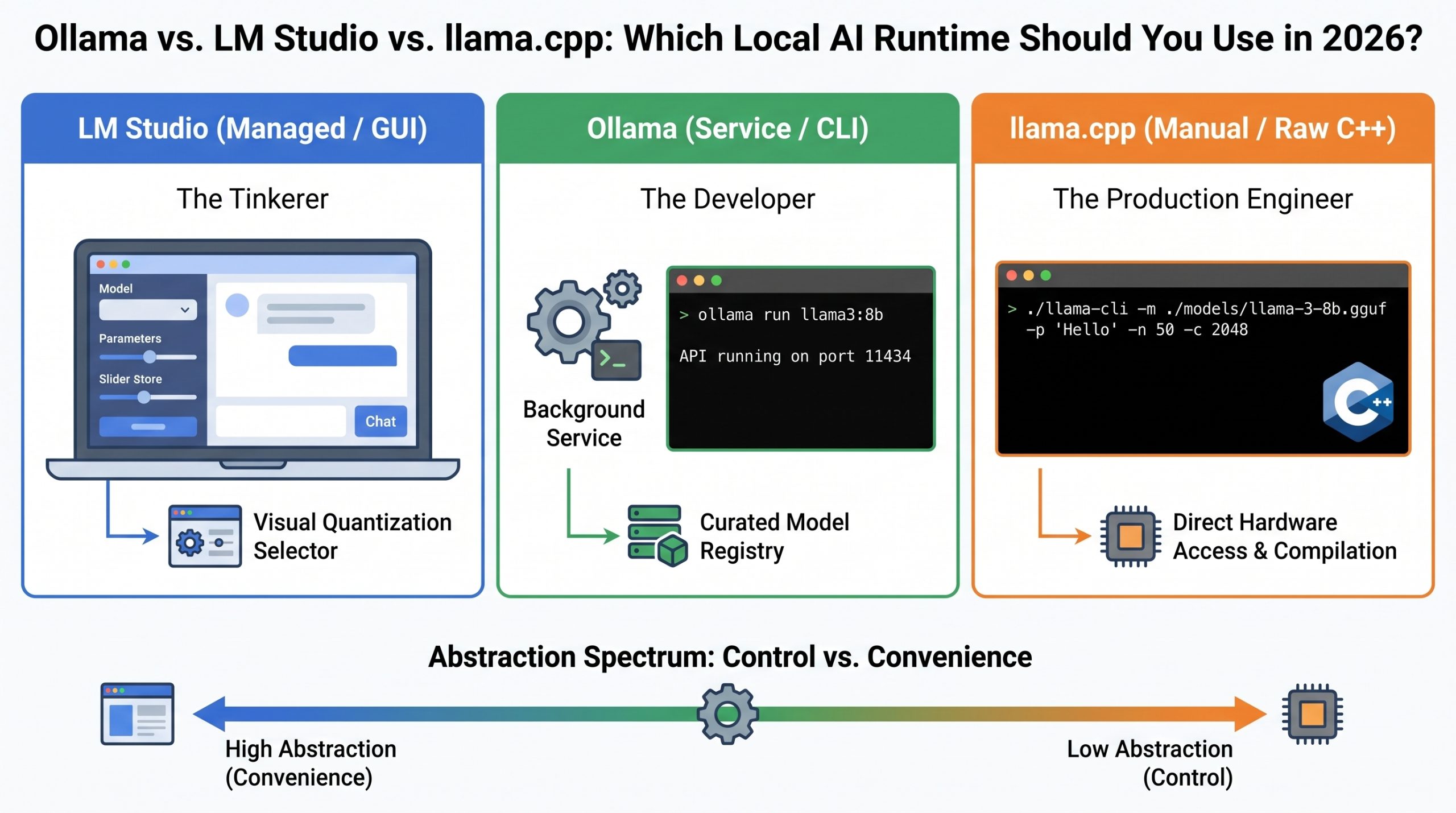
Ollama, LM Studio, and llama.cpp now lead the race as local AI runtimes for 2026, each targeting different operator priorities. Ollama focuses on polished user experience and model management, LM Studio emphasizes flexibility across platforms and models, while llama.cpp prides itself on ultra-low resource use and wide hardware support. These differences reflect sharper specialization in local AI tools rather than a one-size-fits-all approach.
Why builders should care
Choosing the right local AI runtime directly affects cost, performance, security, and ease of deployment. Ollama’s managed environment simplifies startup and scaling but can lock users into a particular ecosystem and has higher resource needs. LM Studio offers granular control and model variety but requires more setup and technical know-how. llama.cpp delivers the leanest footprint, suitable for edge devices or limited hardware, but trades off raw speed and some convenience. For operators balancing costs, security risks of cloud dependencies, and deployment scope, these distinctions shape technical strategy and operational overhead.
The practical takeaway
Operators with dedicated GPUs and a need for rich UI and multitasking may lean into Ollama for streamlining workflows and collaboration. Developers aiming to test multiple models and platforms on varying hardware gain from LM Studio’s adaptability. Projects constrained by CPU-only environments or mobile scenarios benefit most from llama.cpp’s minimal requirements. Investing time upfront to align use case with runtime design will reduce friction and cost over the product cycle.
What to watch next
Expect further convergence as runtimes borrow strengths from each other—Ollama trimming resource needs, LM Studio enhancing UI polish, and llama.cpp improving output speed. Watch for increased integration with larger AI ecosystems and expanding model support on all three. The battle over developer mindshare and enterprise adoption will intensify as local AI shifts from hobbyist experiments to mainstream infrastructure components.
AI Quick Briefs Editorial Desk