NVIDIA BioNeMo Agent Toolkit Turns Biomolecular Models Into Callable Skills for AI Agents in Drug Discovery
What it does
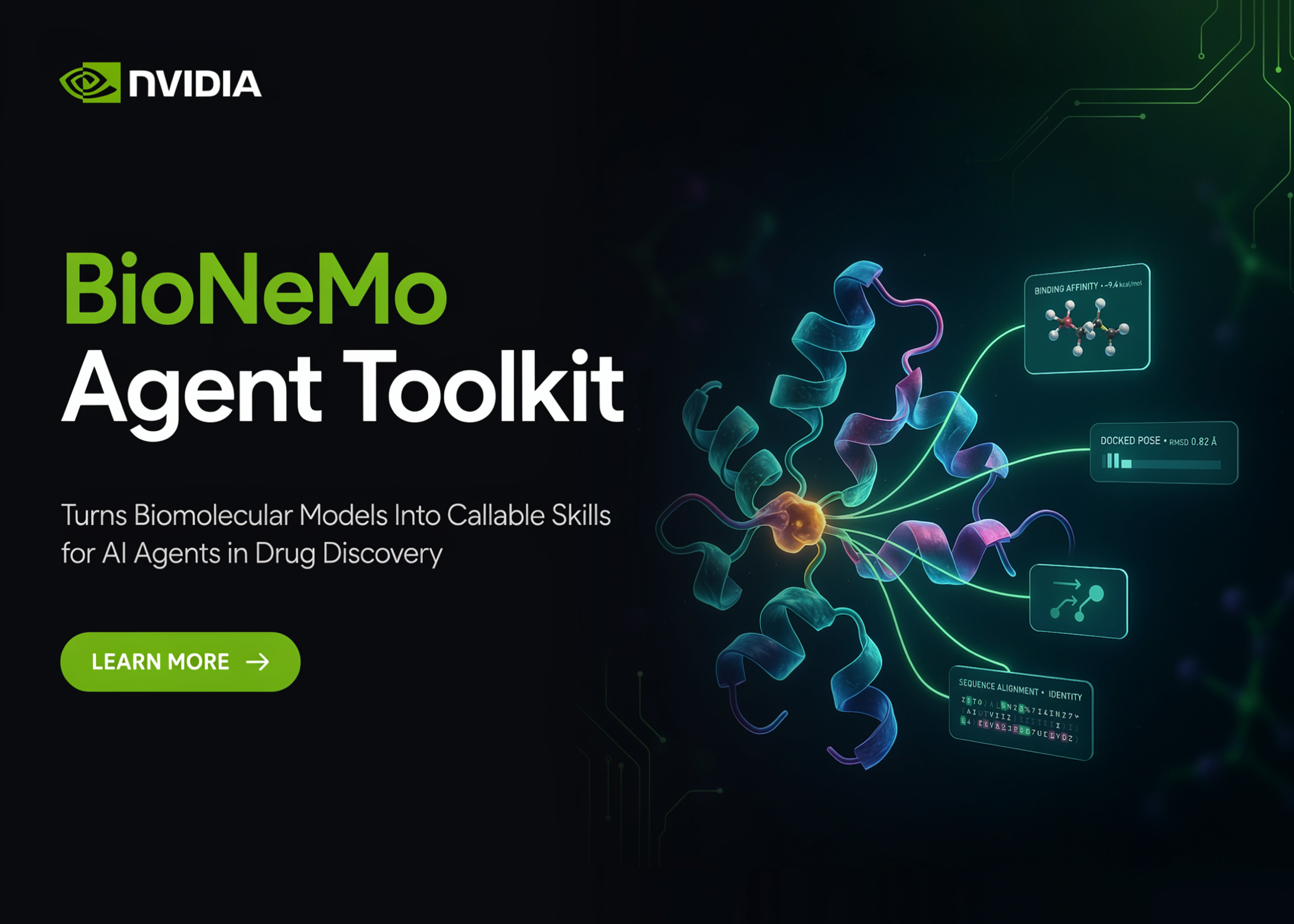
NVIDIA’s BioNeMo Agent Toolkit converts biomolecular AI models into callable, self-describing skills that agents can directly use in drug discovery workflows. Models such as OpenFold3, DiffDock, and GenMol are wrapped with documentation detailing their inputs, outputs, failure modes, and technical artifacts. This allows AI agents to choose the right model, execute it, and interpret results autonomously.
Why it matters
Biomolecular AI models are complex, requiring detailed knowledge to deploy effectively. The BioNeMo Agent Toolkit simplifies integration by packaging each model as a clearly defined skill. This reduces trial and error for drug discovery teams using AI agents to automate scientific tasks. NVIDIA’s internal benchmarks showed this approach doubled token efficiency and lifted task completion rates from 57% to 100% with Codex CLI and GPT-5.5 fast agents. More reliable model composition means faster iteration on candidate molecules, docking simulations, and generative design—all key in drug development.
Who it is for
Bioinformatics researchers, AI developers, and drug discovery teams building automation pipelines will find this toolkit most valuable. It bridges the gap between standalone biomolecular models and AI agents that coordinate multiple tools. Investors and founders in biotech and AI-driven pharmaceuticals can also watch this to assess how infrastructure improvements may accelerate drug candidate generation and reduce experimental costs.
The catch
Open-source as it is, the toolkit’s effectiveness depends on high-quality, up-to-date model wrappers and skills documentation. Teams still need domain expertise to validate results and handle edge cases. The gains also hinge on compatible AI agents capable of understanding and orchestrating these skills—an evolving ecosystem that requires continuous refinement.
What to watch next
Look for expanding support to more biomolecular models and tighter integration with AI agents like GPT-5.5. Adoption by biotech firms and open research labs will reveal how well this scalable skills approach shortens drug discovery timelines in practice. Technical improvements in skill generalization and adaptive failure handling may further lift task success and reduce human oversight.
AI Quick Briefs Editorial Desk