NVIDIA AI Introduces ASPIRE: A Self-Improving Robotics Framework Reaching 31% Zero-Shot on LIBERO-Pro Long …
What changed
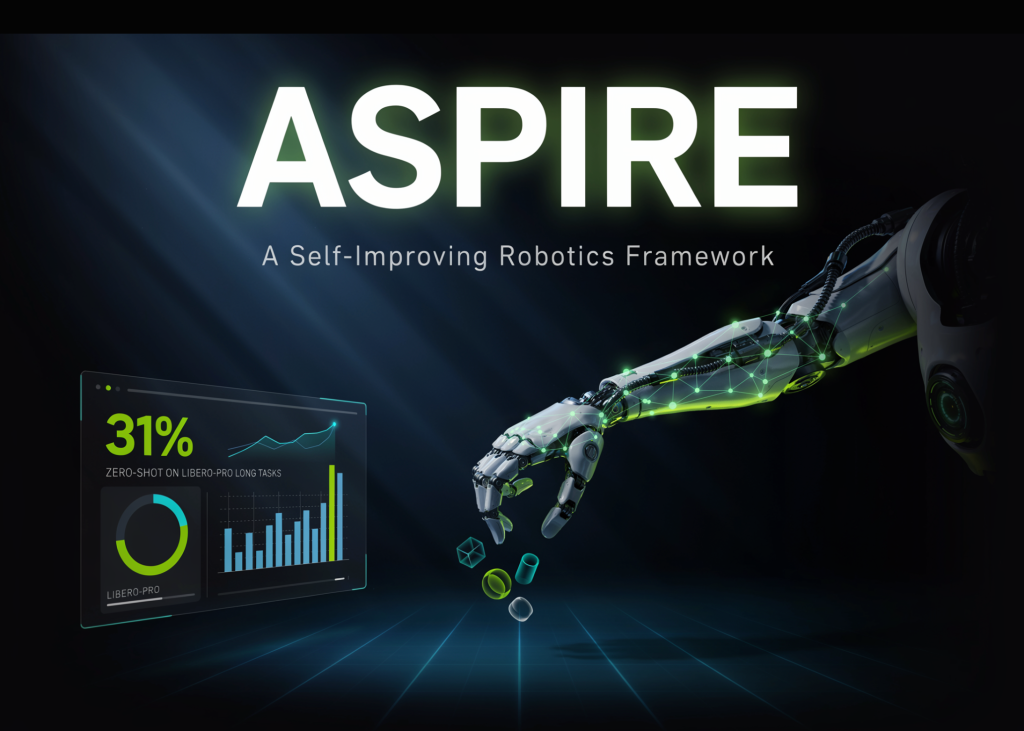
NVIDIA rolled out ASPIRE, a robotics framework that writes and refines its own control programs. It builds these plans iteratively and then extracts validated fixes into a skill library. The twist is that ASPIRE doesn’t just repeat known tasks; it reaches 31 percent zero-shot accuracy on long-horizon tasks in the LIBERO-Pro benchmark. That means it successfully handles new, unseen robot tasks without prior training on those specific routines. The system gains up to 77 points as it learns, showing significant improvement beyond initial performance.
Why builders should care
Robotics has long struggled with long-horizon tasks—sequences requiring many steps and adaptive decisions. Current approaches often need extensive retraining or manual programming for each new task. ASPIRE’s ability to self-improve and zero-shot transfer skills cuts down on costly human interventions and retraining cycles. For developers and operators working on autonomous robots, this reduces integration complexity and speeds up deployment in dynamic, real-world environments.
The practical takeaway
ASPIRE’s method of distilling repaired programs into reusable skills lets robots accumulate and reuse knowledge economically. This lowers project costs because each new task need not start from scratch. Operators gain more robust automation without frequent human troubleshooting at every failure point. For builders, this prioritizes modular program design with learning components that evolve and refine over time, a more scalable approach for long, complex workflows.
What to watch next
Key details to track include ASPIRE’s transferability beyond LIBERO-Pro tasks and its deployment in commercial robotics. Examining real-world benchmarks will clarify whether the 31 percent zero-shot applies in industrial or service contexts. Also watch for how NVIDIA integrates this framework with their broader robotics and AI platforms, potentially shaping future autonomous systems that self-correct and extend skills with minimal human tuning.
AI Quick Briefs Editorial Desk