Nous Research Releases Token Superposition Training to Speed Up LLM Pre-Training by Up to 2.5x Across 270M …
What it does
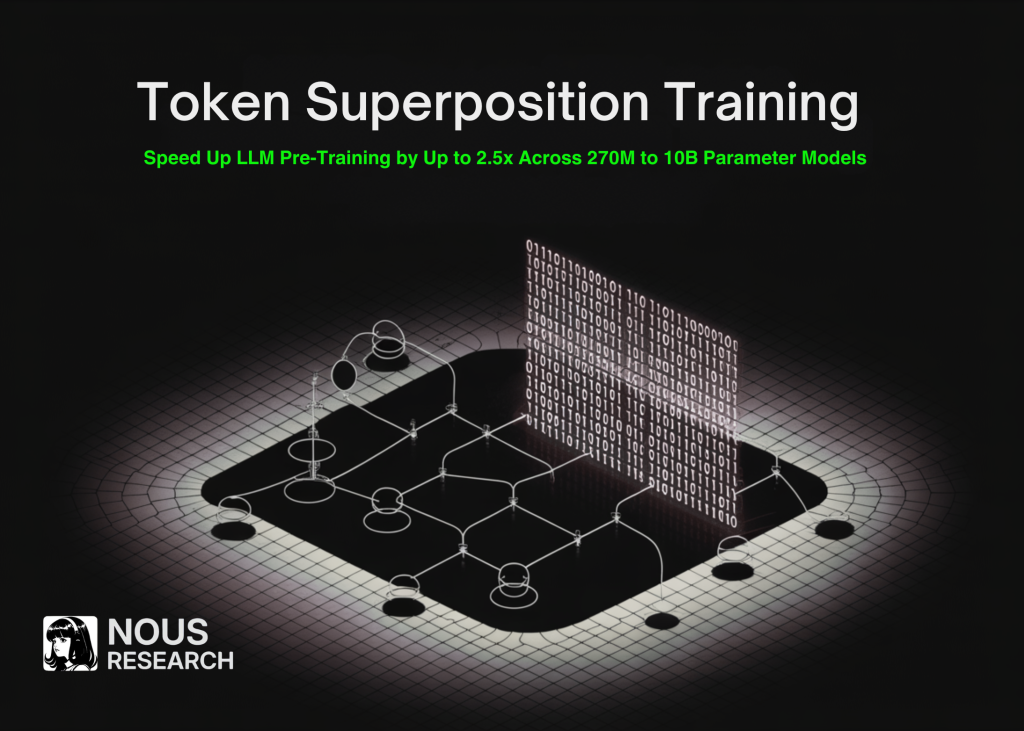
Nous Research has introduced Token Superposition Training (TST), a new two-phase pre-training approach to speed up large language model (LLM) training. The method compresses contiguous token embeddings into averaged bags during the first phase and then returns to conventional next-token prediction for the second phase. This approach requires no changes to model architecture, tokenizer, optimizer, or inference processes. It has been validated on models ranging from 270 million to 10 billion parameters, including dense and mixture-of-experts variants.
Why it matters
Training large language models is resource-intensive and costly, often requiring weeks of computation time on expensive hardware. TST cuts training wall-clock time by up to 2.5 times at the same floating point operations (FLOPs) cost. Importantly, it achieves this acceleration without sacrificing model structure or downstream inference behavior, making integration straightforward for teams wanting to save time and operational expenses. Faster pre-training can lower barriers for organizations building custom LLMs and compresses the development cycle from prototype to deployment.
Who it is for
This method primarily benefits AI research labs, startups, and enterprises training LLMs at scale who want to reduce compute costs and speed iteration. Model developers who need quick turnaround but cannot alter deployed model components will find TST attractive. It also suits groups experimenting with a range of model sizes since it has been tested on both mid-sized (270M, 600M) and very large (3B, 10B) parameter architectures.
The catch
While TST accelerates training time, it requires a two-phase workflow that might complicate schedule planning. Averaging token embeddings in phase one may influence training dynamics in ways not yet fully characterized outside the tested scales and datasets. Adopters should verify task-specific performance and robustness after switching to this method. Also, there is no indication it changes inference speed or resource needs once the model is deployed.
What to watch next
Keep an eye on whether broader adoption of TST emerges across open-source and commercial LLM projects. Watch for comparisons on model quality retention and energy savings in real-world scenarios. Further research might refine or extend TST to even larger models or alternative training paradigms. Competitive responses from major cloud providers or AI frameworks offering similar acceleration features would also be significant.
AI Quick Briefs Editorial Desk