LLM Orchestration Frameworks Compared: LangChain vs. LlamaIndex vs. Raw API Calls
What changed
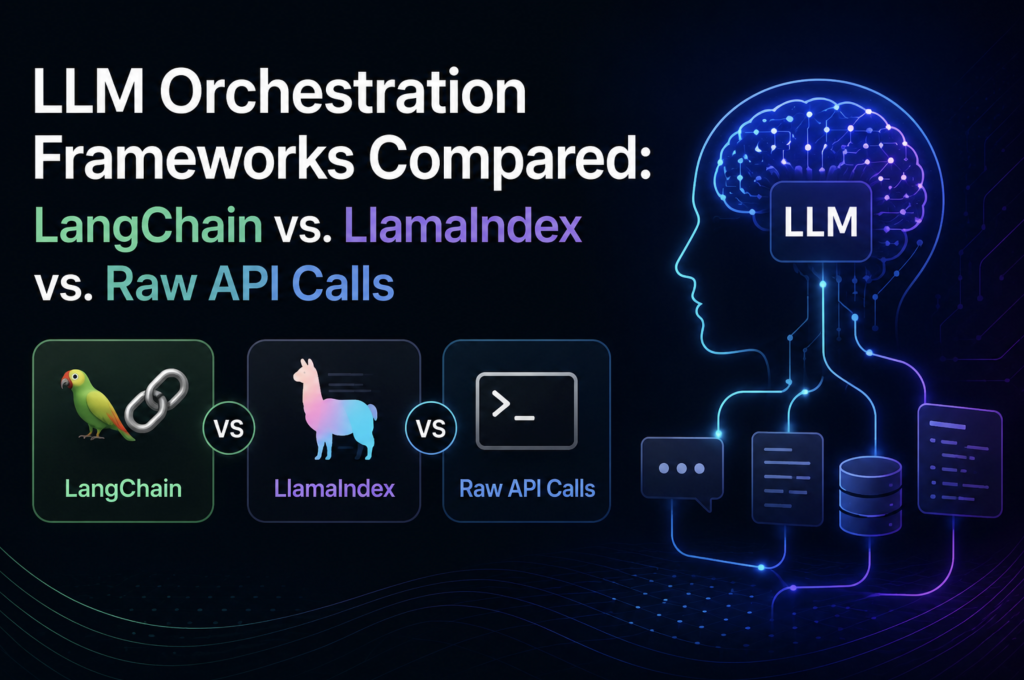
Developers working with large language models (LLMs) commonly start projects with direct, raw API calls to providers like OpenAI. As projects scale or require more complex orchestration, many move to frameworks that help manage chains, memory, embeddings, and data integrations. This story compares the popular LLM orchestration frameworks LangChain and LlamaIndex against just sticking with raw API calls. Both frameworks aim to simplify complex workflows but differ in focus and user needs.
Why builders should care
Raw API calls give complete control but quickly become cumbersome when workflows need chaining, context maintenance, or integration with external data sources. LangChain offers a modular system to build pipelines with tools for prompt management, memory, agents, and document processing. LlamaIndex focuses more on data ingestion, indexing, and retrieval combined with LLM calls. Choosing the right framework shapes development speed, system complexity, and long-term flexibility. For operators, knowing when to graduate from raw calls to a framework can mean fewer bugs, faster iteration, and better scalability.
The practical takeaway
Raw API use suits early experiments or very simple use cases but grows inefficient as logic layers and data dependencies increase. LangChain works best for projects needing flexible orchestration and diverse data workflows. LlamaIndex excels if the priority is building powerful retrieval-augmented generation pipelines with rich document indexing. Both frameworks add overhead and complexity compared to raw calls, so adopting them demands careful tradeoff analysis based on project scale, team expertise, and performance needs. The comparison pressures developers to plan API layering thoughtfully rather than defaulting to “one size fits all.”
What to watch next
Frameworks like LangChain and LlamaIndex will likely expand their capabilities and ecosystem integrations, nudging more developers toward early adoption. API providers may also improve raw API tooling to reduce reliance on external frameworks. Builders should monitor feature improvements, community adoption patterns, and emerging best practices around LLM orchestration frameworks to avoid late-stage refactoring. How these factors recalibrate the balance between raw API control versus framework convenience will steer LLM project architecture strategies in 2024.
AI Quick Briefs Editorial Desk


