Liquid AI Open-Sources Antidoom: A Final Token Preference Optimization (FTPO) Method that Reduces Doom Loop…
What changed
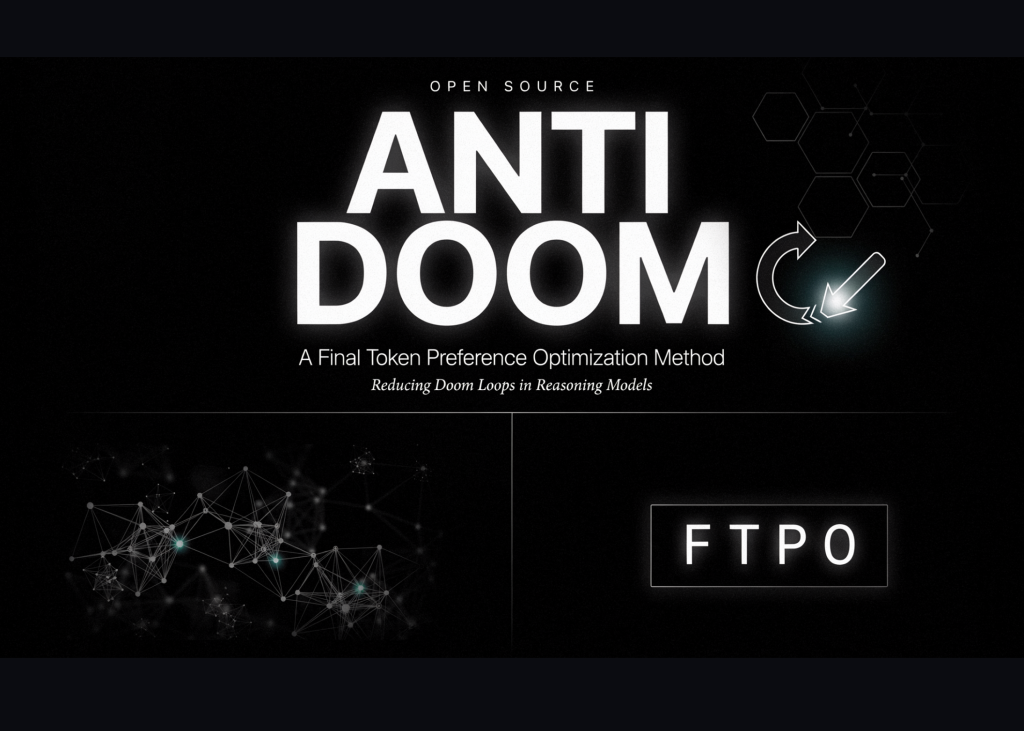
Liquid AI released Antidoom, an open-source tool designed to tackle doom loops in reasoning models. Doom loops occur when a model repeatedly generates the same span, exhausting its context window and causing inefficiencies or failures. Antidoom detects the token where this loop begins and applies a focused retraining approach called Final Token Preference Optimization (FTPO) on that specific position.
Why builders should care
Doom loops waste computational resources and degrade the quality of model outputs, posing a practical bottleneck in deploying reasoning-focused language models. Antidoom’s targeted correction reduces these loops drastically—cutting doom-loop rates from over 10% to under 2% on tested models, and from nearly 23% to 1% on others. Since generation, loop detection, and the FTPO training code are all open source, developers can integrate this method directly into their workflows without needing costly model overhauls or retraining from scratch.
The practical takeaway
For builders working with complex language models in reasoning or multi-step tasks, Antidoom offers a tool to improve model reliability and reduce wasted tokens. It pinpoints exactly where the loop starts and address it by retraining just that token’s prediction, leading to faster fixes and smaller retraining overhead. This translates to more efficient model usage, less risk of stalled outputs, and better overall performance in real-world applications.
What to watch next
Tracking how Antidoom integrates with a broader range of models and real-world production environments will clarify its practical limits. Its impact on larger-scale deployments and different architectures will matter for operational adoption. Further community contributions could expand FTPO’s efficiency or simplify integration. Keep an eye on updates from Liquid AI and open-source collaboration to see if this method becomes a standard tool for mitigating token-level generation issues in reasoning models.
AI Quick Briefs Editorial Desk