Kimi AI and kvcache-ai Open Sources ‘AgentENV’: A Distributed System that Powers Agentic Reinforcement Lear…
What changed
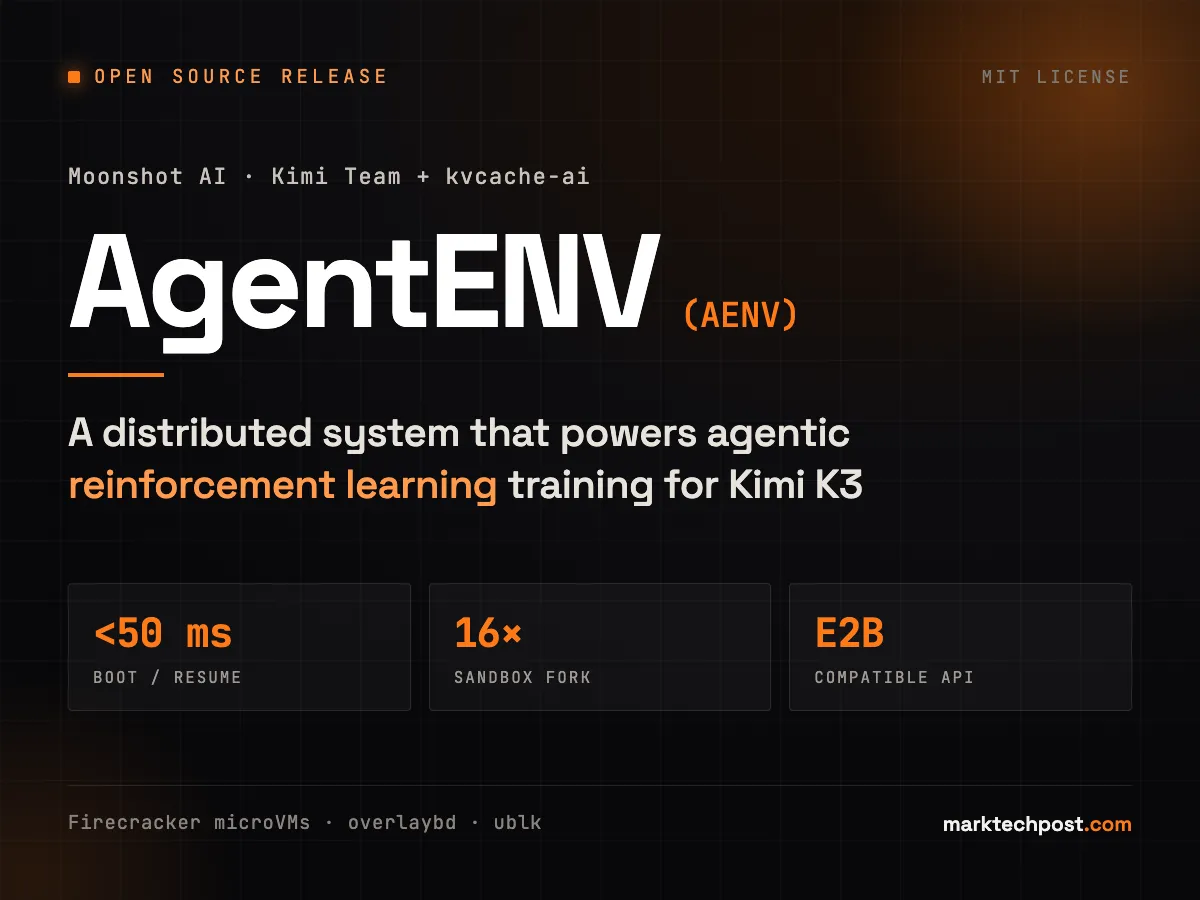
Moonshot AI’s Kimi team and kvcache-ai released AgentENV (AENV), an open-source distributed system designed for training agentic reinforcement learning (RL) models. It runs agent sandboxes using Firecracker microVMs, which support millisecond snapshotting, quick resumption, and 16-way forking. The system exposes an E2B-compatible API, making it easier to integrate with existing RL workflows. AgentENV was launched as part of the Kimi K3 Open Day and is available under the permissive MIT license.
Why builders should care
Reinforcement learning training, especially for agentic models, demands scalable, rapid environment simulation and state management. AgentENV addresses this by leveraging Firecracker microVMs to isolate RL agents while enabling fast environment snapshot and resume capabilities. The 16-way fork feature lets multiple agent instances share snapshots efficiently, lowering computational overhead and speeding experimentation cycles. The E2B-compatible API signals solid integration potential with existing RL frameworks, making it easier for developers to adopt without rebuilding pipelines from scratch.
These features collectively lower the barrier to managing high-throughput RL training at scale. Builders running agent-based RL workloads can expect AgentENV to reduce infrastructure complexity and improve resource utilization, which translates directly to faster iteration and more cost-effective training.
The practical takeaway
AgentENV provides a faster and more modular way to set up isolated RL agent environments on demand. Its lightweight Firecracker microVM approach ensures agents run with strong sandboxing and near-instant state rollback, enabling rapid scenario testing and parallel experimentation. The 16-way fork functionality offers a unique way to scale horizontally without paying heavy VM startup costs for each agent.
This means developers working on RL agent training can accelerate their training loops, reduce cloud compute bills, and handle bursts of training workload more gracefully. By being open source under a permissive license, it also invites community contributions and integrations that could improve the ecosystem around agentic RL.
What to watch next
Pay attention to uptake of AgentENV within open-source RL projects and whether cloud providers or AI platforms begin integrating this system as a native option for agent sandboxing. Watch for early benchmarks comparing AgentENV’s speed and resource efficiency against container- or VM-based RL training alternatives.
Another area to track is the development of complementary tooling around AgentENV’s API, such as orchestration layers and monitoring systems that could make it easier to manage large-scale RL agent fleets in production. The degree to which this open-source approach challenges proprietary RL infrastructure solutions will shape how practical agentic RL development becomes in the next few years.
AI Quick Briefs Editorial Desk


