Google Research Introduces SensorFM: A Wearable Health Foundation Model Pretrained on One Trillion Minutes …
What it does
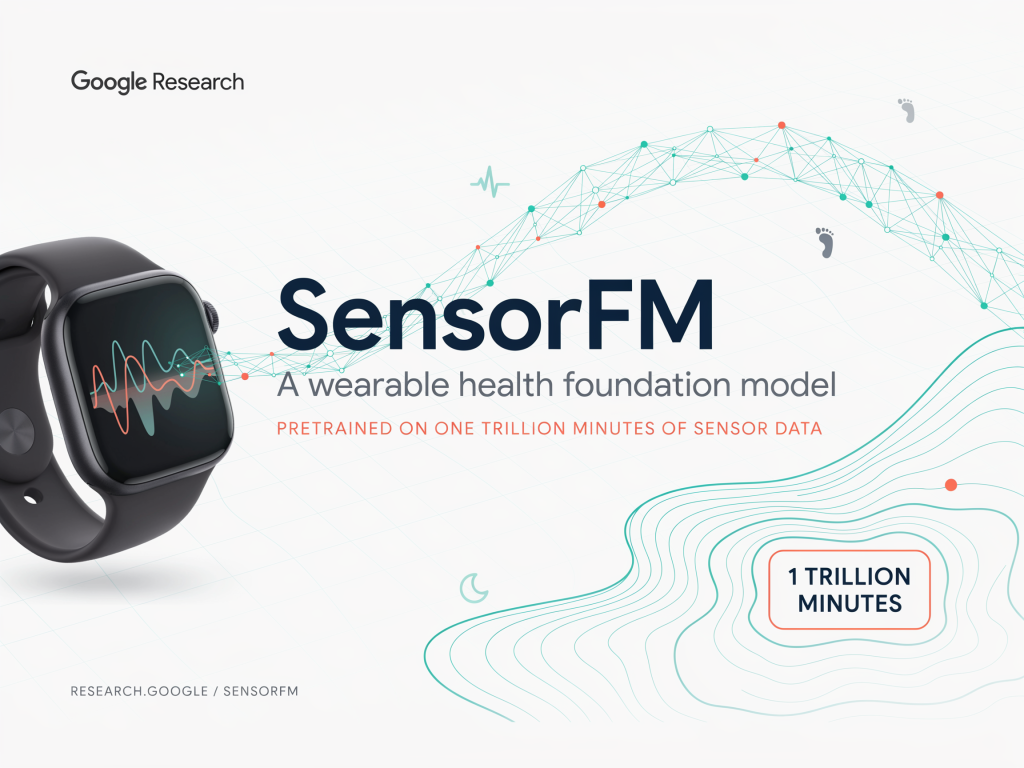
Google Research, DeepMind, and academic partners have released SensorFM, a new wearable health foundation model. It uses a ViT-1D masked-autoencoder architecture specially designed for sensor data. SensorFM was pretrained on a massive amount of data: over one trillion minutes of unlabeled physiological signals collected from 5 million consenting participants. The model captures raw sensor patterns before any clinical labels enter the picture.
Why it matters
The scale of SensorFM’s training data sets a new benchmark for wearable health AI. Most existing models rely on smaller, labeled datasets often engineered by domain experts. SensorFM’s approach can extract meaningful embeddings by pretraining on raw sensor signals, sidestepping expensive manual annotation. This allows for broader application across health tasks without starting from scratch each time. Its frozen embeddings combined with a simple PCA-50 linear probe outperformed traditional, hand-crafted feature sets. For businesses and developers building health apps, SensorFM reduces reliance on feature engineering and labeled data, accelerating model development with potentially more robust representations.
Who it is for
SensorFM targets developers creating wearable health applications, digital therapeutics, and real-time health monitoring systems. Researchers can use it to explore new predictive tasks over wearable data without needing massive hand-labeled datasets. Healthcare providers seeking to integrate continuous sensor data into diagnostics or patient monitoring stand to benefit from models pretrained on the scale and diversity SensorFM delivers.
The catch
Despite its scale, SensorFM still faces challenges. The co-scaling tests showed that bigger model capacity does not always translate to better results if there isn’t enough additional training data. This means SensorFM’s performance gains may plateau or require even more data, which could raise costs and slow development. Also, this is a foundation model with frozen embeddings, so fine-tuning on specific downstream tasks still requires additional engineering. The model is not a plug-and-play solution but a building block for workflow improvement.
What to watch next
Monitor how SensorFM integrates with commercial wearable platforms and if it leads to faster, cheaper development cycles for health insights. Watch for new applications that reuse its pretrained embeddings for novel diagnostics or early warning systems. Also observe if competitors follow with similar large-scale pretraining on sensor data or if this shifts market expectations around data scale for wearable AI performance. SensorFM’s release may accelerate the trend toward foundation models beyond text and images, anchoring sensor data as an AI frontier.
AI Quick Briefs Editorial Desk