Google Deepmind’s Gemma 4 12B squeezes multimodal AI onto a laptop with just 16 GB of RAM

What it does
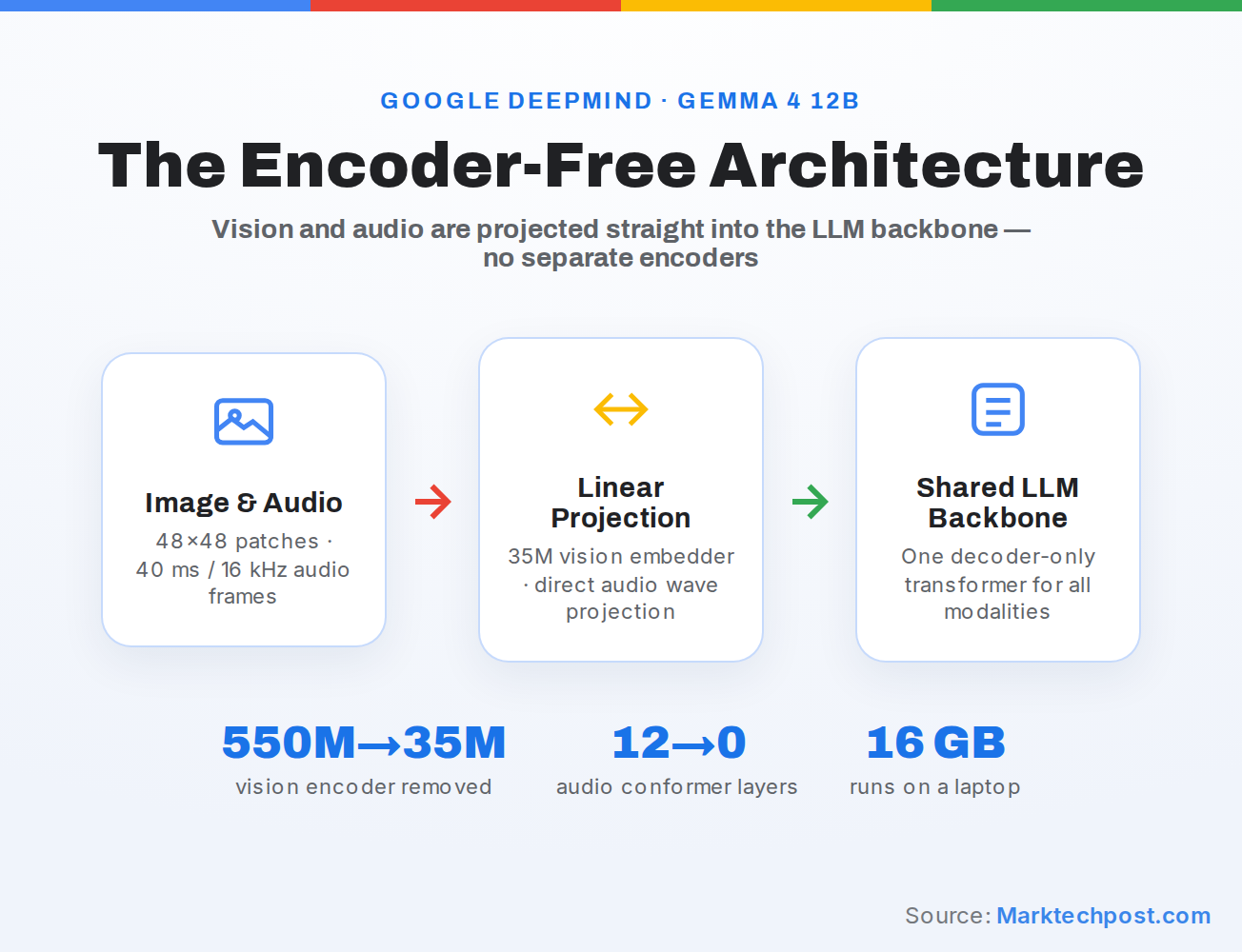
Google Deepmind has released Gemma 4 12B, an open-source AI model that handles text, images, and audio together natively. Unlike many multimodal models that demand heavy hardware, Gemma 4 12B can run on a laptop with just 16 GB of RAM. Despite its relatively small 12 billion parameter size, it nearly matches the performance of Deepmind’s much larger 26 billion parameter model on benchmarks. This model is available under an Apache 2.0 license, allowing unrestricted commercial use.
Why it matters
Multimodal AI usually requires large servers or clusters with vast memory, pushing up infrastructure costs and limiting experimentation to well-funded teams. Gemma 4 12B lowers the hardware barrier sharply, putting advanced multimodal AI within reach of individual developers, startups, and smaller companies. This can accelerate innovation by enabling more hands-on prototyping and customized applications without cloud dependency or heavy investment. The open-source Apache 2.0 license also removes commercial use hurdles, fostering wider adoption and integration.
Who it is for
This model benefits AI builders, startups, and small to mid-sized companies who want to work with multimodal AI but lack access to high-end GPUs or expensive cloud setups. Researchers and product teams can test and deploy solutions on standard laptops, increasing iteration speed. Investors and operators can see this as a sign that AI capabilities will decentralize further, reducing costs and shifting competition toward smarter integration rather than raw scale.
The catch
While 12B parameters is impressive for a laptop-compatible model, it still falls short of the largest models in absolute capability. Applications requiring cutting-edge accuracy or extremely complex tasks may still need bigger models or server infrastructure. Additionally, running at this scale likely demands optimized code and some technical sophistication, so novices may face a learning curve. The open-source license eases legal concerns but does not guarantee ongoing maintenance or commercial support.
What to watch next
Check for benchmarks comparing Gemma 4 12B’s real-world performance against popular commercial models across diverse multimodal tasks. Monitor adoption in startups and research labs as an indicator of lowered AI infrastructure costs. Watch for forks or adaptations that improve usability or extend capabilities. Also, see whether competitors follow suit with more resource-efficient, open-source multimodal models that democratize AI development further.
AI Quick Briefs Editorial Desk