Design a High-Precision Retrieve-and-Rerank Pipeline with ZeroEntropy Zerank-2 Reranker
What changed
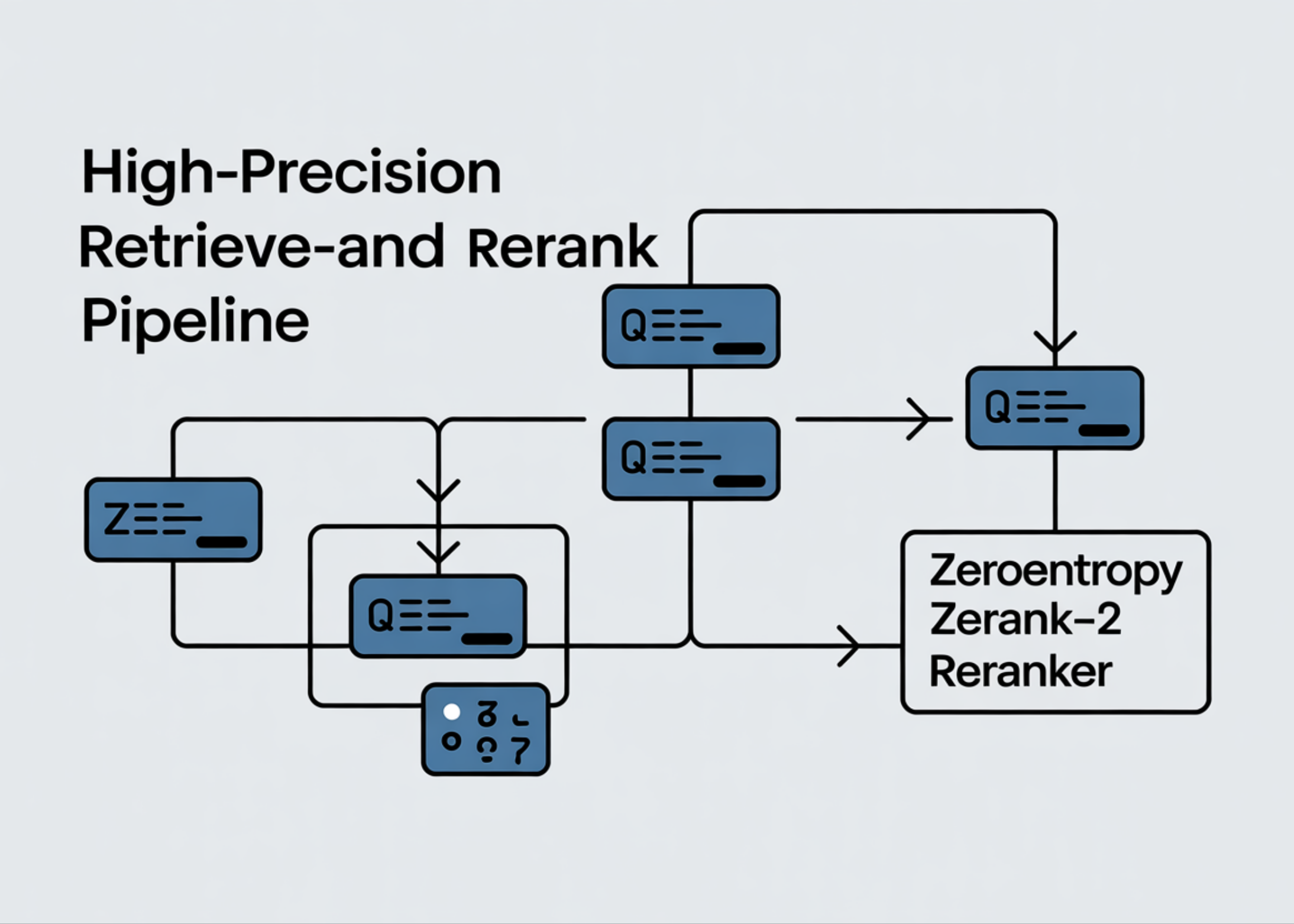
ZeroEntropy released the zerank-2 reranker, a high-precision retrieval tool built on a 4 billion parameter Qwen3-based cross-encoder model. The reranker scores query-document pairs to improve the relevance of search results. Instead of relying solely on a single-stage retrieval, zerank-2 fits into a two-stage pipeline where a fast bi-encoder retrieves candidate documents, and the reranker refines their order by rescoring them more precisely.
Why builders should care
Search and retrieval systems often face a tradeoff between speed and accuracy. Bi-encoders generate embeddings rapidly for initial candidate selection but offer weaker relevance scoring. Cross-encoder rerankers like zerank-2 evaluate candidates with deeper context, boosting precision but at a higher computational cost. Using zerank-2 in a two-stage retrieve-and-rerank pipeline offers a practical middle ground that accelerates workflows while significantly enhancing quality. This pipeline architecture is directly deployable, making better search results accessible for customer-facing apps, knowledge bases, and similar systems.
The practical takeaway
Operators can upgrade existing retrieval setups by combining any fast bi-encoder with zerank-2 for reranking. This means better ranking decisions without fully giving up speed since zerank-2 only processes a limited shortlisted set. The tutorial also demystifies loading and running the model, illustrating how it scores pairs and integrates into retrieval pipelines. Builders gain a concrete example of deploying a high-precision reranker backed by a modern large language model without excessive runtime overheads.
What to watch next
Watch for wider adoption of cross-encoder rerankers based on large, multitask LLMs like Qwen3, which capitalize on massive pretraining while maintaining practical inference speed via staged pipelines. Also, keep an eye on developments in more efficient reranker architectures or hybrid retrieval designs that squeeze even more precision into lower latency. As datasets grow and user expectations for precision rise, techniques like zerank-2’s two-stage reranking may become standard in search stacks across industries.
AI Quick Briefs Editorial Desk