Datalab Marker v2 vs MinerU, Docling, and Liteparse: Benchmark Breakdown
What it does
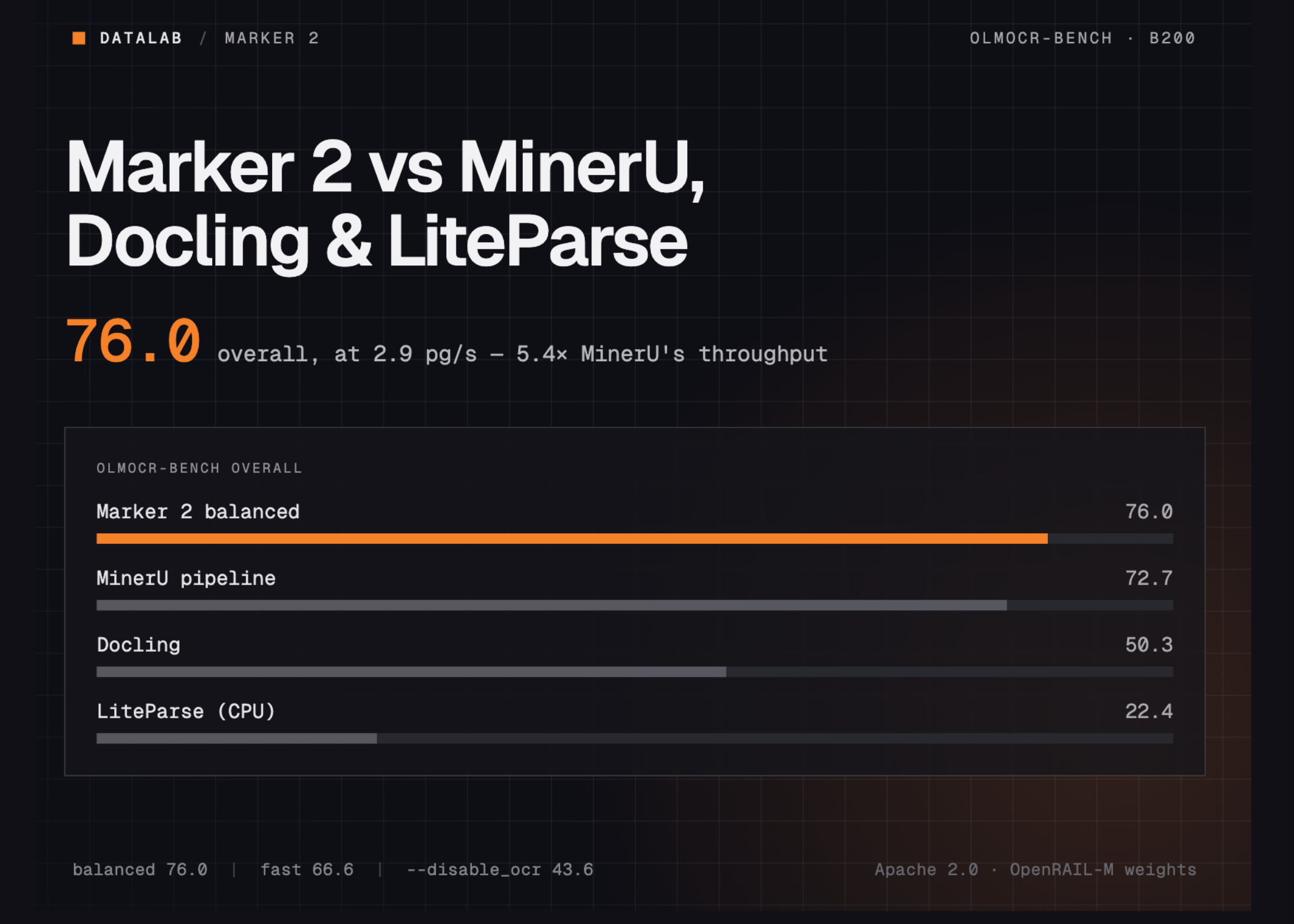
Datalab Marker version 2 is a redesigned OCR pipeline with three separate operational modes. It improves both accuracy and processing speed compared to competitors MinerU, Docling, and LiteParse. On the olmOCR-bench test, Marker v2 scores 76.0 and can process 2.9 pages per second on a single B200 GPU. This throughput is more than five times faster than MinerU’s backend pipeline and outperforms Docling in both speed and accuracy.
Why it matters
Speed and accuracy in OCR pipelines directly impact document processing tasks across industries like finance, legal, and healthcare. Marker v2’s greater than 5× speed advantage over MinerU means operators can handle larger document volumes with fewer resources, lowering costs or enabling more aggressive SLAs. Its improved accuracy over Docling reduces the need for manual review, decreasing error rates and boosting automation reliability. That combination places Marker v2 ahead for applications demanding fast, scalable, and precise document understanding.
Who it is for
Marker v2 fits organizations prioritizing end-to-end document extraction where throughput and high accuracy are critical. Companies dealing with high volumes of scanned documents or complex layouts will benefit from its multi-mode pipeline. Builders wanting to integrate a performant OCR backend without sacrificing precision will find Marker v2 a strong candidate versus MinerU or Docling. LiteParse users focused on speed might find Marker’s balance more useful, depending on their task complexity.
The catch
While Marker v2 demonstrates clear gains in benchmarks and speed on specific hardware, real-world results depend heavily on actual document types and integration effort. High throughput needs a capable GPU like the B200, so smaller setups may not see the same advantage. As always, switching OCR engines requires validation on target data to avoid surprises in accuracy or workflow disruption.
What to watch next
Look for expanded benchmarks showing Marker v2’s performance across diverse document types and hardware configurations. Further comparisons on operational costs and integration challenges with MinerU, Docling, and LiteParse will clarify real-world operator impact. Updates from Datalab on pipeline customization or new modes could deepen Marker’s appeal. Observing how this affects customer preference in enterprise OCR solutions will give insight into shifting choices driven by speed and accuracy improvements.
AI Quick Briefs Editorial Desk