Context Window Management for Long-Running Agents: Strategies and Tradeoffs
What changed
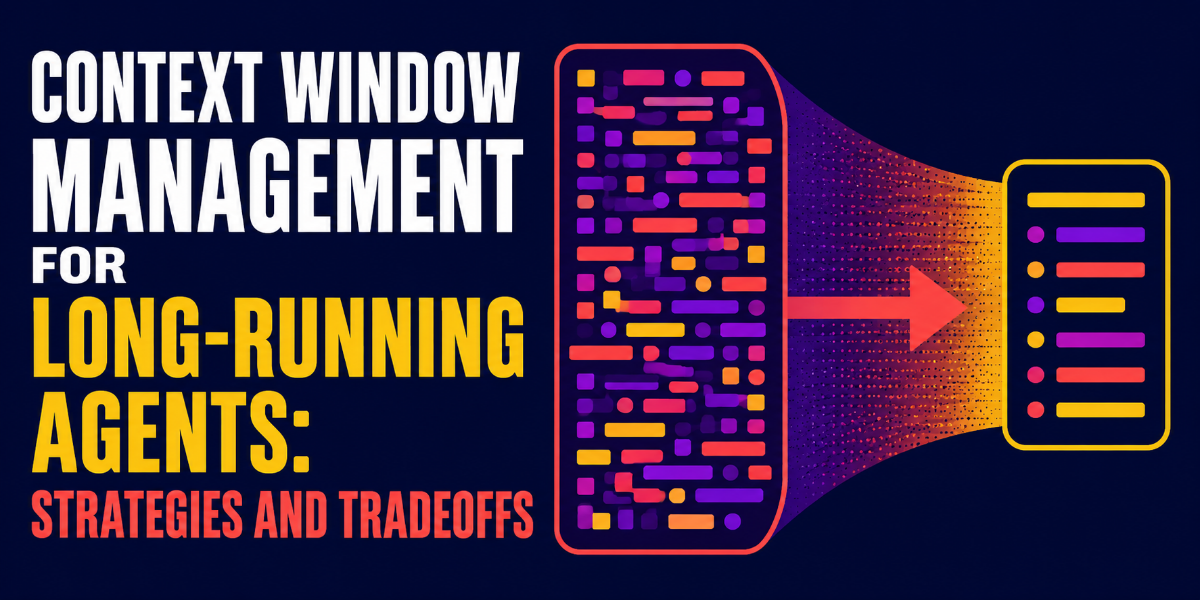
Long-running AI agents face a tough challenge: how to manage context windows when conversations or tasks stretch beyond typical token limits. Five practical strategies now offer distinct ways to keep AI agents on track without losing essential context or overwhelming compute resources. These range from simple pruning of past interactions to sophisticated ways of summarizing or retrieving relevant history on demand.
Why builders should care
The quality and reliability of AI agents depend heavily on context management. If context windows are too small, agents forget critical details and degrade in usefulness over time. If they attempt to keep everything, performance slows and costs spike. Builders need clear tradeoffs between memory usage, latency, and accuracy to choose correct strategies for their applications. How these strategies balance history retention against resource constraints can define user experience and operational cost structures.
The practical takeaway
First, simple truncation of past exchanges is cheap but quickly loses important context, hurting agent performance. Next, using sliding windows with overlap preserves recent context better but still drops older threads. Summarization compacts information but risks omitting subtleties. Selective memory retrieval prioritizes relevant history based on semantic similarity, offering a balanced approach but requiring retriever infrastructure. Finally, hierarchical or layered memory architectures combine these strategies, trading complexity for improved long-term coherence. Understanding these tradeoffs arms builders to optimize around latency, memory cost, and task complexity without trial-and-error guesswork.
What to watch next
Watch for advances in retrieval-augmented generation and dynamic context management tooling that integrate multiple strategies seamlessly. Emerging SDKs or agent frameworks that provide built-in context window management will accelerate adoption and reduce engineering overhead. Also, expect experimentation with hybrid models that dynamically adjust context strategies based on task demands or user behavior. How major LLM providers support long-term context in their APIs will reshape which approaches become standard.
AI Quick Briefs Editorial Desk


