Constraining Output Space for SLM Narrow Automation Optimization
What changed
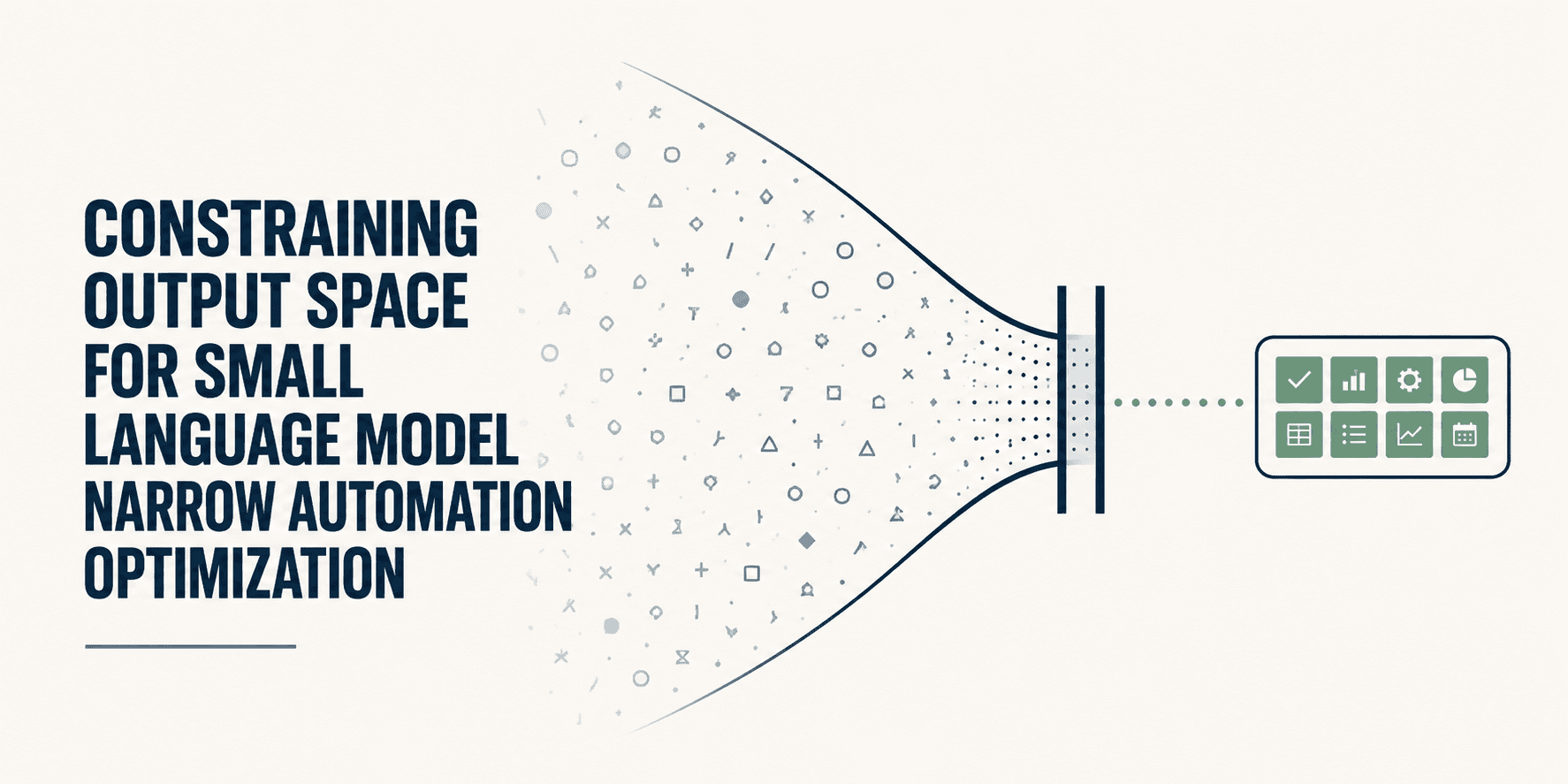
Small language models (SLMs) are gaining traction for narrow automation tasks, but their outputs can be unpredictable and hard to parse reliably. A practical way to improve performance is shifting focus from parsing generated text to constraining the model’s output space directly. Instead of letting the model produce free-form responses that then require complex parsing and error handling, output constraints limit the range of allowed answers upfront. This reduces ambiguity and streamlines downstream automation.
Why builders should care
Constraining output space lowers the technical debt and complexity involved in automating SLMs for specific tasks. Parsing generated text introduces latency, errors, and brittle workflows as models may produce unexpected or malformed outputs. Operators and developers wrestling with narrow automation using small models will find that enforcing tight output limits improves reliability and predictability. This approach also enables more efficient error detection and recovery since outputs can be validated against a known set of possibilities.
The practical takeaway
For founders and operators building automated workflows around small language models, investing upfront in output constraints can cut integration headaches. This may mean designing prompts that restrict format or content, using token-level filters, or applying classification models that reject off-limits outputs. The payoff is cleaner pipelines, easier maintenance, and more consistent results even with smaller, less resource-intensive models. Narrow use cases that demand precision, such as form filling or command execution, benefit most from this strategy.
What to watch next
The first part of this series sets the stage for exploring additional optimization techniques for narrow automation with SLMs. Builders should watch for follow-up discussions on balancing constraints with flexibility and integrating output control with model fine-tuning or prompting strategies. The evolution of tools and frameworks to enforce output space restrictions will also be crucial. Startups and operators focused on practical SLM deployments will want to track advances that simplify robust automation without resorting to large models or complex parsing layers.
AI Quick Briefs Editorial Desk