Clustering Unstructured Text with LLM Embeddings and HDBSCAN
What changed
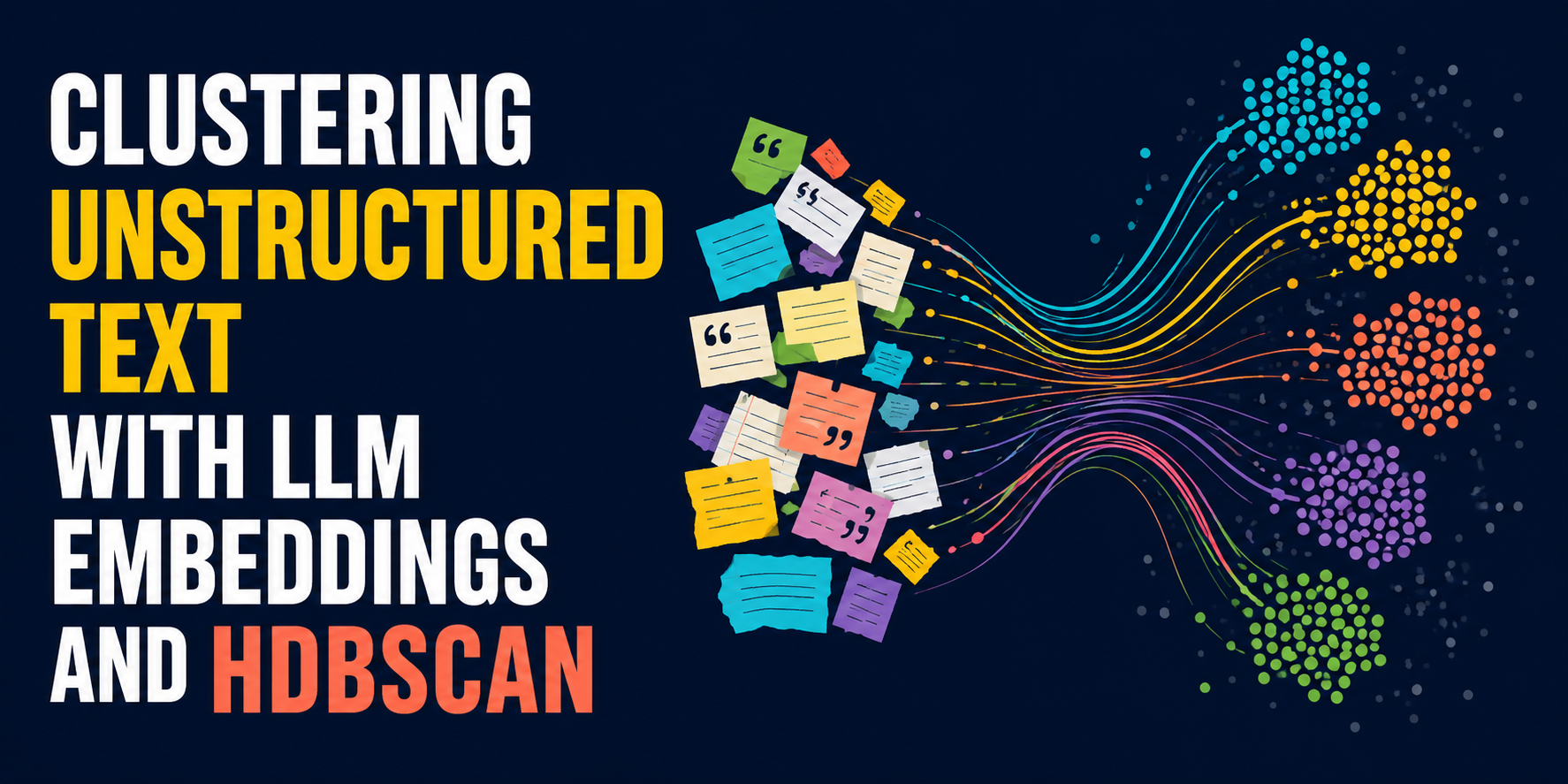
Unstructured text, a huge part of business data, is hard to organize at scale. The latest approach combines large language model (LLM) embeddings with HDBSCAN, a clustering algorithm, to group text data without manual labels. LLMs convert raw text into numerical vectors that capture semantic meaning. Then HDBSCAN detects natural clusters based on density, identifying related content and ignoring noise. This method moves beyond simple keyword matching or shallow topic models.
Why builders should care
This technique unlocks smarter ways to organize mountains of documents, transcripts, customer feedback, or any text-heavy assets. Since it does not need labeled data, teams can deploy it on new or evolving datasets quickly. The embedding step leverages pre-trained LLMs, so no massive in-house training is needed. HDBSCAN’s density-based approach handles clusters of different sizes and shapes better than traditional methods, improving accuracy. This increases automation potential for search, recommendation, and content curation workflows with less manual tagging.
The practical takeaway
Anyone working with large volumes of unstructured text can implement this pipeline to reveal hidden themes or communities in data that were previously buried. It reduces reliance on fragile keyword heuristics or expensive annotation. The process fits well with existing AI tools since popular LLMs offer APIs to generate embeddings, and HDBSCAN is open-source and efficient. It accelerates building knowledge graphs, customer insights, or automated monitoring systems where organizing raw text fast and flexibly has been a bottleneck.
What to watch next
Watch for broader adoption of LLM embedding plus density clustering beyond academic demos into real operational workflows. Vendors packaging these techniques will start to appear in platforms focused on text intelligence and analytics. Improvements in embedding generation and clustering algorithms will continue to sharpen the precision of unsupervised text grouping. Operators should also track how well this method scales on very large or streaming datasets, as that determines feasibility for enterprise use cases.
AI Quick Briefs Editorial Desk