Building Supervised Fine-Tuning Data from NVIDIA Open-SWE-Traces: Trajectory Parsing, Patch Analysis, Token…
What changed
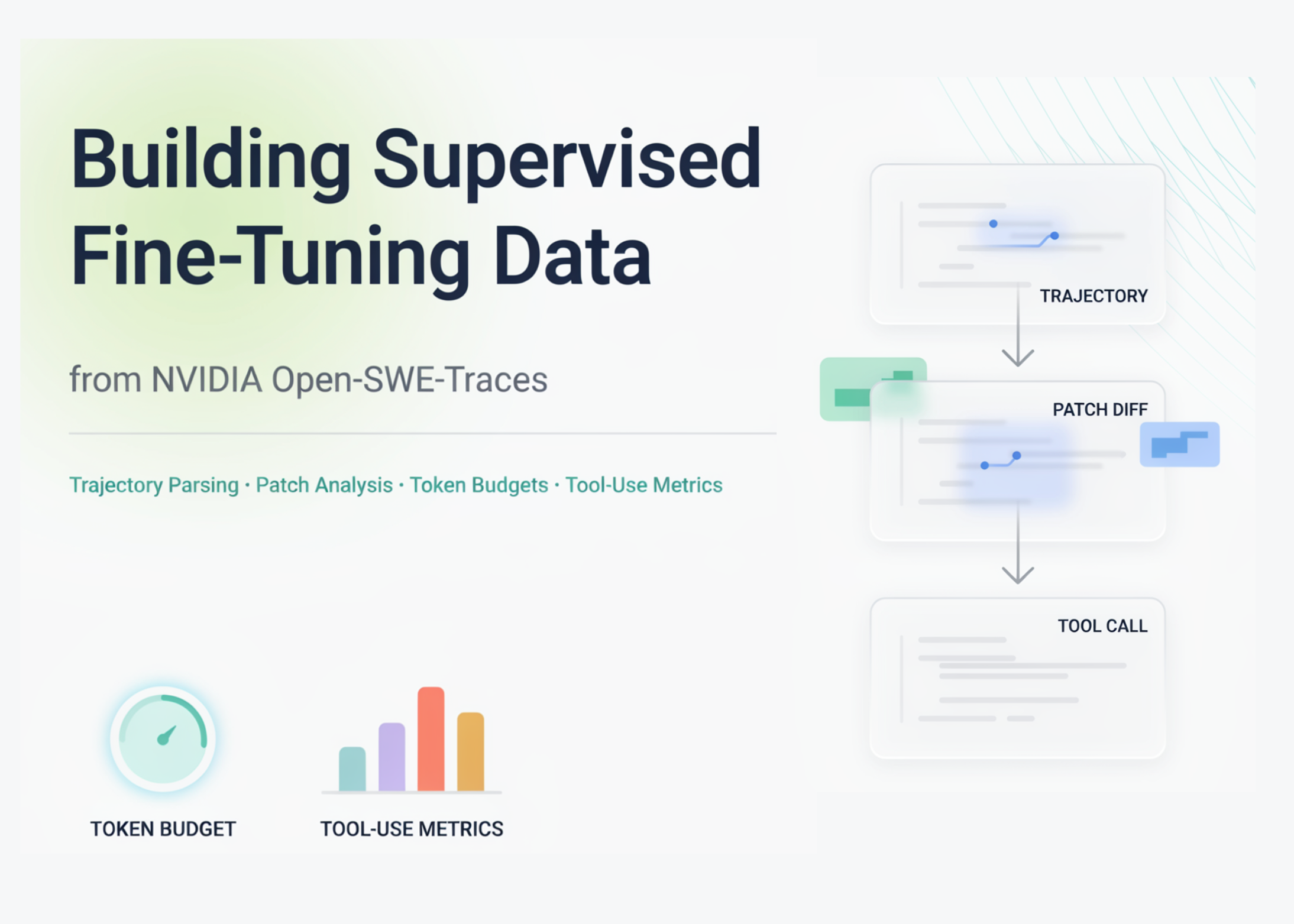
NVIDIA’s Open-SWE-Traces dataset now comes with a practical walkthrough for parsing and preparing supervised fine-tuning data. The process streams software-engineering trajectories directly from Hugging Face, bypassing heavy local downloads. It tackles the complexity of multi-turn conversations between agents, extracting normalized dialogue and isolating final code patches. Importantly, the workflow builds a detailed analysis DataFrame capturing metrics like trajectory length, patch sizes, token budgets, tool usage, programming language distribution, and resolution outcomes.
Why builders should care
Fine-tuning AI agents on realistic development scenarios requires high-quality, structured data that mirrors actual engineering workflows. This tutorial reveals how to harness NVIDIA’s dataset efficiently in cloud environments like Google Colab, making agent training more accessible and scalable without expensive infrastructure. It also exposes the practical limits of patch sizes and token budgets while quantifying the role of tool use within coding conversations. These insights allow developers to fine-tune models on data that reflects real-world coding complexity and collaboration patterns, boosting their agent’s relevance and performance.
The practical takeaway
Operators working on software-engineering AI agents gain a concrete blueprint for turning raw trajectory logs into supervised training sets. Streaming data cuts down storage overhead and accelerates iteration time. Careful normalization and patch parsing ensure the training input precisely reflects final code intent — avoiding noisy drafts or incomplete edits that would weaken model quality. Analyzing token and tool metrics highlights how much context and external utilities agents need, shaping fine-tuning strategies around realistic token limits and tool integrations. Overall, this methodology drives more efficient, data-driven fine-tuning that better prepares models for coding assistance tasks.
What to watch next
Look for further extensions of this approach to other coding datasets or multi-agent scenarios that involve richer tool ecosystems. Also monitor improvements in streaming and normalization workflows that reduce preprocessing friction. How well this fine-tuning data translates to downstream task gains will be crucial to track, as AI-assisted coding tools jockey for reliability and productivity edges. Finally, the dataset’s language and tool usage statistics may influence how multi-language or polyglot developer agents evolve, pressing builders to optimize token budgets accordingly.
AI Quick Briefs Editorial Desk