Building a Multimodal RAG Pipeline with NVIDIA NeMo Retriever, Hosted NIMs, LanceDB, Reranking, and Grounde…
What changed
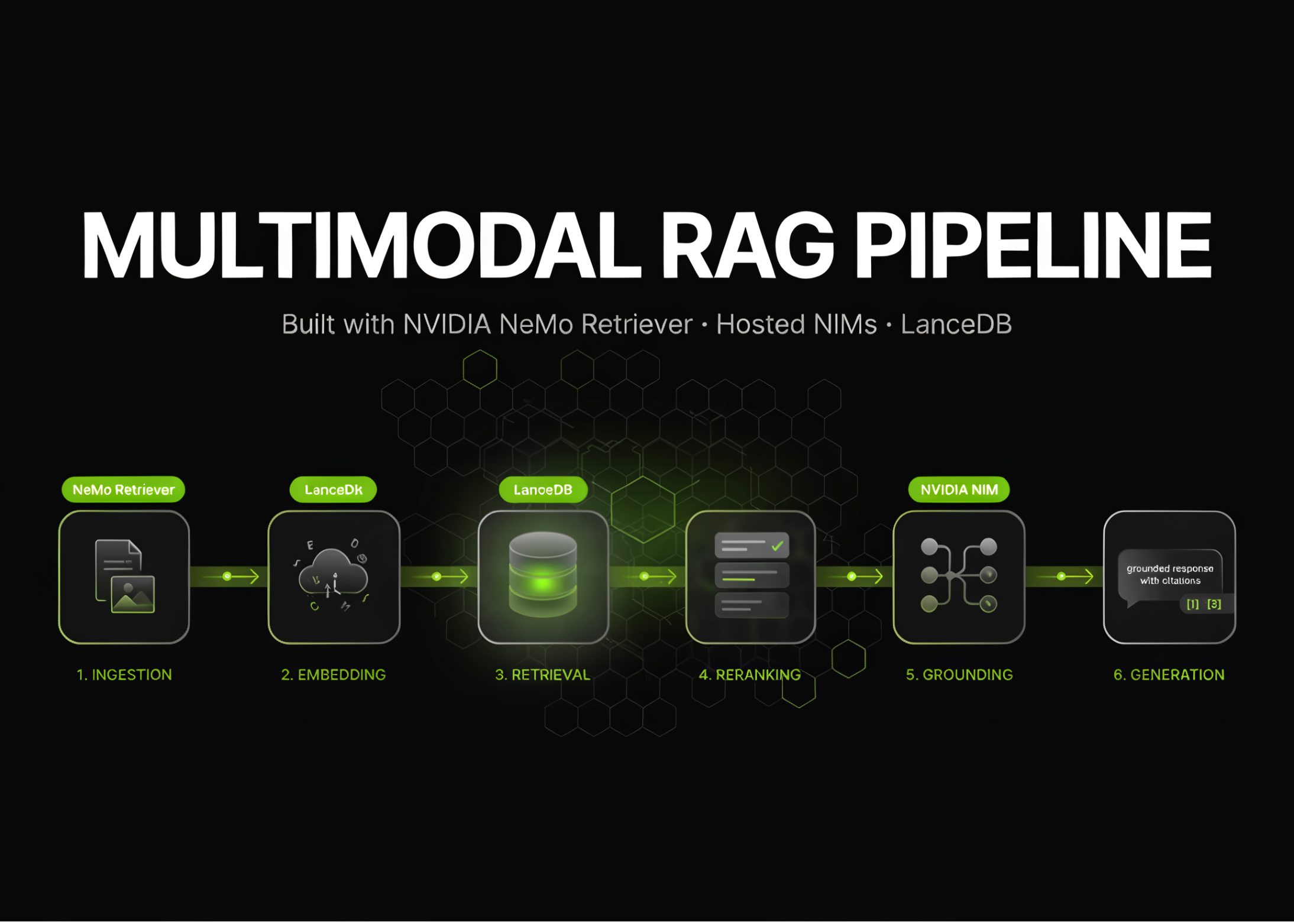
NVIDIA’s NeMo Retriever now supports building a multimodal retrieval-augmented generation pipeline that handles not just text but also visual and structured data. The process starts by setting up Python 3.12, installing required packages, and extracting text from PDFs offline without needing GPUs or cloud API keys. It then evolves by incorporating hosted NVIDIA NIM endpoints for tasks such as page detection, combined with LanceDB for efficient data storage and retrieval, plus techniques like reranking and grounded generation to improve relevance and response quality.
Why builders should care
This pipeline pushes retrieval-augmented generation beyond pure text to include multimodal inputs, which widens practical use cases in AI documentation, knowledge management, and customer support. Performing offline PDF extraction without expensive GPUs or external APIs lowers operational costs and privacy risks, making it more accessible to smaller teams. The integration of hosted NIMs and LanceDB means operators can rely on scalable, managed components while maintaining high precision via reranking. This setup challenges builders to rethink how they extract, index, and serve complex data types in AI workflows.
The practical takeaway
Operators can now deploy a robust multi-input RAG pipeline that balances cost, scalability, and quality. The offline extraction reduces dependency on cloud services, cutting latency and costs for document-heavy environments. Using hosted NIM endpoints offloads heavy model workloads, simplifying pipeline maintenance. LanceDB’s vector index supports fast, large-scale retrieval, and reranking tightens query relevance, enhancing user experience. This approach prepares builders to handle more diverse data formats under tighter resource constraints without sacrificing output quality.
What to watch next
See how real-world applications adopt multimodal NeMo Retriever pipelines in operational settings where document and image processing converge. Monitor advancements in hosted NIMs that could expand capability and reduce integration friction. Watch for community and vendor contributions improving offline extraction modules and expanding LanceDB integrations. Pay attention to what happens with reranking strategies as competition in RAG-driven interfaces heats up and generating grounded, reliable answers becomes a commercial differentiator.
AI Quick Briefs Editorial Desk