Build a Nanobot-Style AI Agent in Google Colab with Tool Calling, Session Memory, Skills, and MCP Servers
What changed
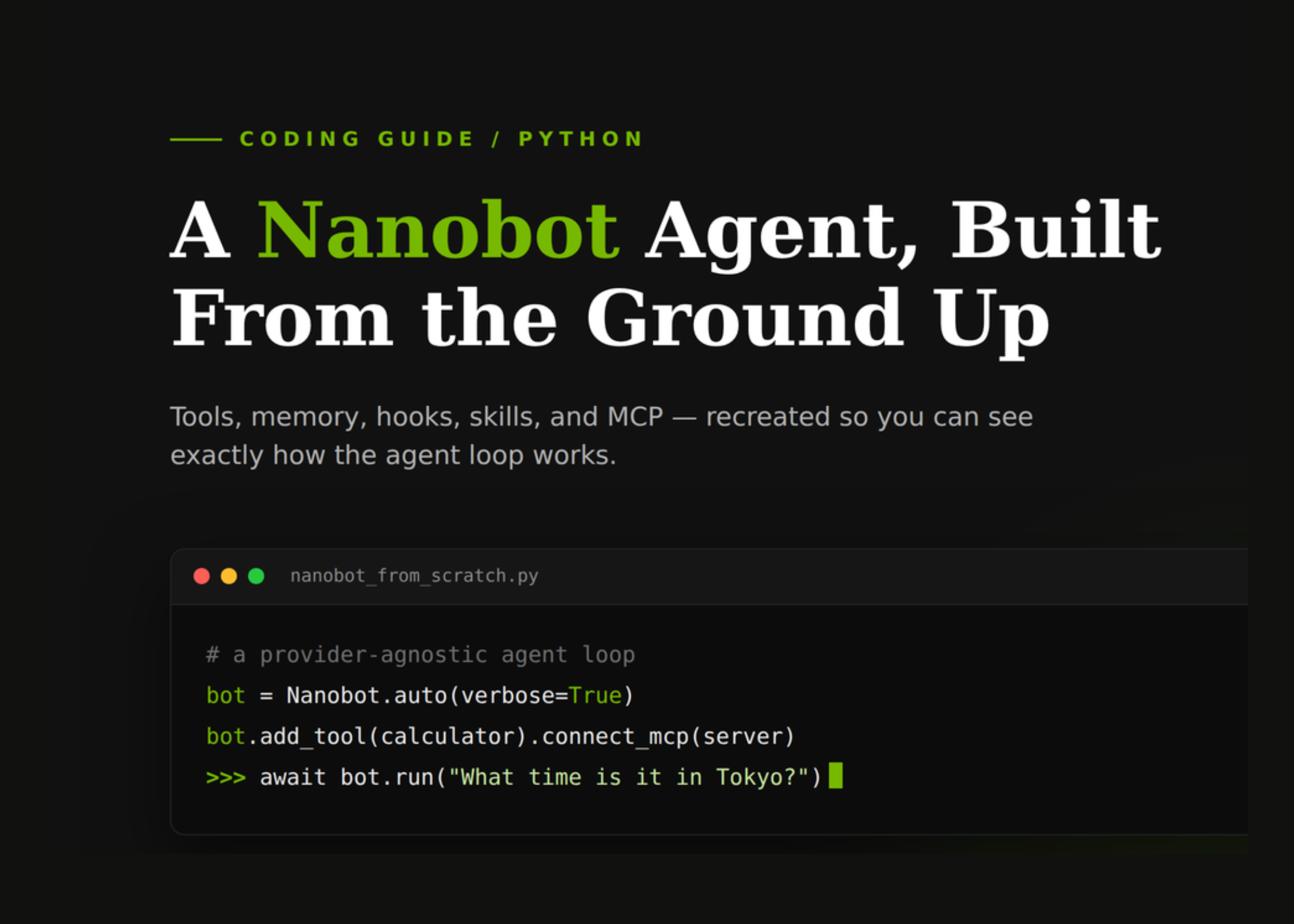
A new tutorial details how to build a lightweight personal AI agent inspired by the nanobot architecture, fully runnable in Google Colab. The approach strips back reliance on external frameworks by reconstructing core building blocks from scratch. It starts with provider abstraction and layers on tool registration, session memory, lifecycle hooks, skills, and an MCP-style tool server. This method creates a flexible, provider-agnostic agent loop that highlights how messages, tools, memory, and model responses connect.
Why builders should care
This hands-on approach exposes the plumbing behind agent frameworks, giving builders control over each component rather than outsourcing to black-box solutions. It clarifies the relationship between tools and AI model calls and shows how session memory can persist state across interactions. Running the whole stack in Google Colab lowers barriers to experimentation by providing a free, accessible environment. For developers eyeing customized AI agents without vendor lock-in, this is a rare, practical blueprint that balances simplicity with extensibility.
The practical takeaway
Building your own agent foundation reveals the trade-offs in handling tool calling, memory persistence, and multitool orchestration. It pressures off-the-shelf frameworks to be more transparent about their internals while enabling builders to tailor agents tightly to their use cases without surplus bloat. The MCP-style server demonstrates a way to centralize tool management, which can improve scalability. Ultimately, it pushes the idea that meaningful AI agents can be lightweight, provider-agnostic loops rather than massive, opaque stacks.
What to watch next
Keep an eye on further open-source projects that rebuild AI agent components from the ground up to gain insight and tight control. Watch for how this approach evolves toward integrating real large language models in production environments. The interplay between session memory design and tool invocation will likely become a critical differentiator in personal AI agents. Also, check for how providers might respond to increased builder demands for composability and transparency.
AI Quick Briefs Editorial Desk