Best AI Agents for Software Development Ranked: A Benchmark-Driven Look at the Current Field
What changed
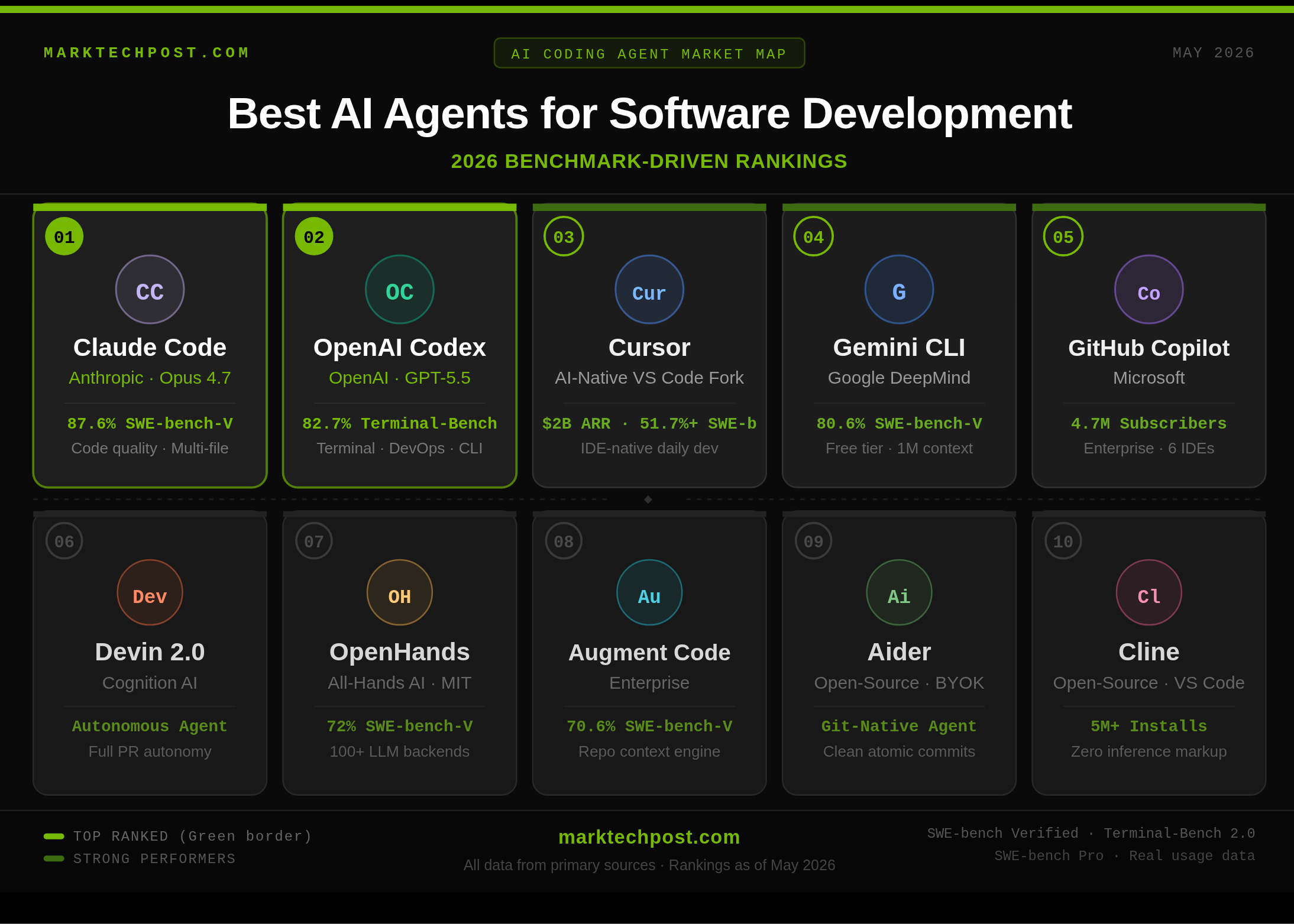
The 2026 AI coding agent market is more capable and fragmented than ever. Claude Code leads with an 87.6% score on the SWE-bench Verified code quality test, making it the top performer on developer-centered quality metrics. Meanwhile, GPT-5.5 dominates the Terminal-Bench test, scoring 82.7% on terminal interaction and command execution. Despite these advancements, many rankings still rely on a benchmark flagged as contaminated early this year by OpenAI itself, reducing the reliability of published scores across the board. Labs continue to use this benchmark even when promoting their own tools.
Why builders should care
Builders, developers, and teams evaluating AI coding agents face real challenges assessing which tools actually improve software development outcomes. Code quality metrics like Claude Code’s SWE-bench Verified score show the potential for higher-quality output, but fragmented benchmarks mean it is harder to compare tools fairly. Terminal-based testing is critical for automation-driven workflows, so GPT-5.5’s lead there signals strength in command execution and scripting assistance. However, reliance on a tainted benchmark threatens to hide true differences between agents and pressures users to look deeper beyond headline scores.
The practical takeaway
When picking an AI assistant for coding, do not trust rankings blindly, especially those that still cite the contaminated benchmark. Look for verified code quality results like those from SWE-bench and test terminal command handling independently if your workflow depends on it. Expect that no single agent dominates every aspect—Claude Code is strong in pure software engineering tasks, GPT-5.5 excels with terminal commands, and other tools may offer niche advantages. The market’s fragmentation means operators must pilot multiple agents where possible and track actual impact on development efficiency and bug reduction.
What to watch next
Watch for new, uncontaminated benchmarks to emerge or existing ones to be cleaned up. Labs that develop AI coding agents face pressure to deliver transparent, robust, and unbiased performance metrics. Additional capabilities around debugging, test generation, and CI/CD integration could reshape rankings beyond static code quality or terminal test scores. Buyers should expect increased differentiation based on vertical focus or tooling ecosystems rather than raw benchmark comparisons alone. The best agents in 2026 will be those that reduce friction in end-to-end development pipelines, not just code generation quality.
AI Quick Briefs Editorial Desk