Anthropic Launches Claude Science Beta: A Multi-Agent AI Workbench for Reproducible Genomics, Proteomics, a…
What changed
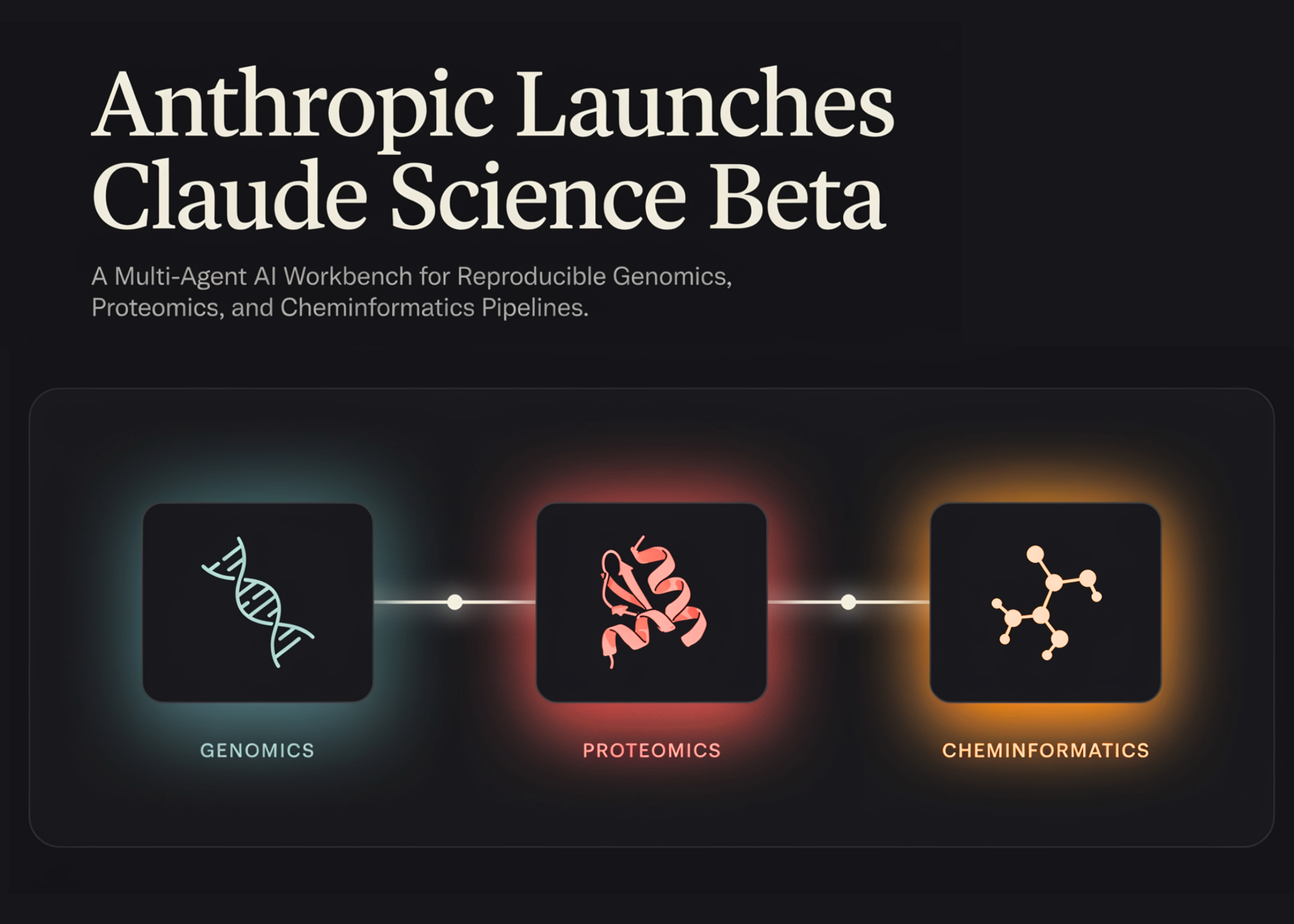
Anthropic launched the beta version of Claude Science, a new AI workbench designed for reproducible scientific workflows in genomics, proteomics, and cheminformatics. This platform uses existing Claude models but integrates multiple specialized AI agents. A coordinating agent distributes tasks to domain-specific agents, while a reviewer agent ensures accuracy by checking citations and numeric data. Every output includes the exact code, runtime environment, and full message history needed to reproduce the results. Claude Science also manages computational resources flexibly, spanning local machines, high-performance computing over SSH, and cloud instances on Modal. It has built-in access to over 60 scientific databases and leverages NVIDIA BioNeMo for enhanced biological data modeling.
Why builders should care
Reproducibility and traceability remain critical and costly pain points in computational biology and chemistry workflows. Claude Science’s multi-agent design targets these issues by combining specialist AI agents with a reviewer that mitigates common errors and misquotations, crucial for scientific rigor. Its cross-infrastructure compute management eases the logistical overhead of running demanding pipelines, potentially lowering the barrier for smaller teams or startups unable to maintain dedicated HPC setups. The embedded provenance tracking means anyone reviewing the work can verify and rerun exactly what produced each figure, which tightens trust and auditability in scientific AI outputs.
The practical takeaway
Claude Science offers a turnkey environment that automates coordination across multiple expert AI agents, handles complex compute logistics, and guarantees full reproducibility with code and environment capture. For operators managing research pipelines, this reduces errors, speeds iteration cycles, and improves transparency. Its integration with 60+ databases and NVIDIA BioNeMo extends its reach into real biological datasets and modeling tasks. Builders can focus more on scientific questions instead of infrastructure or manual cross-checking, cutting costs and risks around reproducibility failures.
What to watch next
The key indicators will be how widely Claude Science gains adoption among bioinformatics and chemistry research groups, especially those requiring strict reproducibility. Watch for integrations with other scientific AI tools and whether it expands beyond beta with support for additional compute platforms and domain extensions. Its impact on how scientific workflows are audited and validated could pressure competitors to follow suit with similar multi-agent, provenance-first platforms. Performance limits, ease of use, and real-world error rates as reported by users will determine if it truly lowers costs or adds complexity in practice.
AI Quick Briefs Editorial Desk


