Black Forest Labs Releases FLUX 3: A Multimodal Flow Model for Image, Video, Audio and Robot Action Prediction
What it does
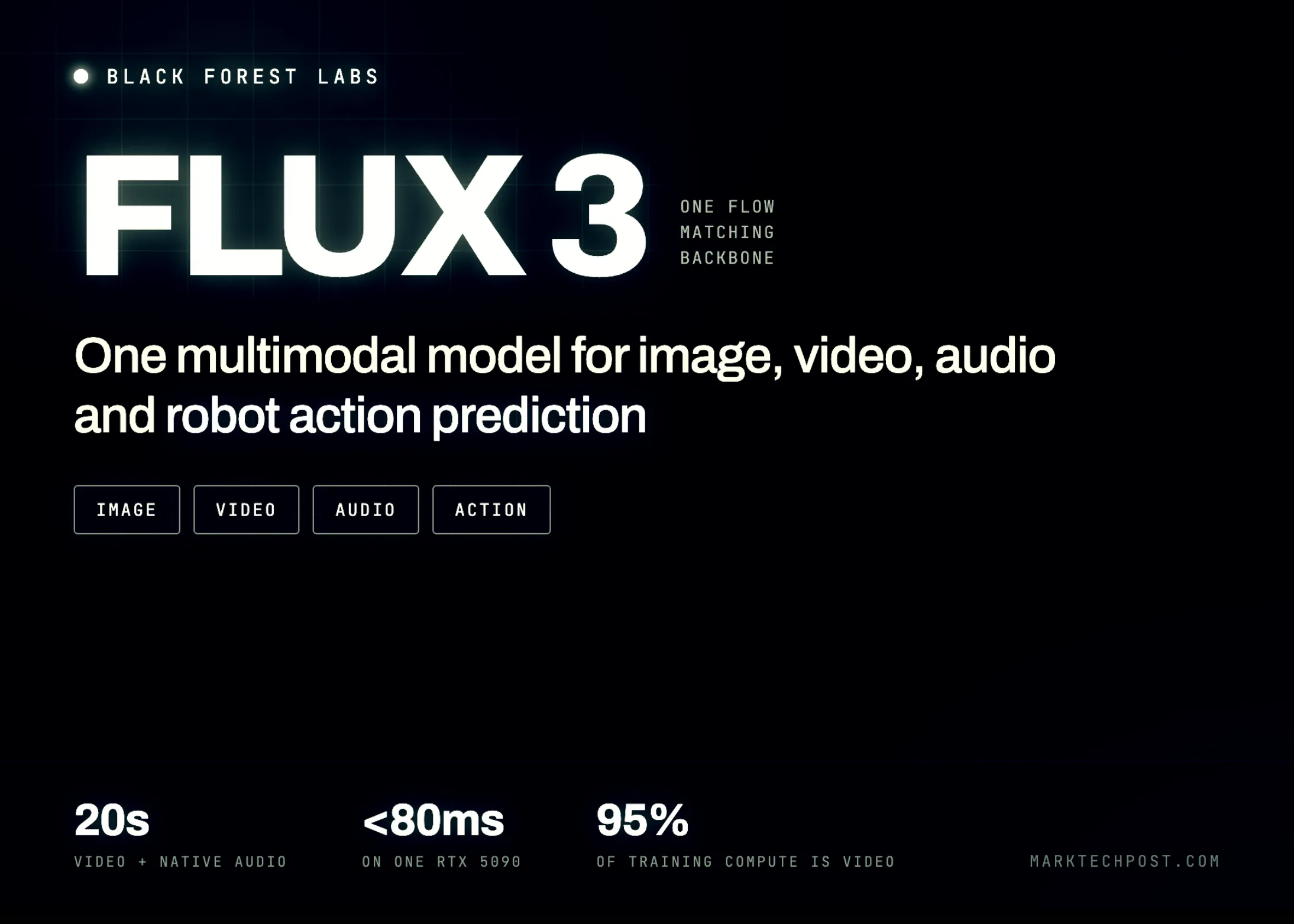
Black Forest Labs (BFL) has launched FLUX 3, a multimodal foundation model capable of processing images, video, and audio within a single architecture. Unlike previous versions, FLUX 3 integrates video, audio, and robot action prediction from one unified set of weights. This allows the model to analyze and generate across multiple data types while also predicting physical robot actions.
Why it matters
Running multiple modalities through a single architecture and weight set reduces the complexity and computational overhead of managing separate models for visual, auditory, and robotic inputs. For builders and researchers working on robotics, autonomous systems, or advanced multimedia AI, FLUX 3 streamlines workflows and can potentially improve prediction consistency by grounding different data types in a unified representation. This model pressures approaches that rely on siloed or modality-specific models and may speed multimodal system development.
Who it is for
FLUX 3 targets AI builders working with complex multimodal data sets, especially those developing robot control systems that must process visual and audio cues simultaneously. Companies building AI-powered robots, surveillance systems, or interactive media apps could integrate FLUX 3 to unify their perception and action prediction pipelines. Researchers interested in multimodal learning frameworks may also find it a valuable baseline or tool.
The catch
Multimodal foundational models like FLUX 3 require extensive, high-quality training data spanning multiple modalities, which can be resource-intensive. There is also the question of how well the integrated model handles real-world complexity and edge cases compared to specialized models. While the single-weight, single-architecture design simplifies deployment, it could limit flexibility when fine-tuning for modality-specific tasks or scaling system components independently.
What to watch next
Monitor how FLUX 3 performs on benchmark multimodal tasks, especially in real-world robot action prediction scenarios. Adoption by robotics and multimedia AI projects will reveal practical integration challenges and performance trade-offs. Advances or spin-offs from BFL that address multimodal training data efficiency or finer control of modality-specific behaviors within unified models will be key to watch.
AI Quick Briefs Editorial Desk


