Stateful vs. Stateless Agent Design: Tradeoffs for Scalable Agentic Systems
What changed
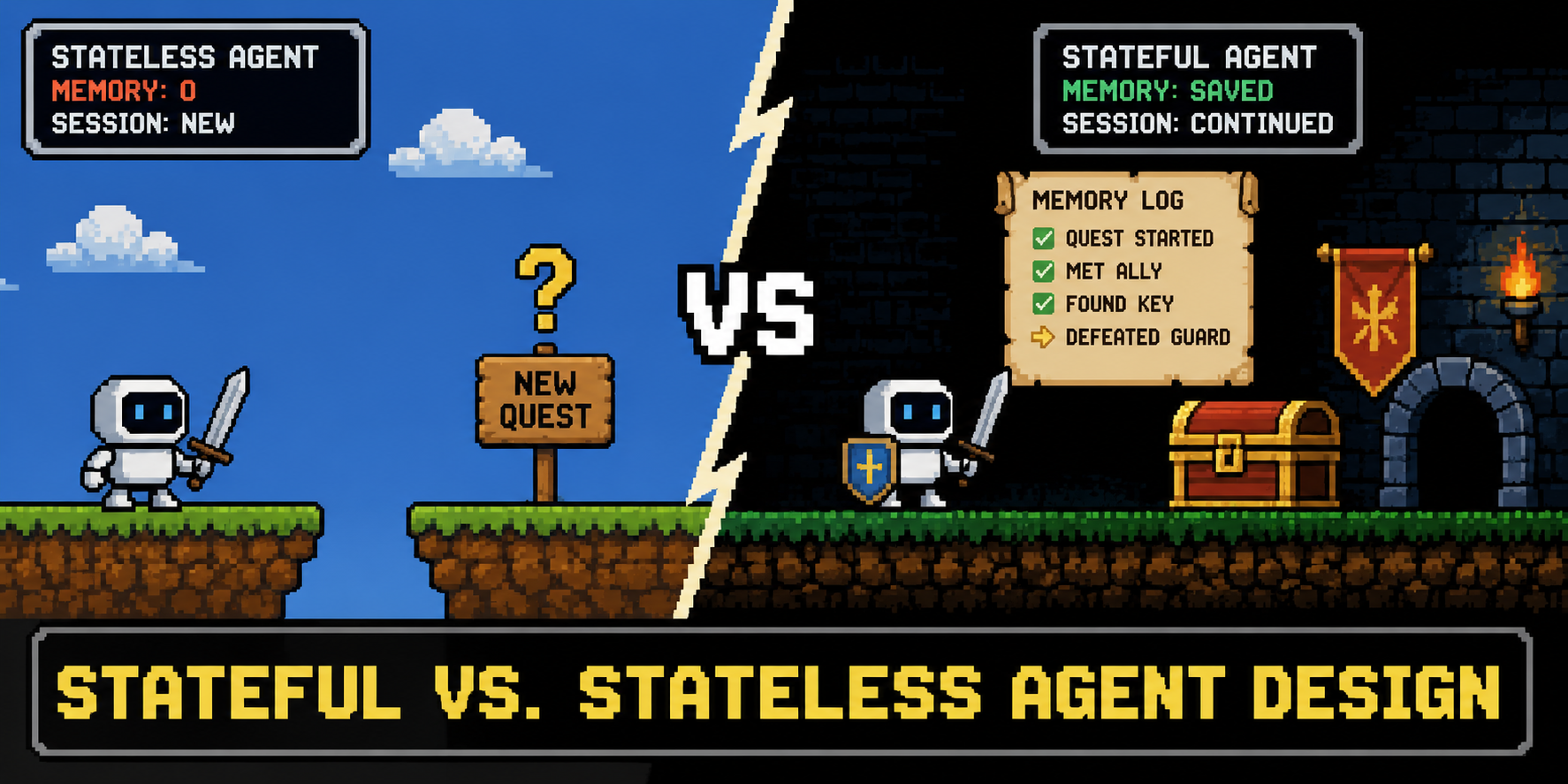
Agent design now forces an early choice: should agents keep track of state or treat each interaction as fresh? A stateful agent maintains context and information across steps, while a stateless agent acts only on current inputs, ignoring past data. This is not just an academic distinction. It shapes how agents perform, scale, and get deployed in real-world systems.
Why builders should care
Stateful designs let agents handle complex, multi-turn tasks by remembering decisions, previous inputs, or environment changes, which can improve performance and user experience. But that memory comes at a cost: more complex infrastructure, storage overhead, and synchronization challenges when scaling horizontally or deploying across multiple nodes. Stateful agents can bottle up operational risks like data consistency and increase latency.
Stateless agents are simpler and faster to scale because they don’t need to manage or store historical data. Their simplicity enables easier deployment in distributed environments and better fault tolerance since any instance can respond to any request independently. However, they often require external memory systems or simpler workflows, which can elongate development time or constrain functionality.
The practical takeaway
The choice between stateful and stateless affects the total cost of ownership and system reliability. Businesses building conversational AI, automated workflows, or decision-making bots need to weigh performance gains from statefulness against operational complexity and scaling headaches. Stateless agents fit when the priority is rapid, scalable deployment with fewer moving parts. Stateful agents make sense for workloads demanding context continuity and nuanced, multi-step reasoning despite higher operational effort.
What to watch next
Expect innovation in hybrid approaches combining stateless scalability with selective statefulness triggered by demand. Advances in distributed memory storage, consistency protocols, and cloud orchestration will influence how stateful agents scale. Builders should also watch emerging frameworks and orchestration tools that reduce the friction around managing state without sacrificing scale or speed. The right balance will distinguish which AI agent architectures gain traction in demanding operational environments.
AI Quick Briefs Editorial Desk


